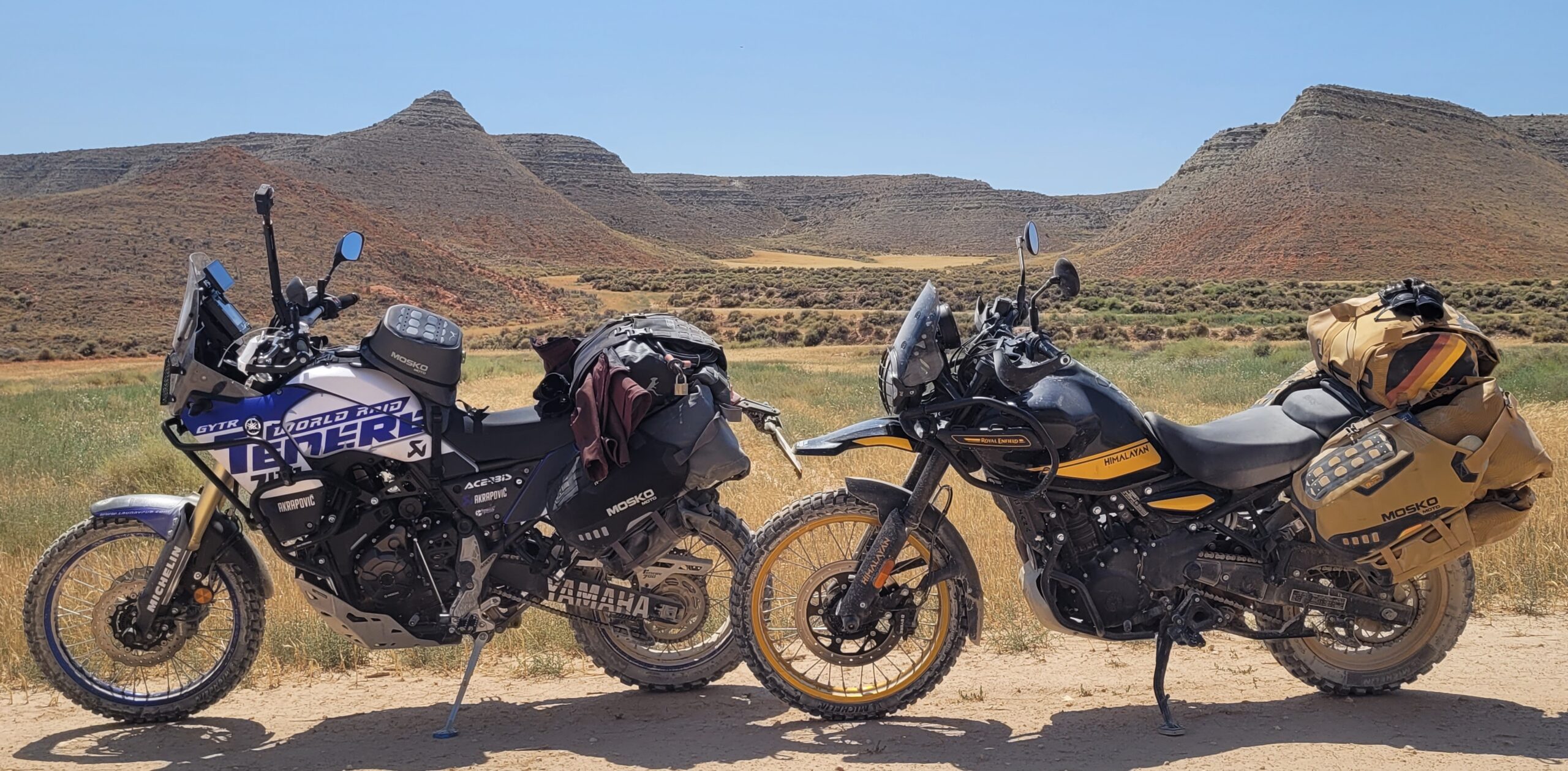
For several years, we had been thinking about dropping everything and setting off on a trip to the other side of the world with our motorcycles. But for a very long time, it remained just a project. Whenever I asked Thomas about the departure date, he would reply, “in five years.” After 2 or 3 years of hearing the same answer, I no longer really believed in it. But one day he came home from work and said to me, “Go, we’re leaving!” The date was set: we would leave in the autumn of 2025.
Once we had made the decision to leave, and it was no longer just a distant dream, we began announcing it to our families and friends. Many of them systematically asked us the same questions: “But what will you do when you get back?” and “What are you going to do with all your stuff?”
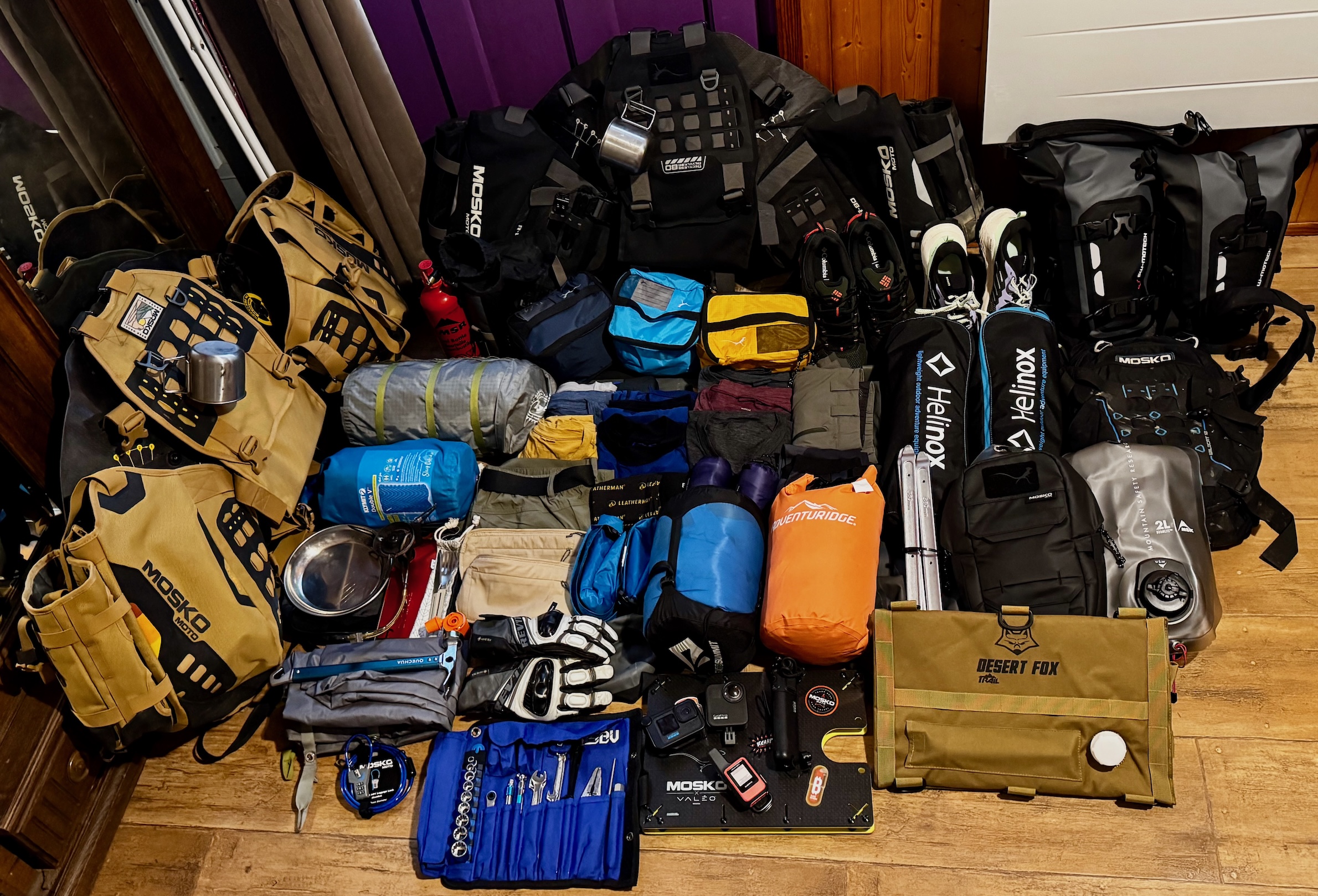
The answers to these two questions are intrinsically linked: we don’t know what we’ll do when we return, and therefore we need nothing—except the bare minimum to be self-sufficient on our motorcycles.
Beyond the two main threads we’ve planned for this road trip (see here), we want to travel according to the people we meet, to let ourselves be surprised, and to be able to seize the opportunities that arise. We’re going to discover new cultures, new landscapes, meet local people, and learn about their daily lives. It’s very likely that this experience will transform us, that our worldview will evolve, and so will our desires.
We want to set off with a light mind and the freedom to not return (or perhaps later than planned) if we fall in love with another country. In short, we want to make the most of every moment of the trip and not project ourselves onto the return.
To achieve this goal, we’ve decided to sort through our material possessions and keep only the bare minimum. Everything has to go: our clothes, the dishes, almost all our furniture, etc. We’ve only kept a few trinkets that we’ll be happy to find again upon our return (at least, we tried!). Obviously, the biggest part of this process was selling the apartment and ending up technically without a fixed home.
For some people, this phase of downsizing before the trip might be a source of stress: for us, the prospect of having fewer material possessions gives us the vision of greater freedom and a certain serenity.

When we started sorting through our belongings, we quickly got into the swing of it. We got rid of superfluous items—those we hadn’t used for several years and that were just lying around in cupboards or in the corner of a room. More visual space in the apartment, less clutter to tidy up: it gave us a significant feeling of satisfaction.
After the initial euphoria, we quickly encountered difficulties in continuing the sorting process. We were faced with moral and practical questions: Do we keep this object because it’s useful, or because it might be useful (one day, you never know…)? Do we feel guilty about giving away or selling this memento because it was a gift, or are we truly attached to it? Do we keep only the objects that are useful, or those to which we are emotionally attached? And where do we store things when we’ve gotten rid of all the storage containers?! Clearly, sorting and packing our belongings wasn’t always a smooth process.
After lengthy debates between us, but also with ourselves, we agreed not to keep anything that was gathering dust on the shelves or that wasn’t used on a daily basis.
Very often, picking up an object to decide its fate would bring back memories—some more or less distant, more or less intense and cherished. This is where the acceptance of letting go comes in. Freeing oneself from possessions also means accepting a certain release, sometimes turning the page on a lived experience in order to move forward. In the same way, parting with an object that was given to us by a loved one does not mean that we place less importance on that relationship. It’s accepting that the attachment to the relationship goes beyond the object itself. Of course, we made exceptions—it still remains important to preserve certain roots: photos, centuries-old family heirlooms, childhood memories…
After several months of sorting and organizing, we who thought we weren’t very materialistic… realized that we had significant room for improvement, and it took several rounds before we arrived at a satisfactory result.
Next came the time-consuming phase of selling items on well-known second-hand websites, making donations, and repeated trips to the recycling center. The sales provided a nice, non-negligible boost to our budget. As for the donations, we were happy knowing that those pieces of furniture and objects would get a second life and be useful to others.
In the end, we kept 3 pieces of furniture and a few boxes that are stored with our families. We’re quite happy with the work we’ve done. We managed to get rid of a large part of our belongings and keep only the essentials (according to our criteria), which amounts to about 30% of everything we owned. That said, it’s likely that when we return and open some of those boxes, we’ll wonder why we kept certain clothes or trinkets and go through another round of sorting.
Today, we’ve refocused on the essentials and are setting off with a light mind, ready to live our motorcycle adventure.