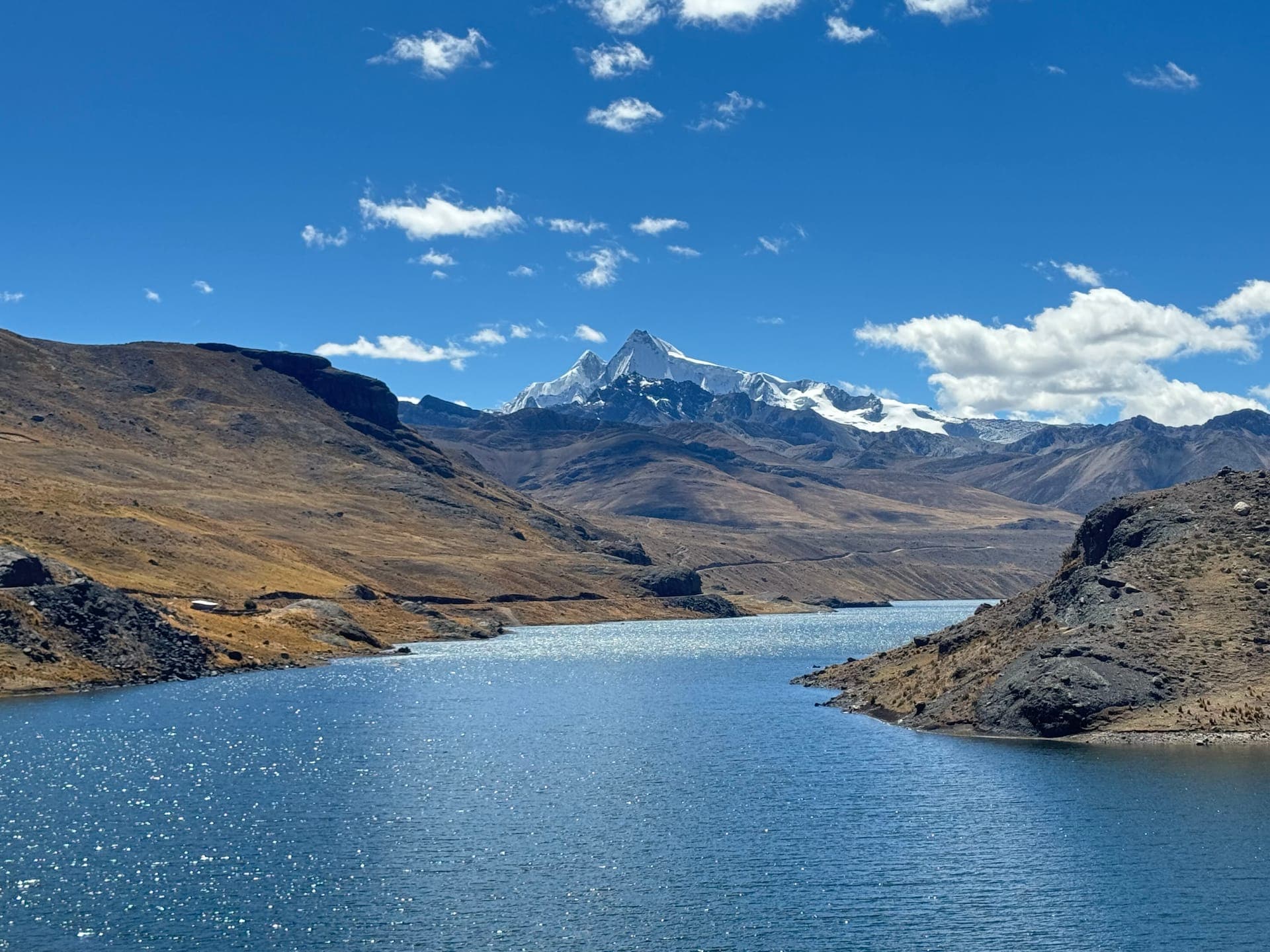
The Peru Great Divide by motorcycle: from the Andes to Ecuador
"God was heavy-handed and gave Peru a thousand beauties."
We leave Ica and the big cities to climb back into the sierra. Two weeks on the tracks of the Peru Great Divide, the PGD to its friends, between 3,000 and 5,000 m of altitude, all the way to the Ecuadorian border. The most beautiful landscapes of the trip, and some of our worst days.
From the Panamericana to the vicuña festival
Last errands in Ica before leaving: we need to find oil so Thomas can change his bike's oil. The Liqui Moly dealer has nothing, of course, and Thomas only wants one thing: to leave. Adeline insists on going to the street where all the motorcycle shops are, because if we can't find it here, it'll be worse elsewhere. Jackpot. At 1 p.m., we finally leave town with everything we need. Guillaume advised us to stop at a lagoon on the way, but given the time we don't really have time to stop, and we really want to make progress towards the mountains.
Today we ride a lot of Panamericana and straight lines. Luckily we climb back up at the end of the day and stop in Huaytará for the night. It's a small, unassuming village, but it feels good to find again those village centers that are the soul of Peru.
The next day, we have 70 km of road to reach the PGD. Around 12:30 we arrive in a small, remote village. We decide to stop for lunch because, in principle, the dirt track starts after this and we're not sure we'll find anything to eat. We ask some Peruvians if there's somewhere to eat and they take us to the back of a courtyard with big pots on the fire. We sit on the ground and they serve us potatoes, broad beans and meat a bit tough for our taste. When it's time to pay, they tell us it's free. We quickly learn they're actually cooking for the Chaccu, the traditional, ancestral festival where several communities gather to shear the vicuñas. The festival is happening right now a few kilometers away and they invite us to come. So there we are, following the food convoy, with a flag tied to Adeline's bike.
Once there, we're real celebrities. Everyone wants to talk to us, take pictures with us, and even feed us a second time. The children come first, then we meet the community leaders. We film a bit and explain it's for a little report, mostly for our families. Leaving isn't easy: they won't let us go without a plate or a beer. We repeat several times that we've eaten plenty and leave after an hour, with a bit of vicuña wool in our pockets.
We finally get onto the PGD and discover that the road is actually paved. It's hilly, wild and beautiful. Time flies and the dirt track resumes at the end of the day. We still have 60 km left compared to the original plan, but given the state of the track and the time, we won't make it. So we decide to stop at the next village. We find a hotel with secure parking: La Hacienda. The room is ultra comfortable, almost luxurious, for 70 soles a night. Adeline, who loves nice rooms, is delighted. We meet Thomas there, a cyclist crossing Peru to go to a wedding in Bolivia. We suggest sharing a pizza for dinner and spend a great evening together.
Acobambilla, then a 4,975 m pass
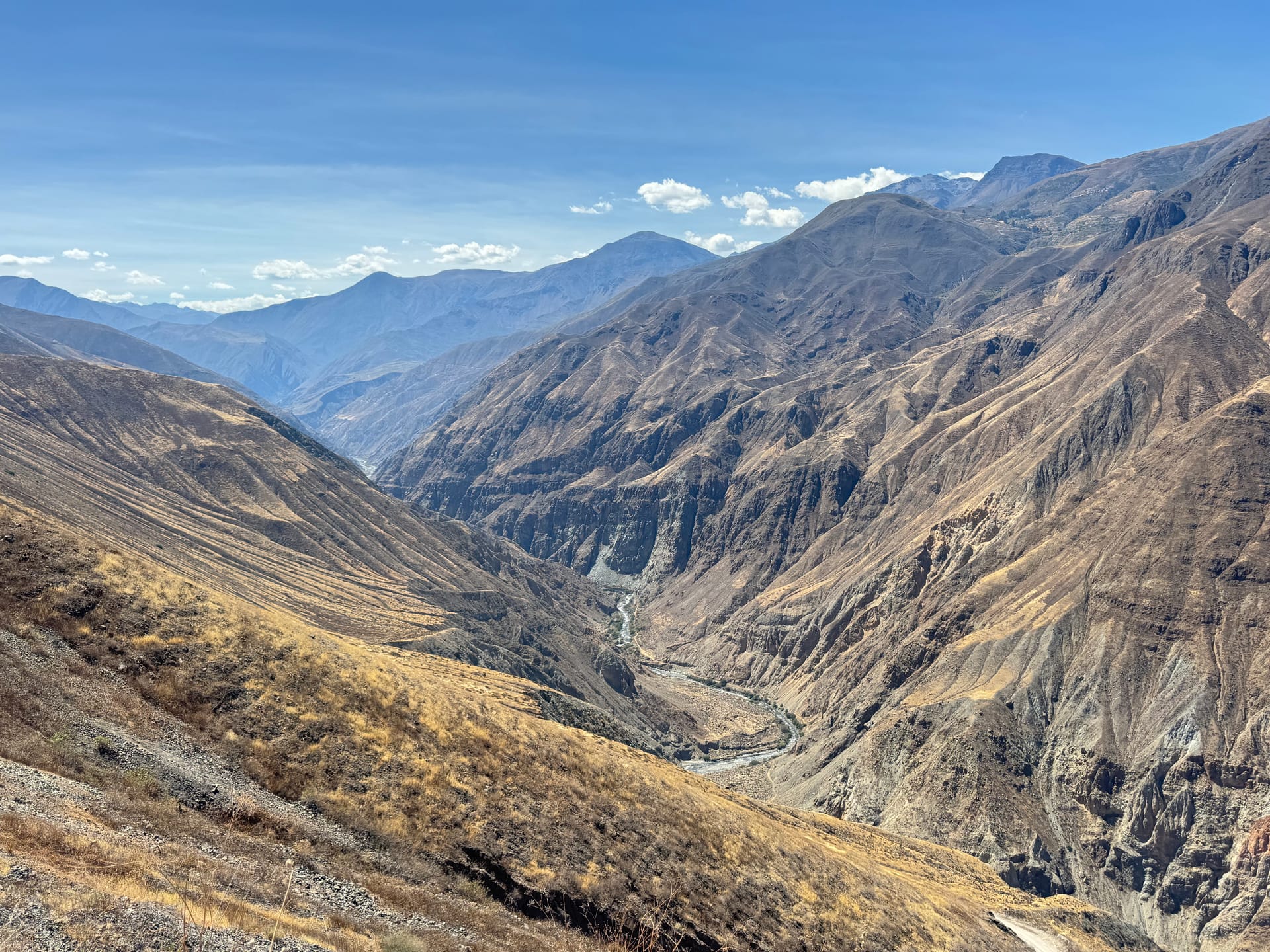
The next day, Thomas the cyclist leaves at 9 a.m. for 120 km by bike. Brave or crazy, we're not quite sure. We're slower. We go for the breakfast offered by the hotel, which actually consists of coffee with dry bread. So Adeline goes to buy a little extra while Thomas takes care of the bikes, and we hit the road around 10:30. On this morning's menu: asphalt to Huancavelica, where we stop for lunch, and good thing we do: in the afternoon, it's 70 km of dirt track in the middle of nowhere. Passes, endless hairpins, it never ends but it's very beautiful. We spare a thought for the cyclists who do this on leg power.
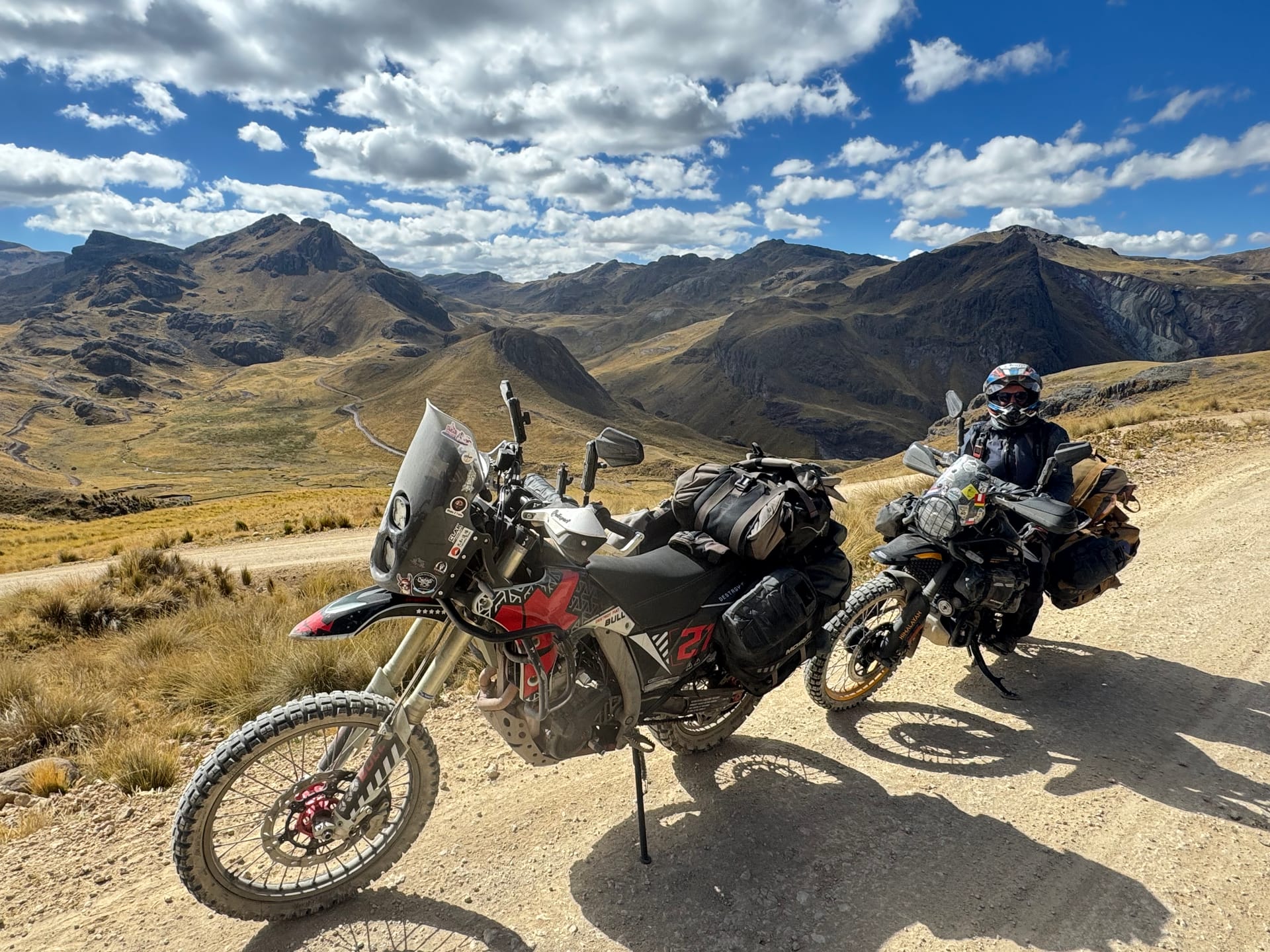
We reach Acobambilla fairly early, but the next place to stay is 116 km away, impossible before nightfall. So we decide to take a room. A change of atmosphere from last night. No hot shower, no heating, no wifi, but at 30 soles a night, we're not going to complain. A cyclist couple arrived just before us and has the second room. A little later and we'd have had to pitch the tent at 4,000 m of altitude. Rough. There's no restaurant in the village, but the owner offers to cook us dinner. Perfect! On the square, a sort of concert is being organized for the vicuña festival. Some locals want to teach us how to dance, we promise to come back after dinner, but the music fizzles out. So we snuggle up under the covers, lights out at 9 p.m.!
The advantage of going to bed early is that the next day we're on the road at 9:15. Our record. The track is easy and the landscapes incredible, as always since we arrived in Peru. Around 11, we leave the main track for a rough, rocky one. We haven't done real off-road in a while, but the reflexes come back. We cross a quarry at 4,300 m. On a climb, Adeline narrowly avoids disaster: it was the ravine or the fall. We pull the bike away from the edge, lift it back up, and off we go again. Big scare. We cross a summit at 4,975 m, just missing the 5,000 m, too bad. The descent is scary with the drop on the side. It's not really difficult, but there's sand in the hairpins, and Adeline hates hairpins and sand!
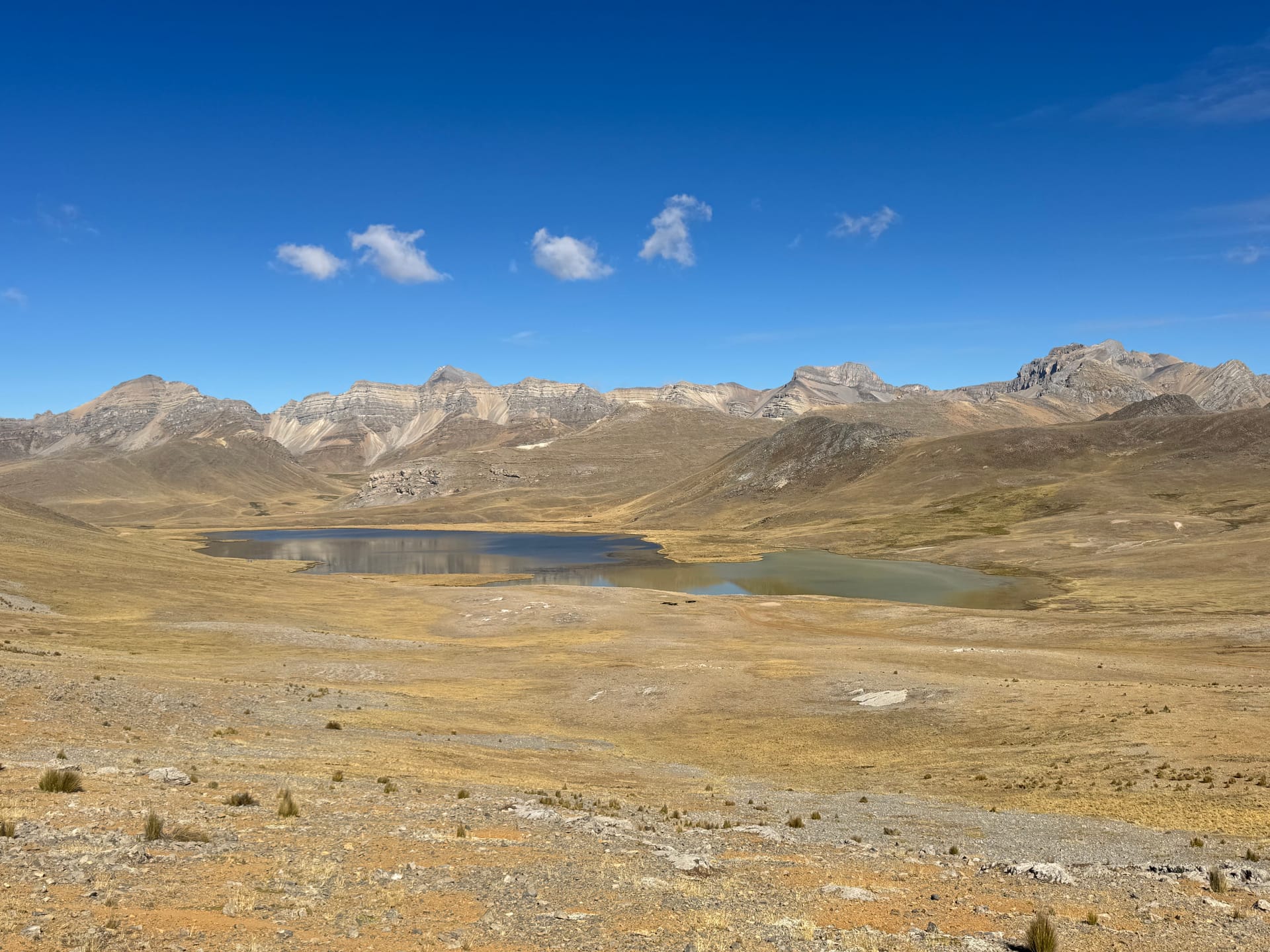
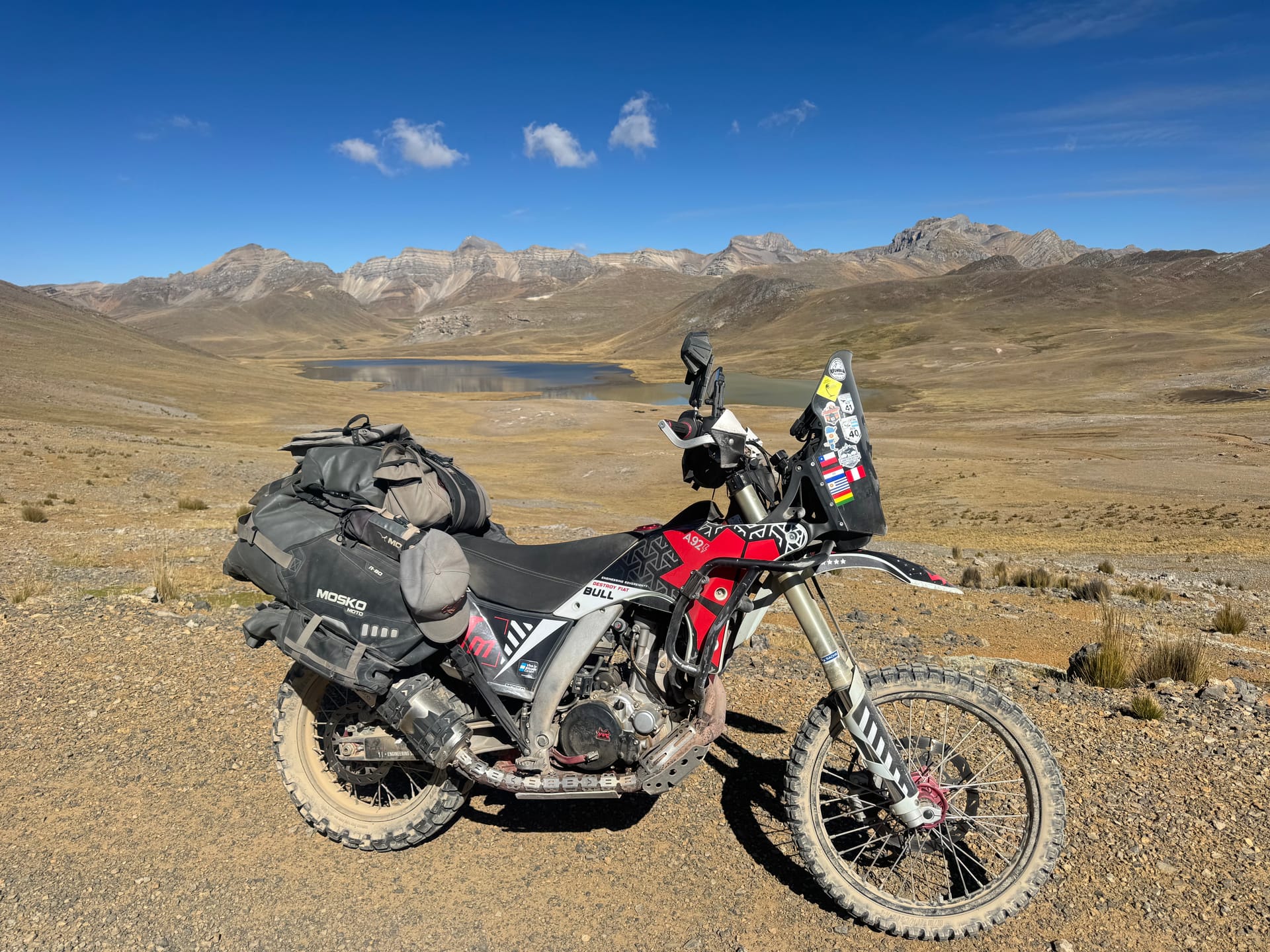
If we left early, it's also because we hoped to find somewhere to watch the French team's match at 2 p.m. We made good progress this morning and reach a restaurant right on time for the match. We ask the owners if they have the channel to show it, and they find a stream on YouTube. We quickly realize it's just live commentary with the same images on a loop... Too bad. Since we can't watch the match, we decide to carry on. If we reach Huancaya early enough, Thomas could do his oil change at the end of the day. That's without counting on the surprises of Peruvian roads. There are roadworks between Tinco and Huancaya and the road only reopens at 5 p.m. It's quite common in Peru: when there are roadworks, they sometimes close the road between 7 a.m. and 5 p.m. So there we are, waiting two hours in a café for the road to open. We put it in perspective: if we'd stopped earlier for the night, we'd have lost the whole next day. At 5:15 p.m., everyone charges off at once. First come, first served, no mercy. In a water crossing, Adeline struggles and gets overtaken from all sides. What an atmosphere. We eventually get through without a scratch and arrive before nightfall. The only cloud on the horizon: France lost.
Huancaya, the lagoons and a 30-hour birthday
In Huancaya, we go on a treasure hunt for the oil change: a container and a tarp, found just in time. So we decide to stay an extra night so Thomas can service his bike. Adeline helps a bit, then deals with emails, postcards and the logbook. In short, the paperwork that's hard to keep up with when you travel. At lunch we go to a restaurant and catch the Argentina-England semi-final. Given how Argentina play, we have to admit we're rather rooting for England and, surprisingly, we're not the only ones. We discover that Argentina doesn't always have a good reputation in Latin America when it comes to football, but the Argentinians wake up in the second half and win the match.
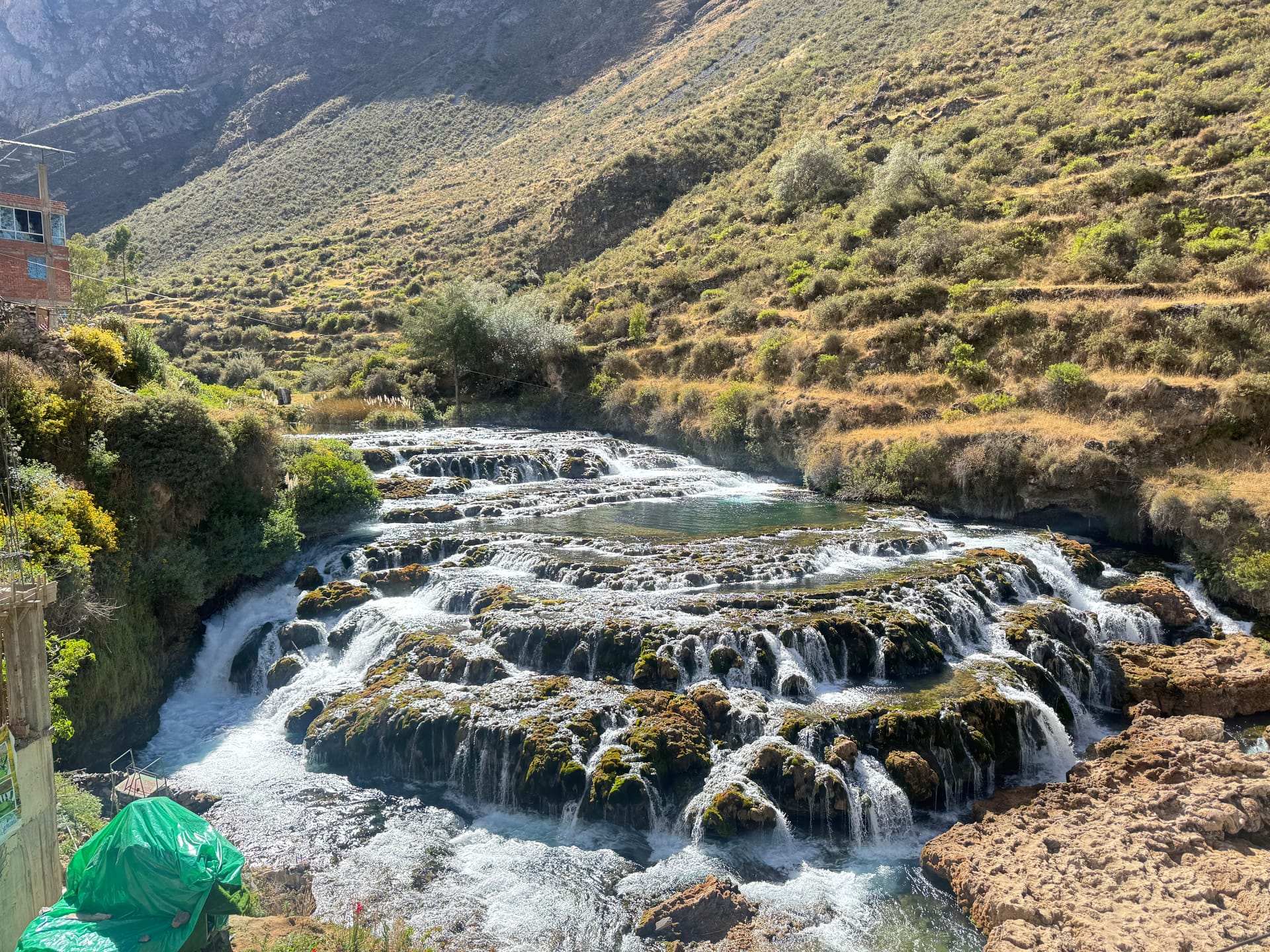
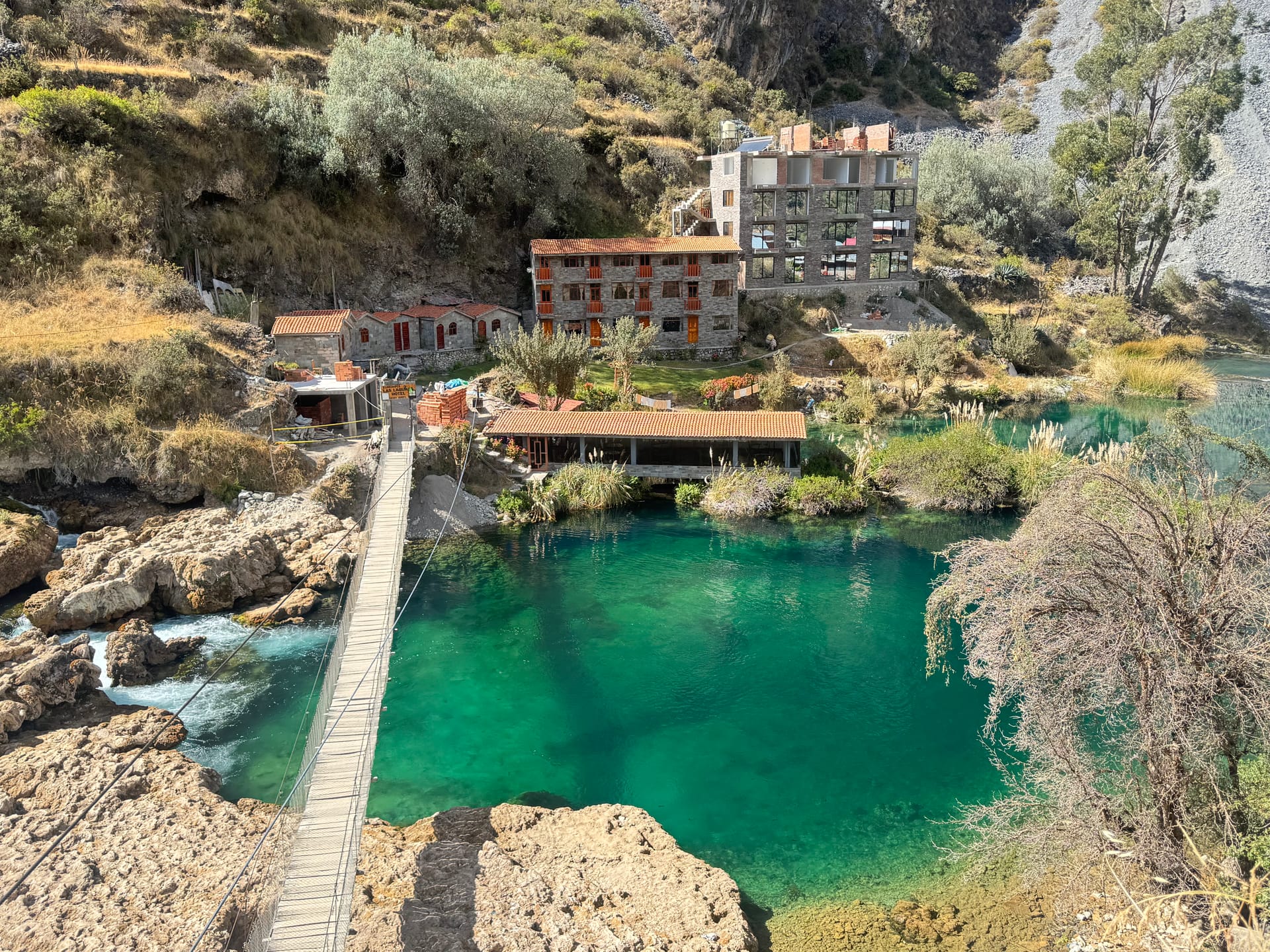
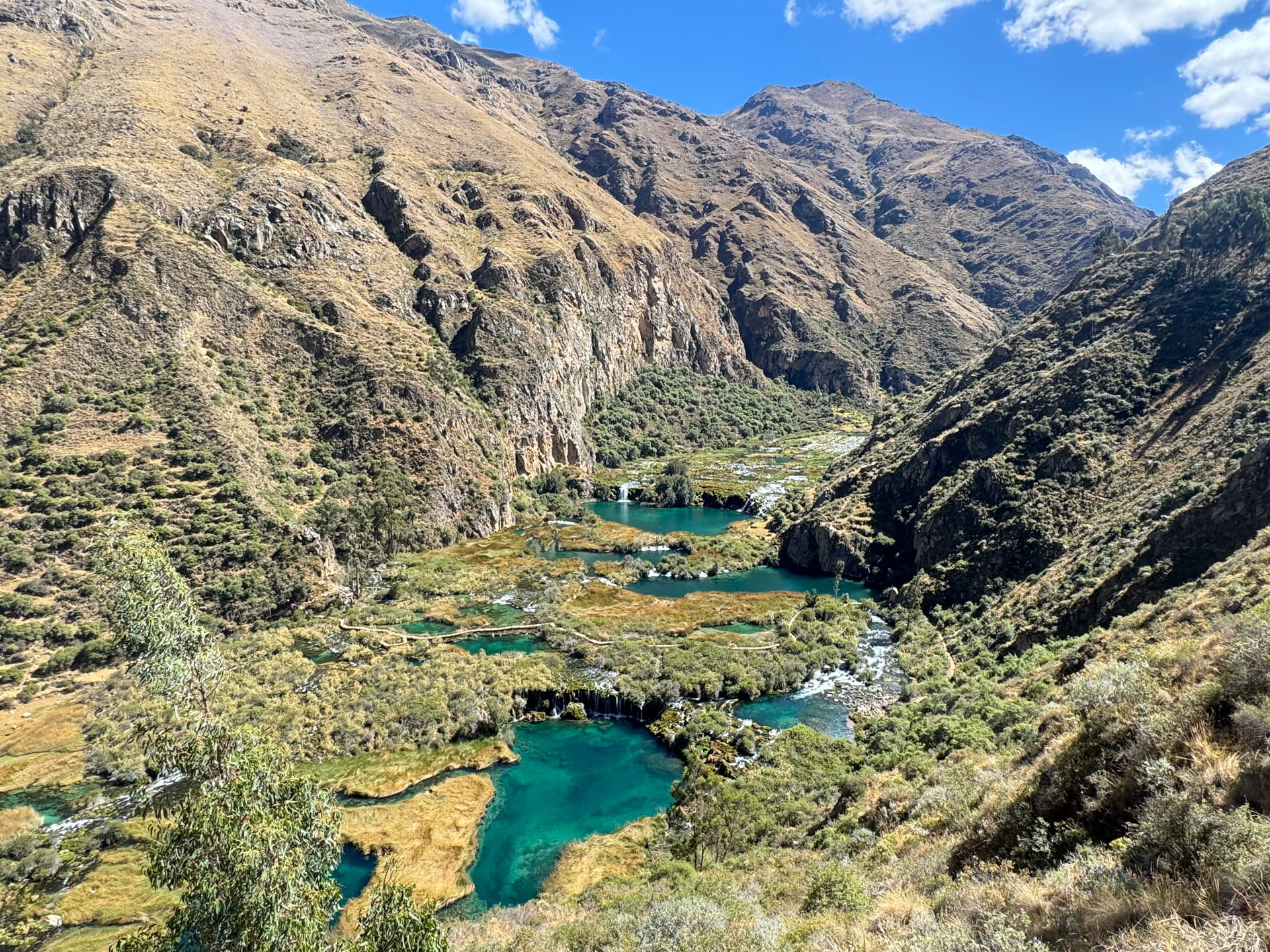
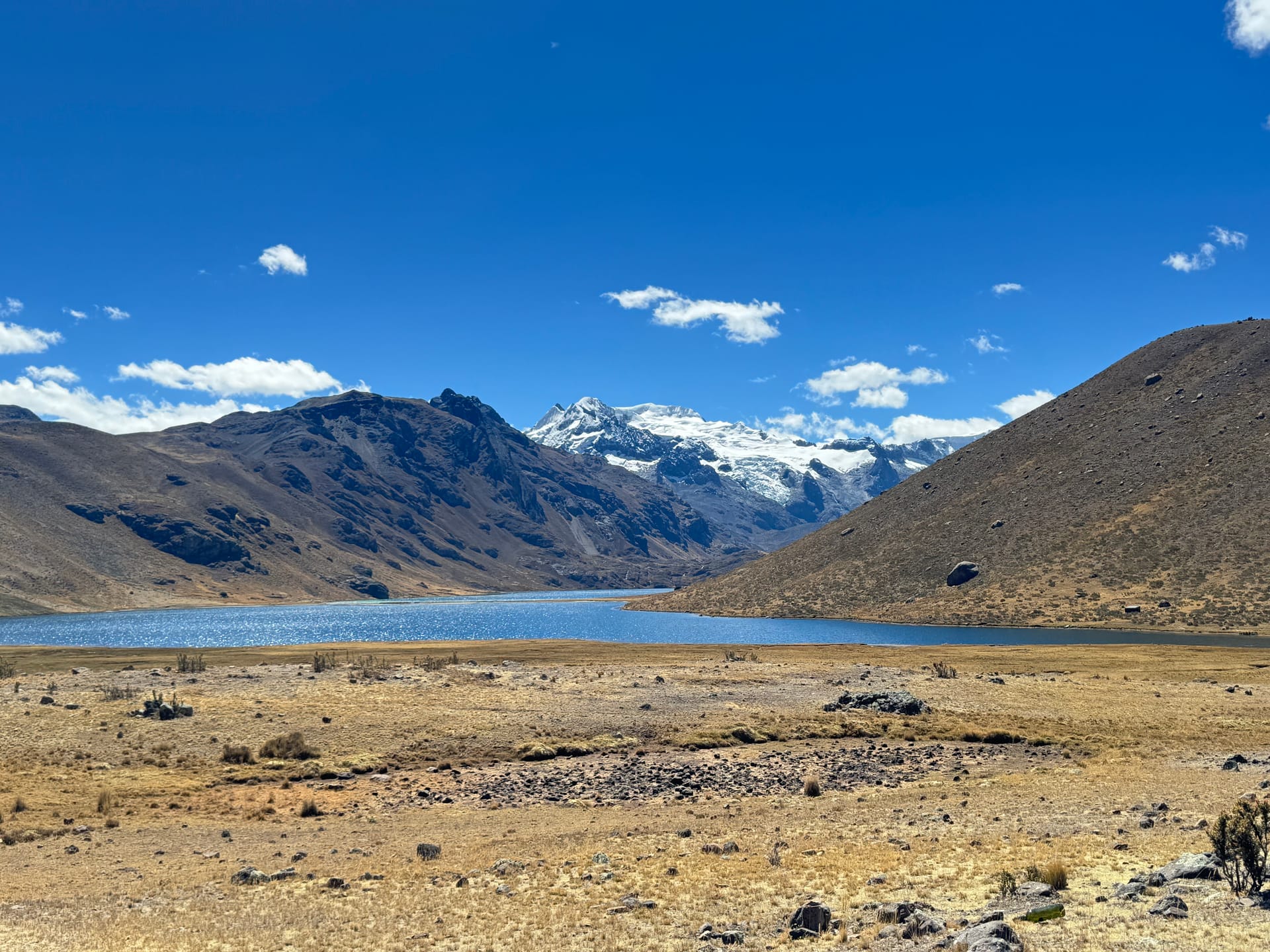
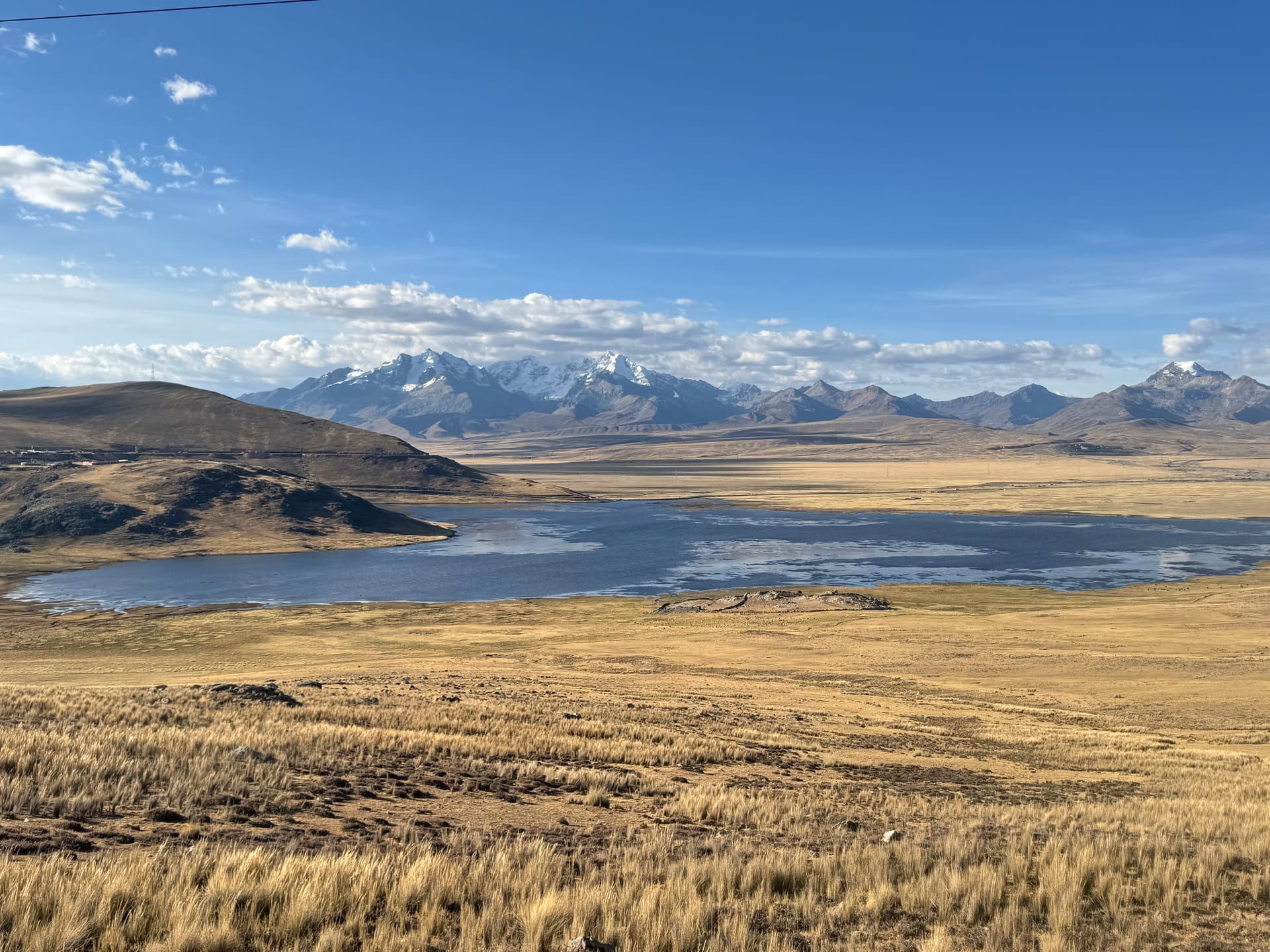
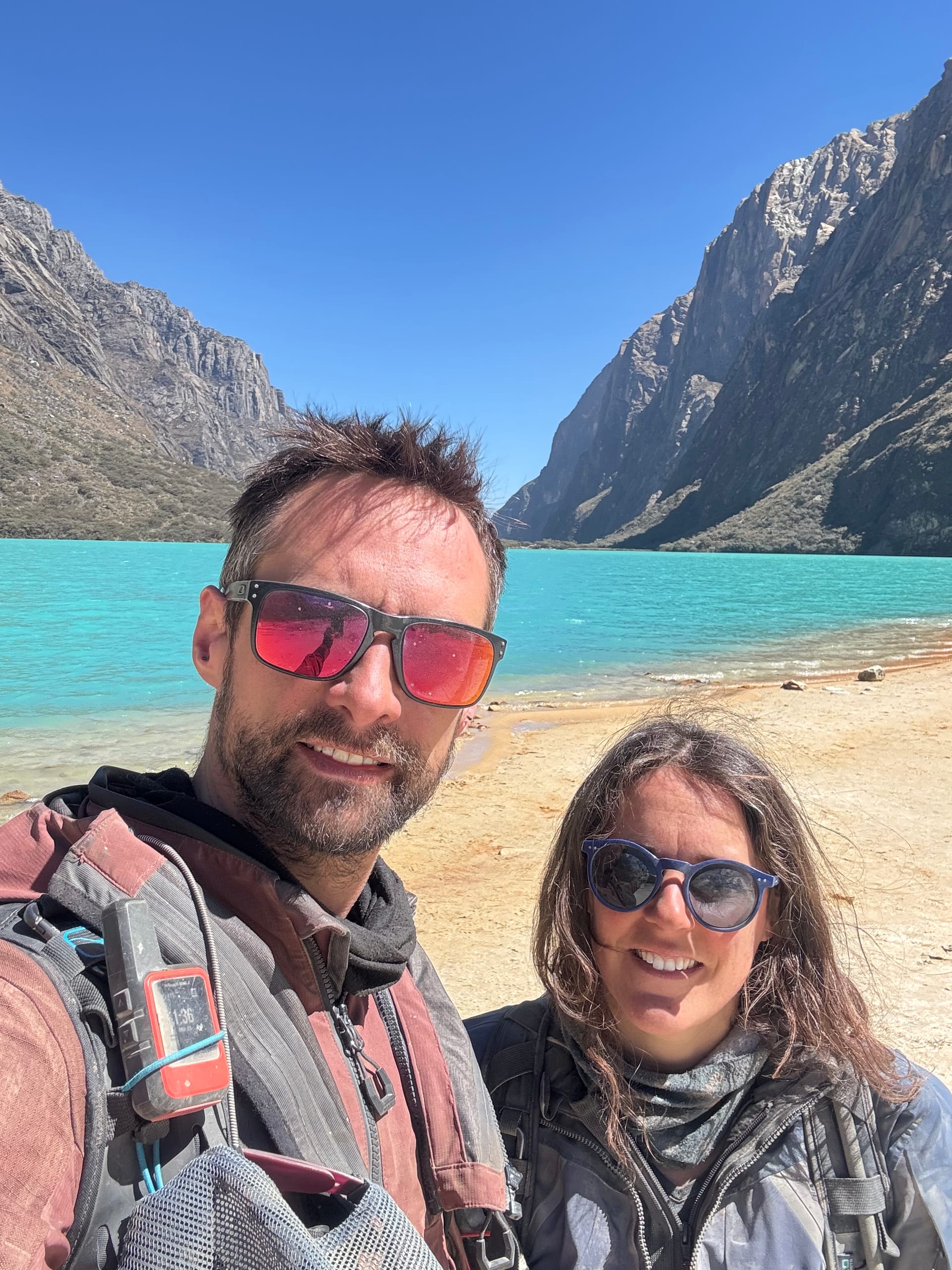
The next day is Adeline's birthday. She was hoping to spend the day at a spa rather than on a motorcycle, but we couldn't find one! So we hit the road again after waiting several long minutes for the gas station attendant to finally come and fill us up. Leaving town, we discover the Hualhua lagoon. Breathtaking turquoise water. The track is easy and runs past many waterfalls and lagoons. We love it. In the early afternoon we go around a huge glacier that we get to admire from different angles. We're amazed. In the end, it's a beautiful birthday that will stay in our memories. We stop for lunch around 3 p.m. at a restaurant that fishes trout from its ponds to order. It doesn't get any fresher.
We check our options for the night and decide to stop in a town 20 km away, otherwise we don't really know what we're getting into. To reach San Mateo de Huanchor, we have to take the Carretera Central, a major road heading down to Lima. It's hell: trucks, cars pulling up alongside us, trying to overtake at the entrance to a tunnel. Adeline gets annoyed and signals to them twice that they're driving like maniacs. San Mateo de Huanchor has no interest, it's just a noisy transit town. We have trouble finding a hotel and decide to go a bit out of town. In the evening, it's hard to find a decent restaurant for Adeline's birthday. So we settle for a burger in a cafeteria. No beer, no cake to celebrate Adeline's 39th. Never mind, the day will still be memorable. Now it's time to wrap up this birthday, which lasted almost 30 hours with the time difference.
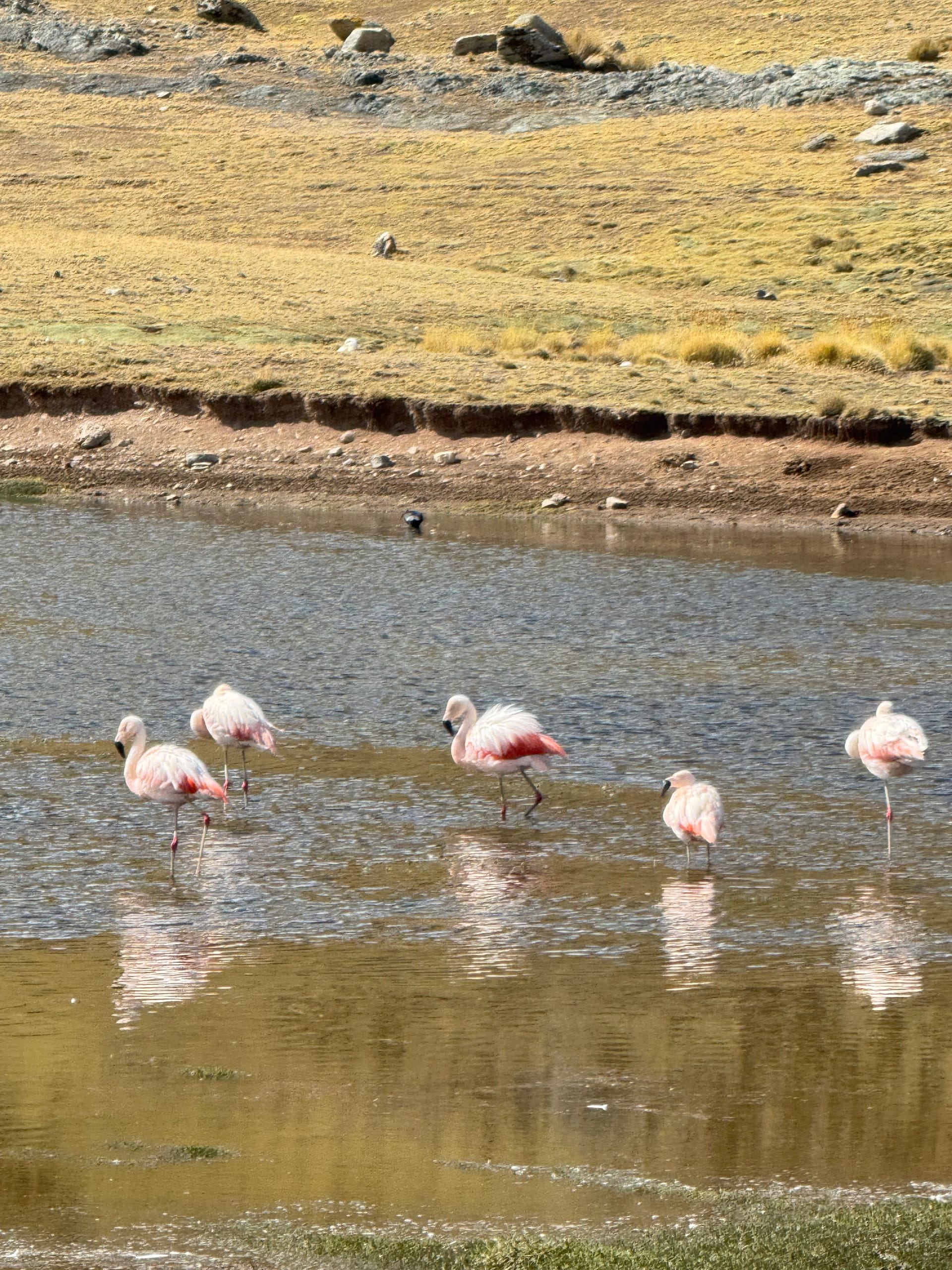
After a good night's sleep, we have to face the 20 km of Carretera Central that take us back to the PGD track. It's only 20 km, but it's enough to push us to the edge. We feel oppressed, mistreated. We love Peru, but Peru wears us out. Fortunately, today we'll mostly be on dirt tracks. We pass a mine, the track is rough but quickly becomes smooth. Once again, we're spoiled by the landscapes. And by a lagoon, pink flamingos, closer than we've ever seen them. The original plan for today was to go as far as Parquín. We miss the turn and discover a village below the mountain. It's already 4 p.m. and we have about 30 km left. Double or nothing: if the track is in good shape, we can make it before nightfall, otherwise it could quickly turn into an ordeal. We ask a local, who tells us there's gas and hotels in the nearby village, which isn't certain in Parquín. So we decide to stop there for today.
We find a grifo selling fuel from jerry cans and a place to stay with a garage. We'll be able to hit the road tomorrow in good conditions.
Popcorn at 3 a.m. and 200 km to Catac
Insulation isn't the strong point of Peruvian buildings. At 3 a.m., we hear "pop... pop". They're making popcorn. At 4 a.m. the noise grows, people talking loudly and going back and forth upstairs to the toilets. Someone even gets confused and walks into our room. Needless to say, we don't sleep for part of the night. The next day the owner explains that tourist buses stop there very early on Saturday mornings to visit the nearby lagoons. Just our luck.
So we set off a bit tired. We ride back up the track we took yesterday down to the village, to the turnoff for Parquín. There's quite a bit of traffic because it's Saturday and there's a tourist site to visit. While Adeline has pulled over to let a car pass, she falls when setting off. The screw of the left handguard is broken, she'll have to do without. Stressed at the idea of dropping her bike again and damaging the handlebar, she then freezes in a hairpin that's actually easy and that she'd normally take without thinking. Her head won't let go, it blocks her even though she knows how to do it. This leads to some tension with Thomas, who doesn't understand what's difficult. In the end, everyone calms down, the track improves and we rack up 100 km of dirt in the morning, with hairpins in every direction and dreamlike landscapes. Did we mention Peru is incredible? And then, for no apparent reason, in the afternoon we find ourselves riding on asphalt in the middle of nowhere. Beautiful smooth asphalt amid incredible landscapes. After a morning on dirt tracks, it's very pleasant. We reach a village around 5 p.m. At the entrance, a parade of people in costume welcomes us with little taps of sticks on the head, in a strong smell of alcohol. We don't know what they're celebrating, but they've certainly celebrated it.
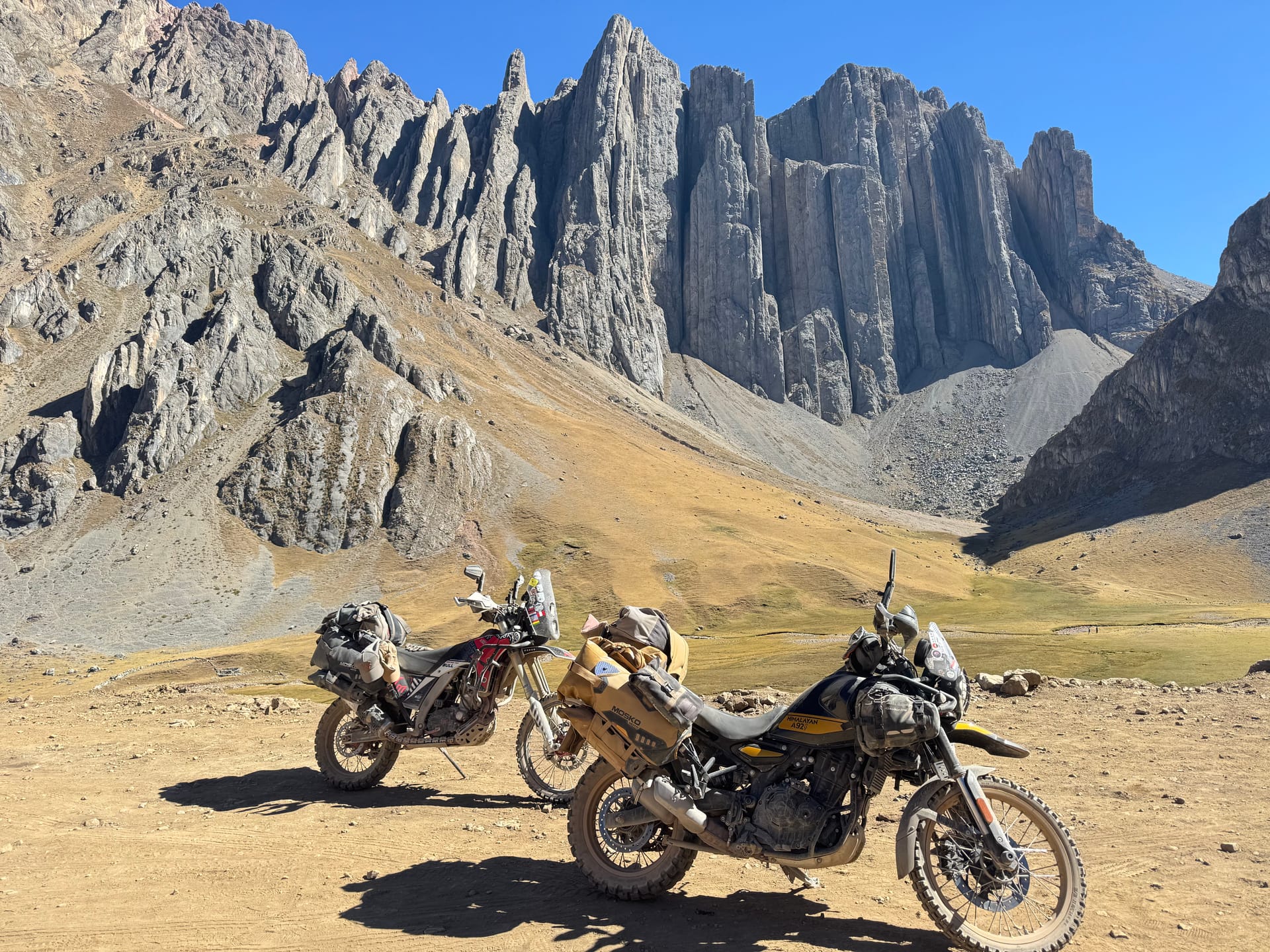
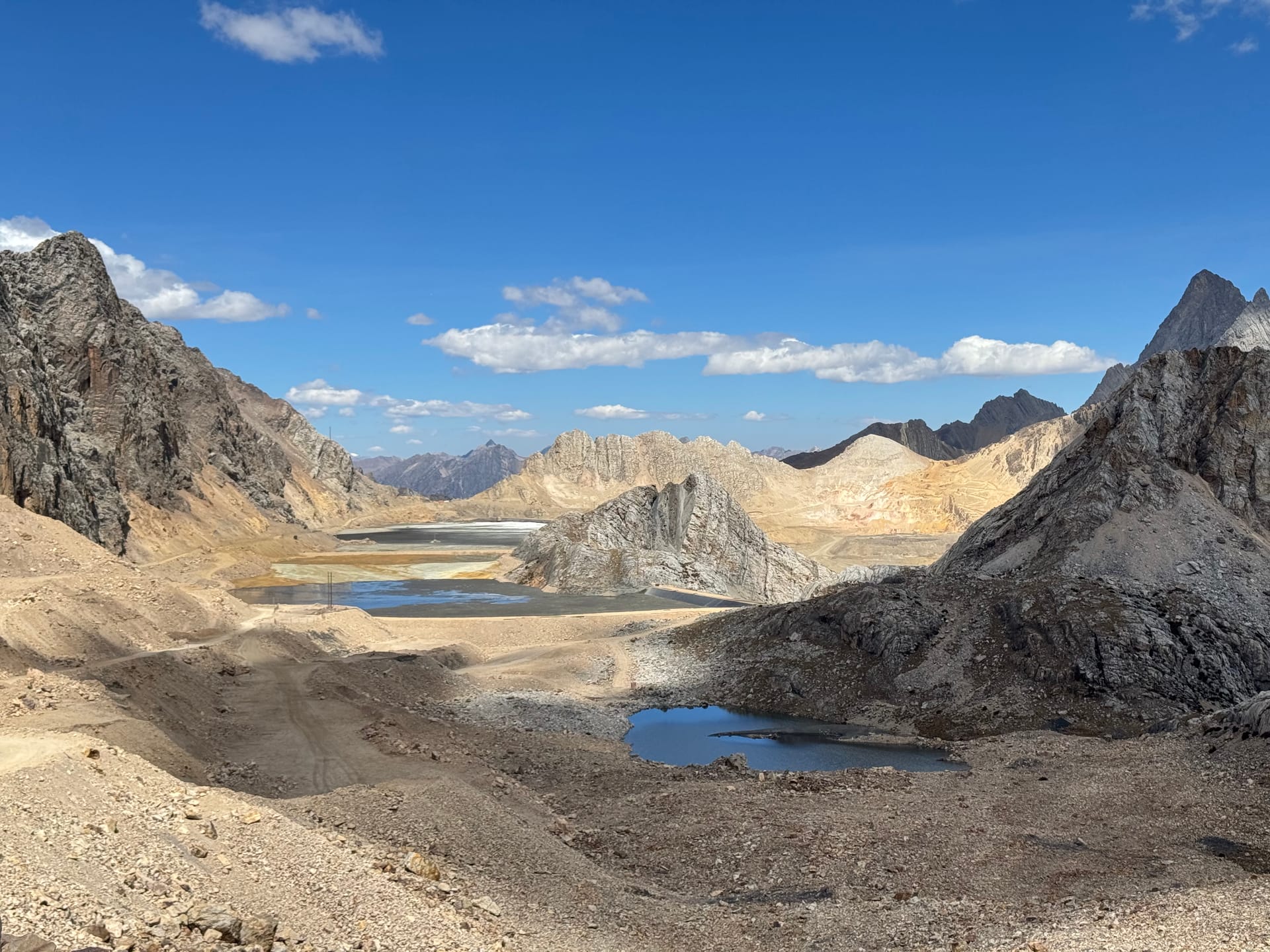
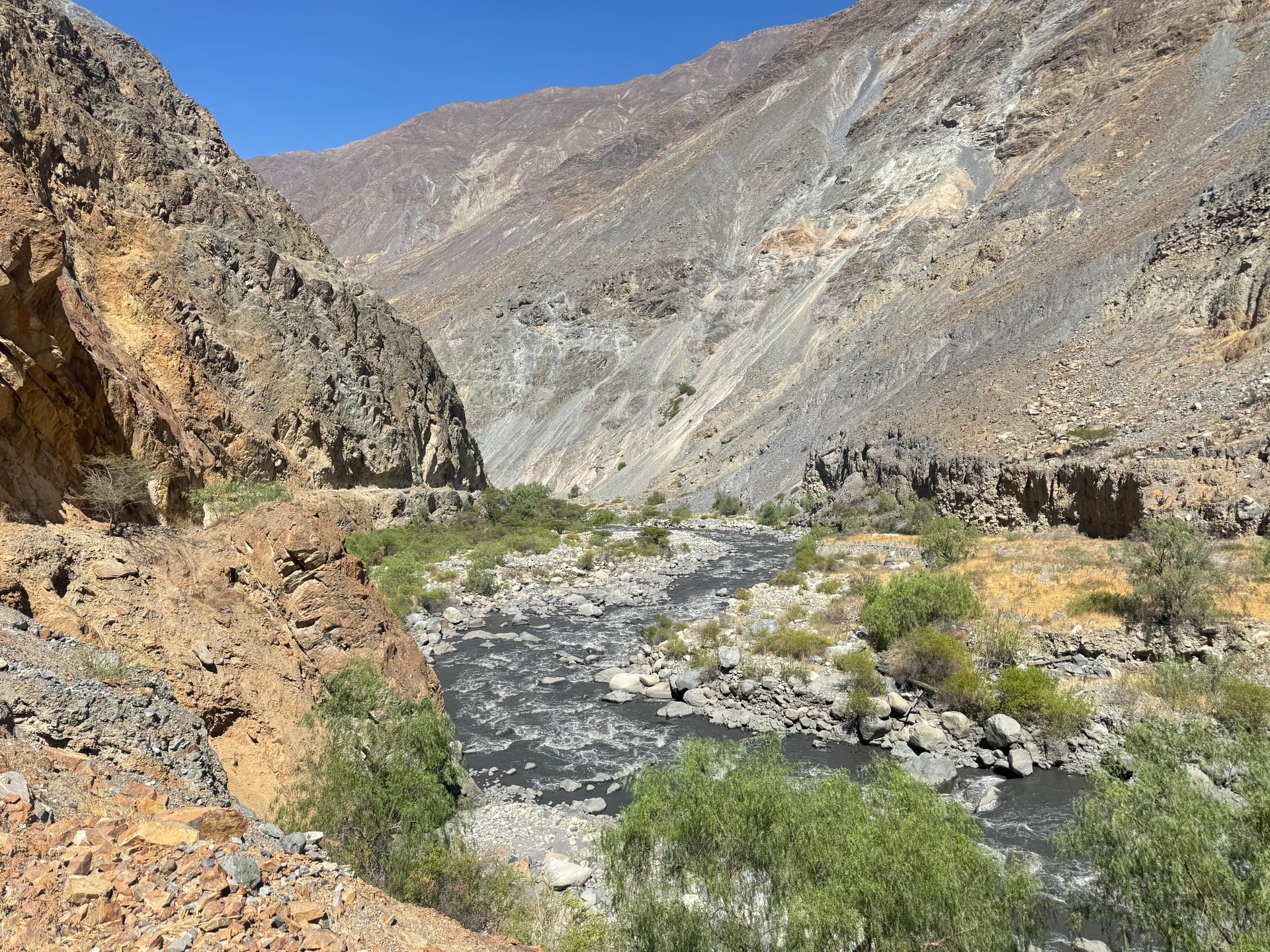
After a good night's sleep, we head for Catac. We've planned 200 km, while we've never done more than 160 a day on the PGD. We hope it'll work out. We go down and back up the mountain on 55 km of asphalt, for maybe 5 km as the crow flies. That's Peru! Then it's back to the dirt. We cross a bridge that has sagged on one side, reassuring, then ride through a superb canyon before launching into an endless climb: almost 2,000 m of elevation gain. It never ends, once again we string together hairpins. At the top there's a village where we find fuel for the AJP, but nothing to eat. So we carry on. The attendant promises us a track with less climbing and easier riding. We clearly don't have the same definition of an easy track: rocks, holes, sand, one after another. At 3 p.m., we still haven't come across a restaurant, so we stop to snack on a few grapes, some chocolate and a banana. At times the track widens, becomes a bit smoother and we make progress. At 4:30 p.m., the tarmac reappears. We're relieved, we know we'll make it to Catac. In the evening we're starving. After dropping our things at the hotel, we go out to eat at a pollería, a classic in Peru.
Pastoruri, Huaraz and the turquoise lagoons
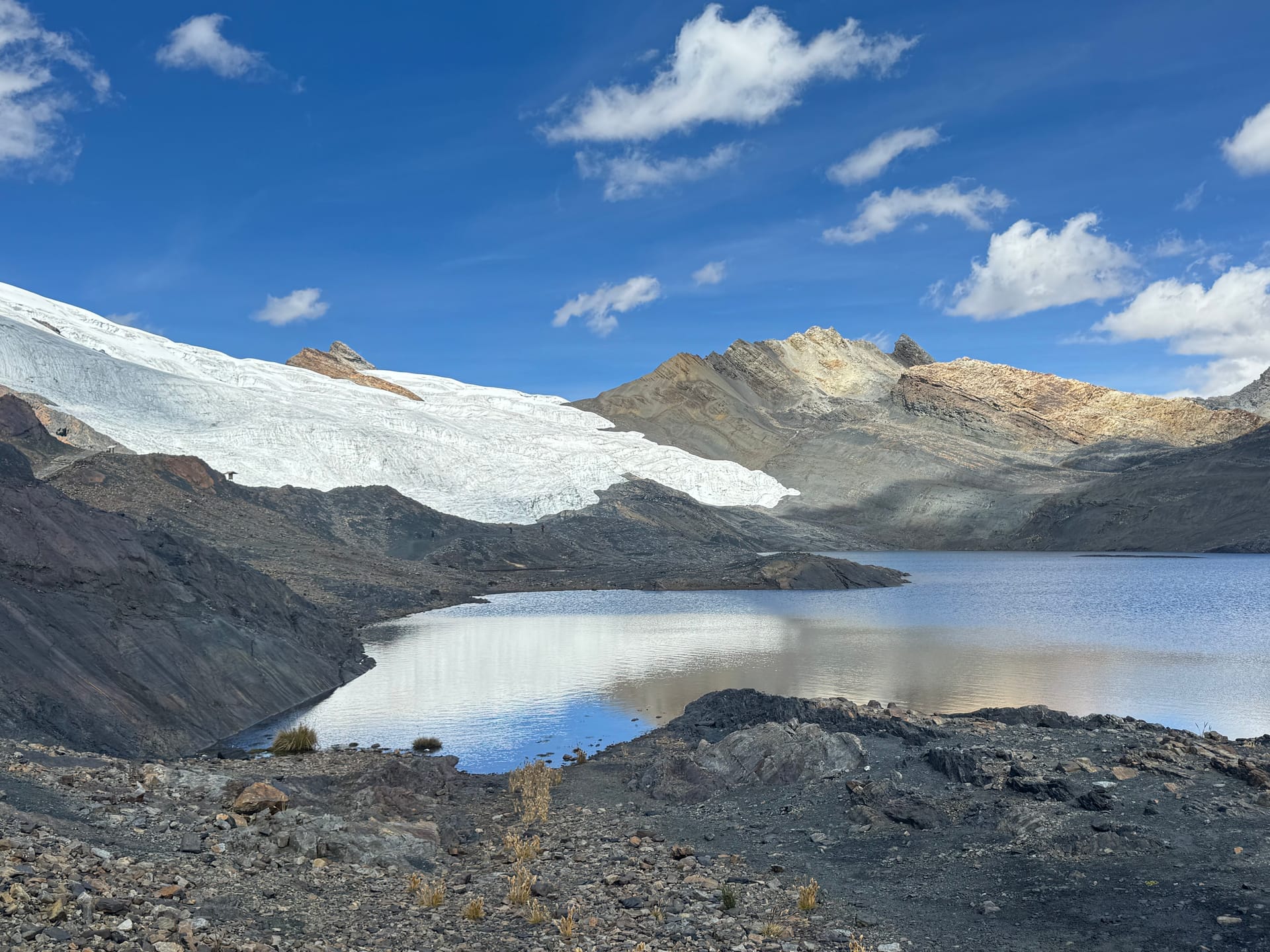
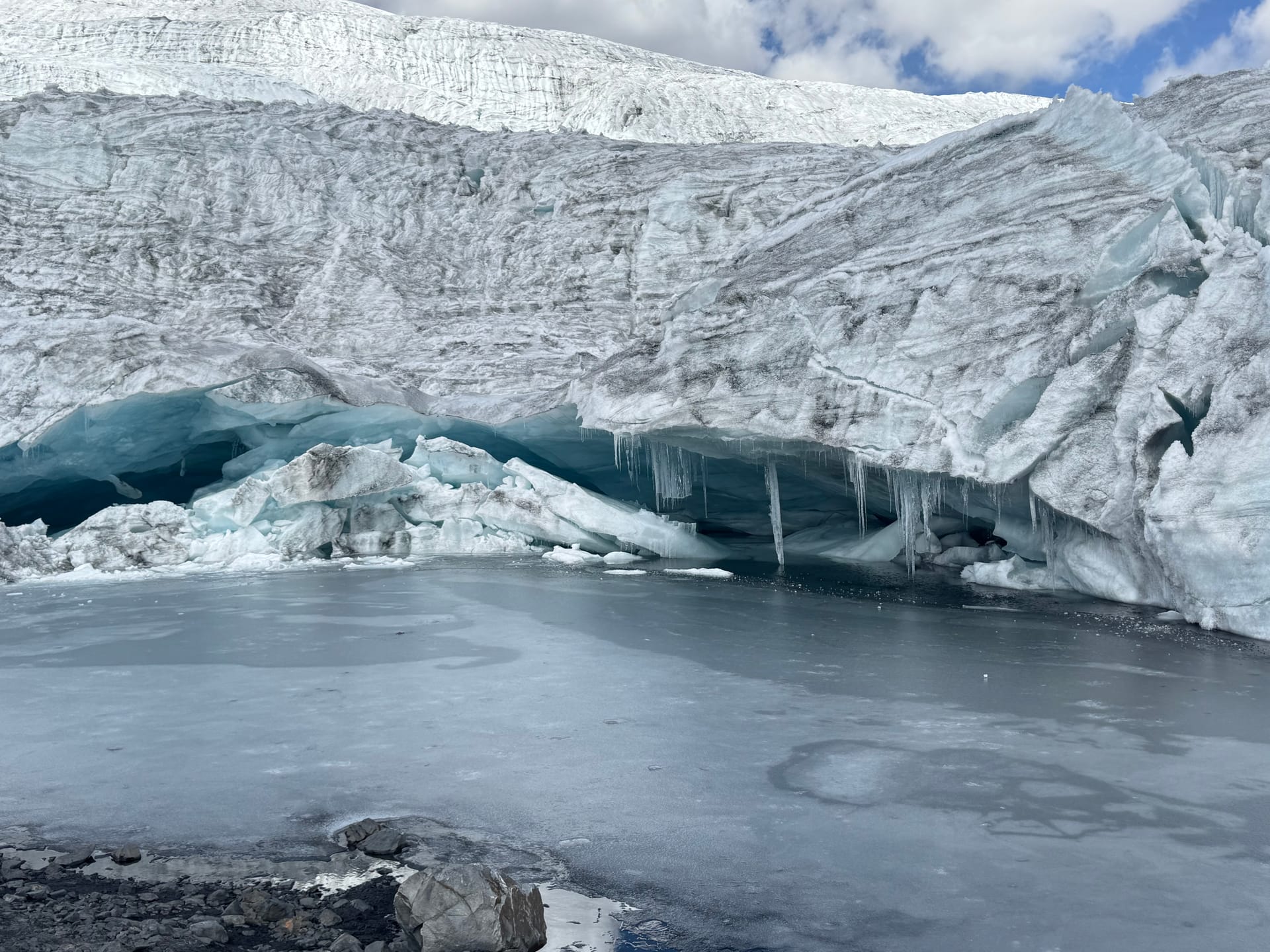
Every day is different. Today we've planned a short day. We go to the Pastoruri glacier before reaching Huaraz, 40 km away. The 11 km of track to the glacier are wide and easy, which feels good. Once there, a small letdown: we still have 5 km of walking there and back, at 4,700 m, to see the glacier up close. Locals offer to take us up on horseback, but come on. Walking is a bit tough, with the altitude and the climb we're short of breath, but the view at the top is well worth the effort: the landscape is magnificent. The glacier is smaller than Perito Moreno, but you can get very close, and we have it all to ourselves. We thought it wasn't very touristy, but on the way down we see that three buses have arrived. Perfect timing.
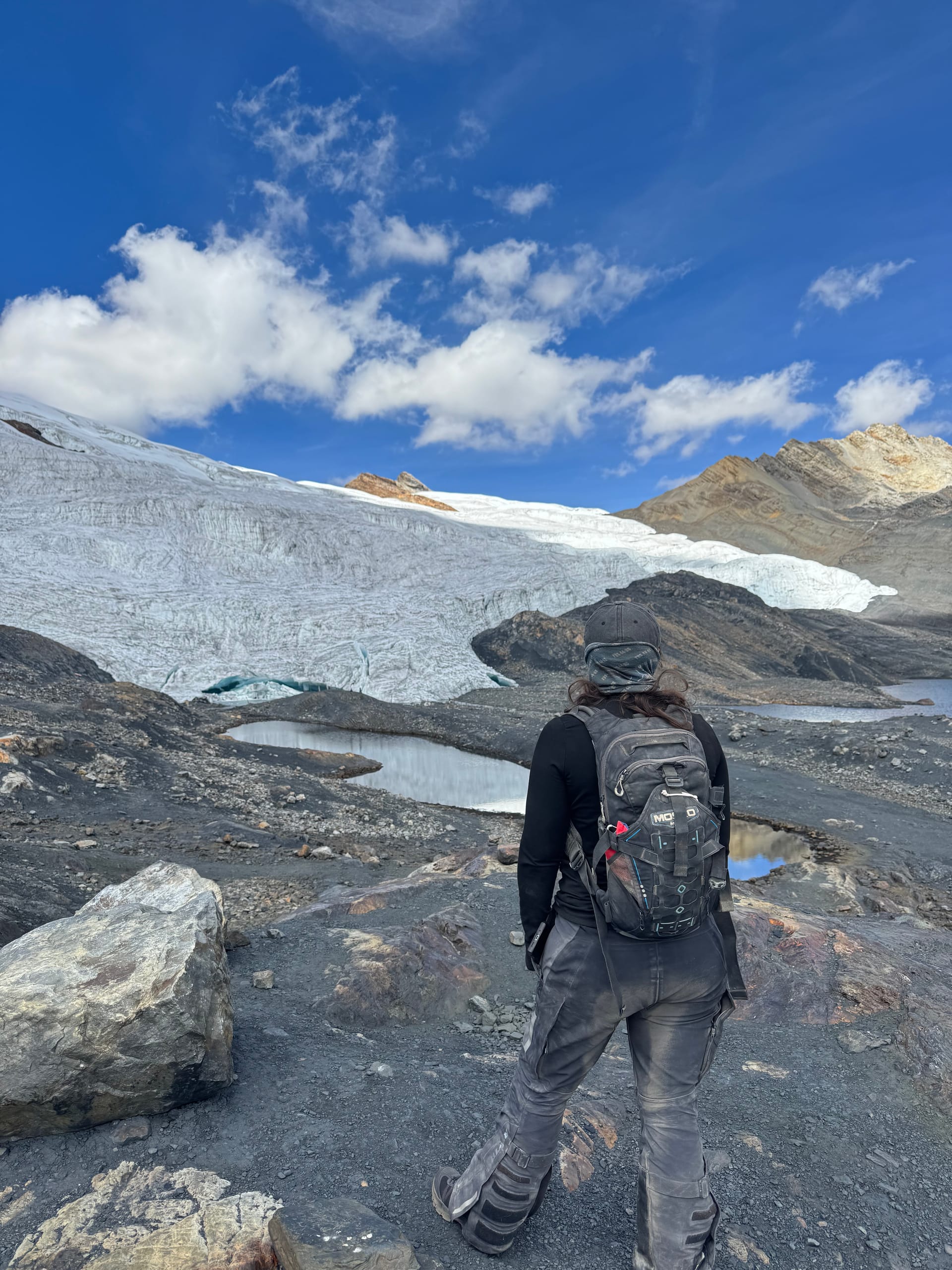
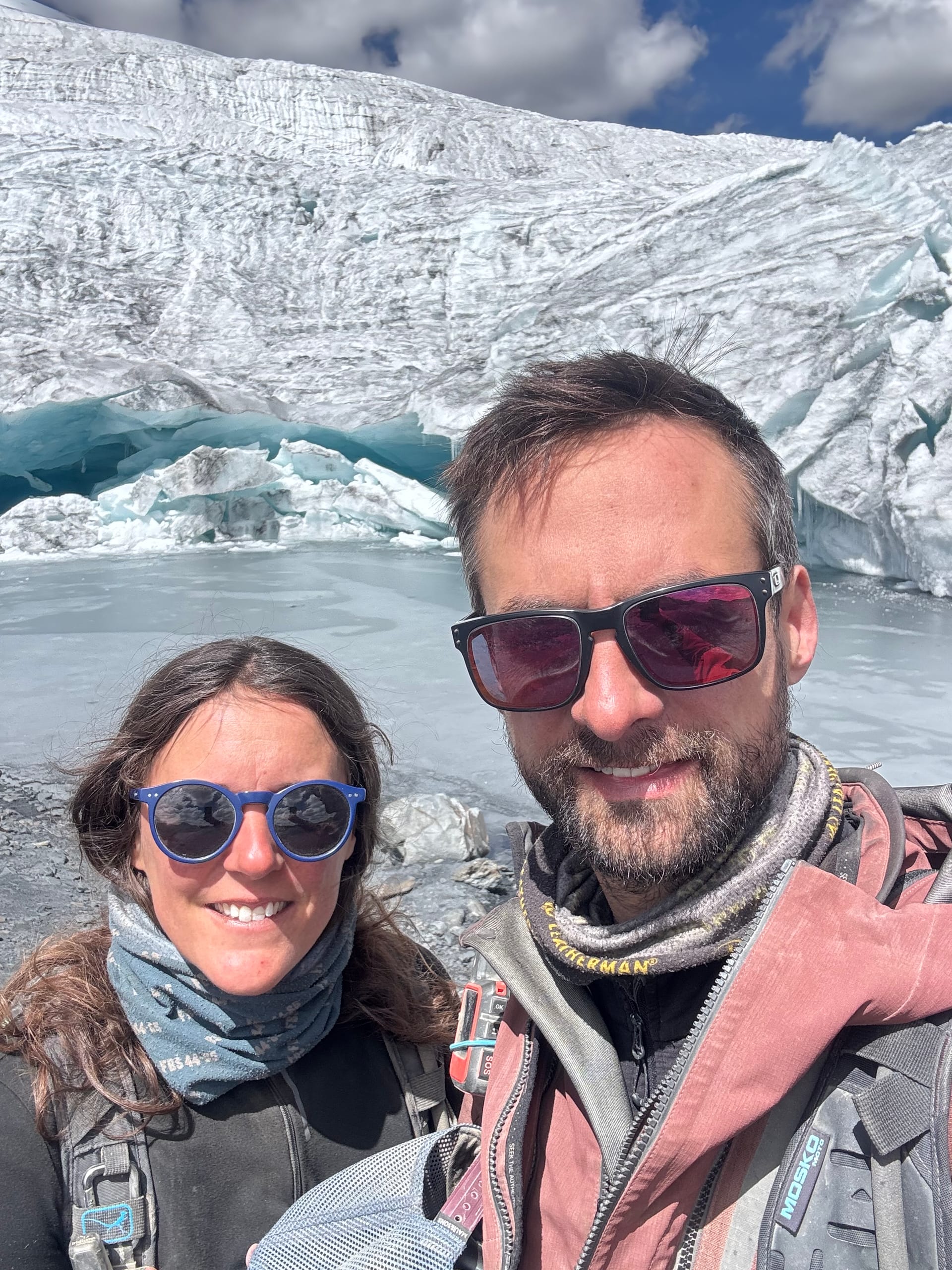
We have lunch on site and head for Huaraz, where we've planned a stop at a motorcycle garage. We have a few small jobs to do, flipping Thomas's front tire and repairing the Himalayan's handguard, which shouldn't take long. We arrive at 3 p.m. but don't get out until 6... that was long! Luckily, in the meantime Adeline has found a place nearby, all we have to do is go and rest.
In the evening we take stock of the rest of the trip. We decide to leave Peru by July 27th at the latest. Our motorcycle insurance expires on that date, and even though we love discovering Peru's landscapes, we're tired of the driving, the disorganization of daily life and the noise. We have one last tourist stop to make, then we head north towards Ecuador.
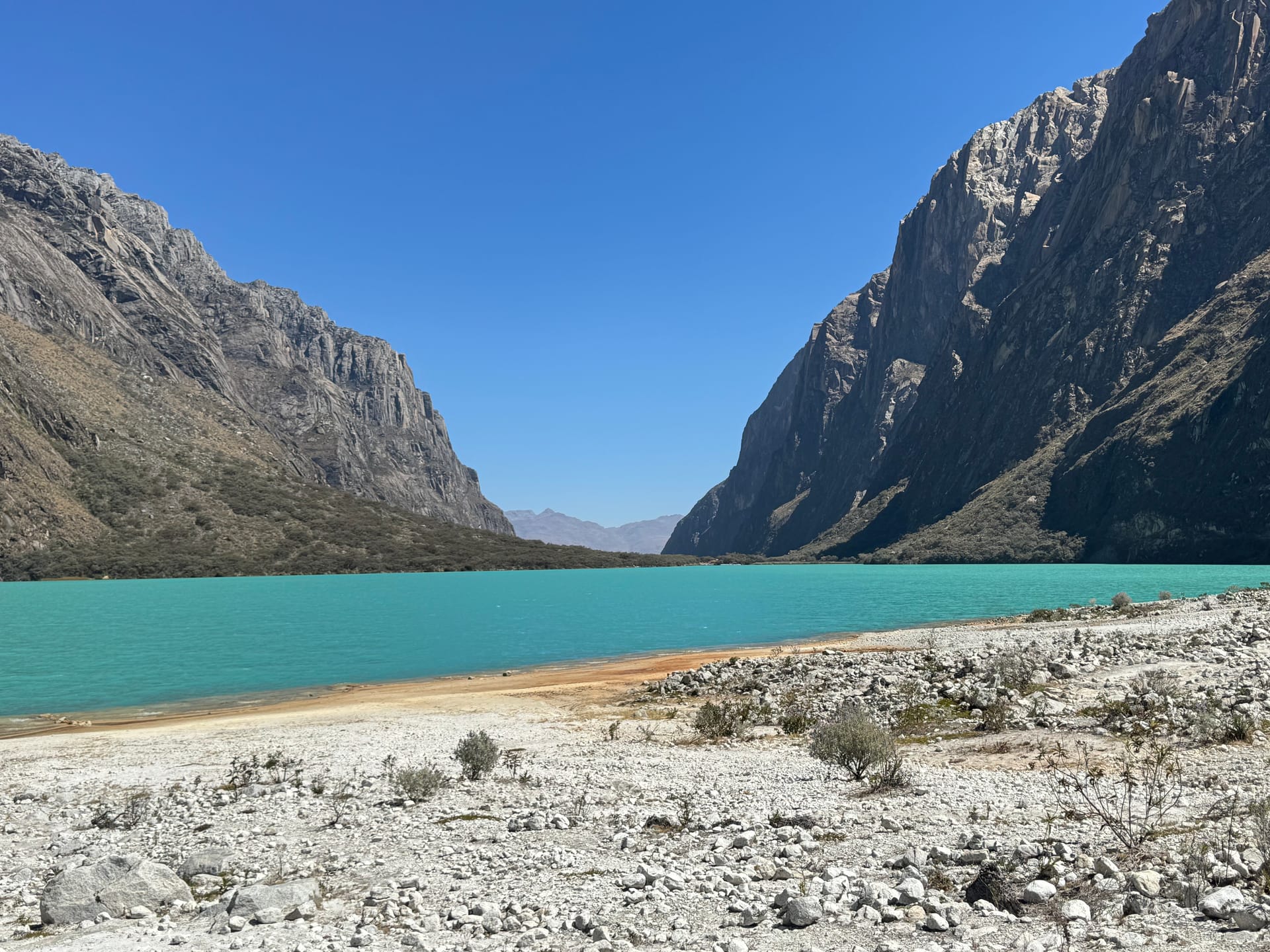
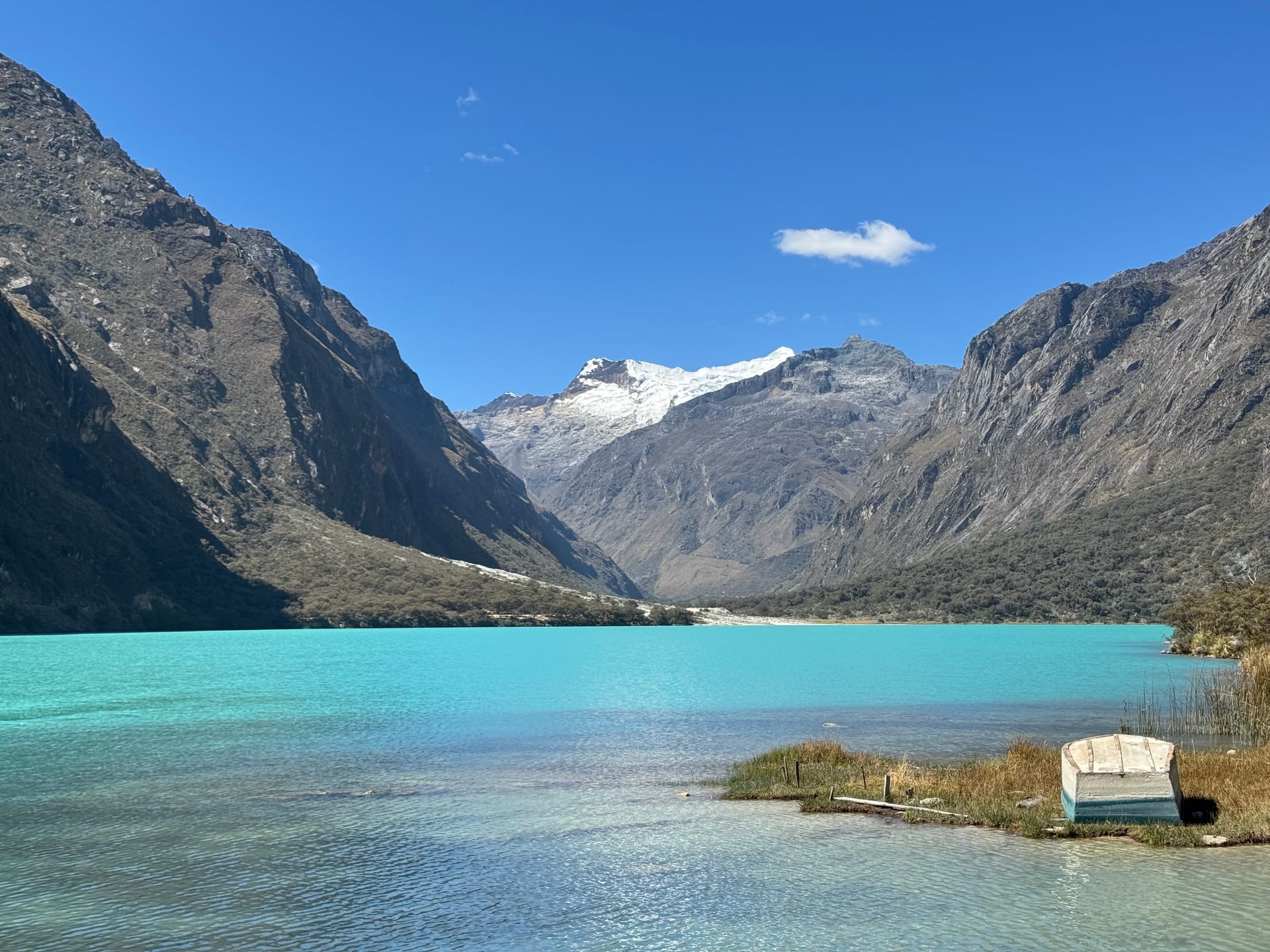
The next day we head to Huascarán National Park to admire Laguna Parón. We could have done the big loop through the park, but it seems hard to do in one day and we don't have much time left. Plus, we'd like to get to Caraz early, we have two or three things to sort out, but of course things don't go as planned. On the road to the park we hit roadworks. "Espera un ratito," they tell us: we're in for a 40-minute wait. At 1 p.m. we're at the foot of the lagoon: the water is an incredible turquoise blue. Wow. We hadn't seen water this blue since Puerto Tranquilo in Chile. It was magical. But the magic is short-lived: Adeline realizes she's lost the hose for the tire pump. Thomas gets angry, it's essential for the trip and this ability to lose everything drives him mad. We retrace our steps in silence and find it... crushed by cars. Now we have to find another pump to buy, but we had other plans for the afternoon. In a bit of a hurry, on the way back we can't escape the wait for the roadworks again. A chance to chat with some French people living in Peru and a rider traveling solo, but it puts us behind schedule. We finally reach Caraz at 5:30 p.m. We have to try a few shops, but we eventually find a pump. What a relief. The relief is short-lived, because when we test it we discover it deflates the tires instead of inflating them. Of course. Luckily, the seller agrees to exchange it and it works! Hooray. We finally reach the place we booked at 6:30 p.m. Thomas takes care of the bikes while Adeline heads to the laundromat, and at 7:30 p.m. we're ready for the tartiflette night organized by the hostel. A bit of comfort food tonight is more than welcome.
Pallasca by night and an afternoon with four falls
Just as we're leaving for the tartiflette night, a group of Ecuadorian riders arrives. They literally take over the hostel's entrance hall with their tents. In itself, that wasn't a problem, but we're less keen on the racket they make at 6 a.m. while packing up. We struggle to get back to sleep and wake up groggy. Needless to say, we're not very productive this morning and we finally leave at 11. Some days are like that. On the other hand, it's a good thing we didn't leave early: barely 10 km in, the road is closed and only opens between 12 and 1 p.m. So we're already stuck. On today's program: the Cañón del Pato and its 35 tunnels. It's a mix of dirt track and road. It's quite nice but less impressive than we imagined. Tunnel after tunnel, we pass a few cars and trucks, but everything goes fine. After lunch, we continue on a rough track that shakes us around a bit. We hit roadworks again and this time it's the last straw: while we're waiting patiently in line, trucks and cars arrive and double-park to be first through, completely blocking traffic. We're annoyed by such a lack of manners and move to the front so we won't be stuck. After three hours of dirt, we're not unhappy to find tarmac again. But the pleasure is short-lived! The GPS suggests the 3N, with 105 km left to Pallasca, but a sign shows 53 km via a dirt track. Given the state of the track and the difference in distance, we decide to take the shortcut. First mistake.
We end up on a mountain track, facing trucks that don't stop in the narrow sections. Thomas is forced to back up at times and, of course, the truck keeps moving forward. After an hour of track, we follow a sign rather than the GPS. Second mistake. After 30 minutes we realize we're not going the right way and have to turn around. It's 5:45 p.m. and we have 20 km left. We try to hurry, the track isn't difficult, but then we're blocked by a Peruvian lying in the middle of the road. We wonder if he's dead, but he's just dead drunk in the middle of the lane. Truck drivers coming the other way half-heartedly try to move him, and 15 minutes later the problem is solved. The trucks pass and we continue on our way. With all that, night falls. Adeline, who doesn't like riding at night, even less on dirt, falls while passing a car in the middle of a rock field. We finally arrive at 7 p.m., exhausted. We drop our things at the hotel and decide to have a pizza at a restaurant we spotted on the village square. We order two pizzas, but the waitress misunderstands and brings two slices. Here people usually share their pizzas, but we're starving! "Dos enteras." "¿Seguro?" Yes, yes, we're sure. Everyone watches us wolf down our two pizzas, and at the end of the meal someone asks if we're Italian.
After a good night's sleep, we hit the road again. There are days you remember for the landscapes, and others you'll tell everyone about because they were a real ordeal. This day falls into the second category. In the morning, we fill up and ride smoothly to Santa Clara de Tulpo. We're happy, we've made good progress and there are 66 km left to Huamachuco on the dirt track. The restaurant owner where we stop tells us it's easy and we should be there in 3 hours. Without a second thought, we take the track and skip the 3N. What a mistake, it's as if we never learn from our mistakes. Here we are on rotten little mountain paths, with rock fields. Hell. Adeline falls three times in the afternoon, Thomas once. He ends up taking over on the difficult sections: it's easier than picking the bike up, and with the fatigue it's a sure way to really get hurt. After two hours of struggle, we finally reach the top of the mountain, and the track looks wider and easier. Except it's closed! We've actually arrived at a mining site and access is controlled. Luckily they let us through and we make decent progress. At 5 p.m. we have 30 km of track left... we can choose between following the GPS on a narrow track or a wider road. The locals tell us the track is passable, so we try it, but after 1 km we turn back: there's a ford on the side of the mountain... if it's like this for 30 km, we're in for fun. We turn back and take the easy option. It'll be our best decision of the day. We've added 15 km, but the track is much smoother. We finally reach Huamachuco at nightfall, earlier than yesterday, that's progress. We stop at the hotel "Nuit tranquille" (Quiet Night). The night is bound to be good.
Cajamarca, and back to the coast to reach Ecuador
No more nonsense: today we stick to the 3N. Except that in Peru, even when you take the national road, you can't be sure of the surface. The asphalt road turns into a dirt track: there is tarmac, but it's buried under rocks and landslides. We don't make much progress with all that. At lunch, Thomas finally tries cuy stew. Yuck: it's like overcooked rabbit, with lots of tiny bones, even harder to eat. We finally reach Cajamarca at the end of the day. We discover that the bag where Adeline keeps her shoes has melted against the exhaust. Of course.
Given our difficulties making progress these past few days, and to make the July 27th deadline, we give up on the Andes and head down to the coast to join the Panamericana. We know we're in for straight lines, but it's just for a day. And sure enough, once we've left the mountains we speed along in stifling heat, with heavy traffic and above all, through mountains of trash lining the road. A sad sight. For our last night in Peru we stop in Las Lomas. We arrive early enough for a snack on the village square. We sit quietly on the main square and watch people. We love these moments: everyone is outside, it's a place to meet and share. We enjoy it one last time, tomorrow we cross the border into Ecuador.
Peru has played with our nerves. There's not a moment's rest in the landscapes, and we've never used the word "incredible" so much. It's the most beautiful country we've crossed since we set off. But the driving, the trash, the noise and the disorganization have worn us down. It's true a bit everywhere in Latin America, but it's more pronounced here. Maybe also, after nine months on the road, we're tired. Either way, we can't wait to find a bit of calm after these two fairly intense months.
Follow our adventures
Get an email for every new article.