Peru: from Arequipa to Cusco backpacking with the parents, after the south by motorcycle
"In Peru, every road is a scenic road."
We leave Bolivia through Chile, head straight north and cross into Peru. Nine days of riding to Arequipa, then a change of plans: Adeline's parents fly in, the bikes stay in a garage and we set off backpacking for two weeks. New country, new rhythm.
A quick return to Chile, then on to Peru
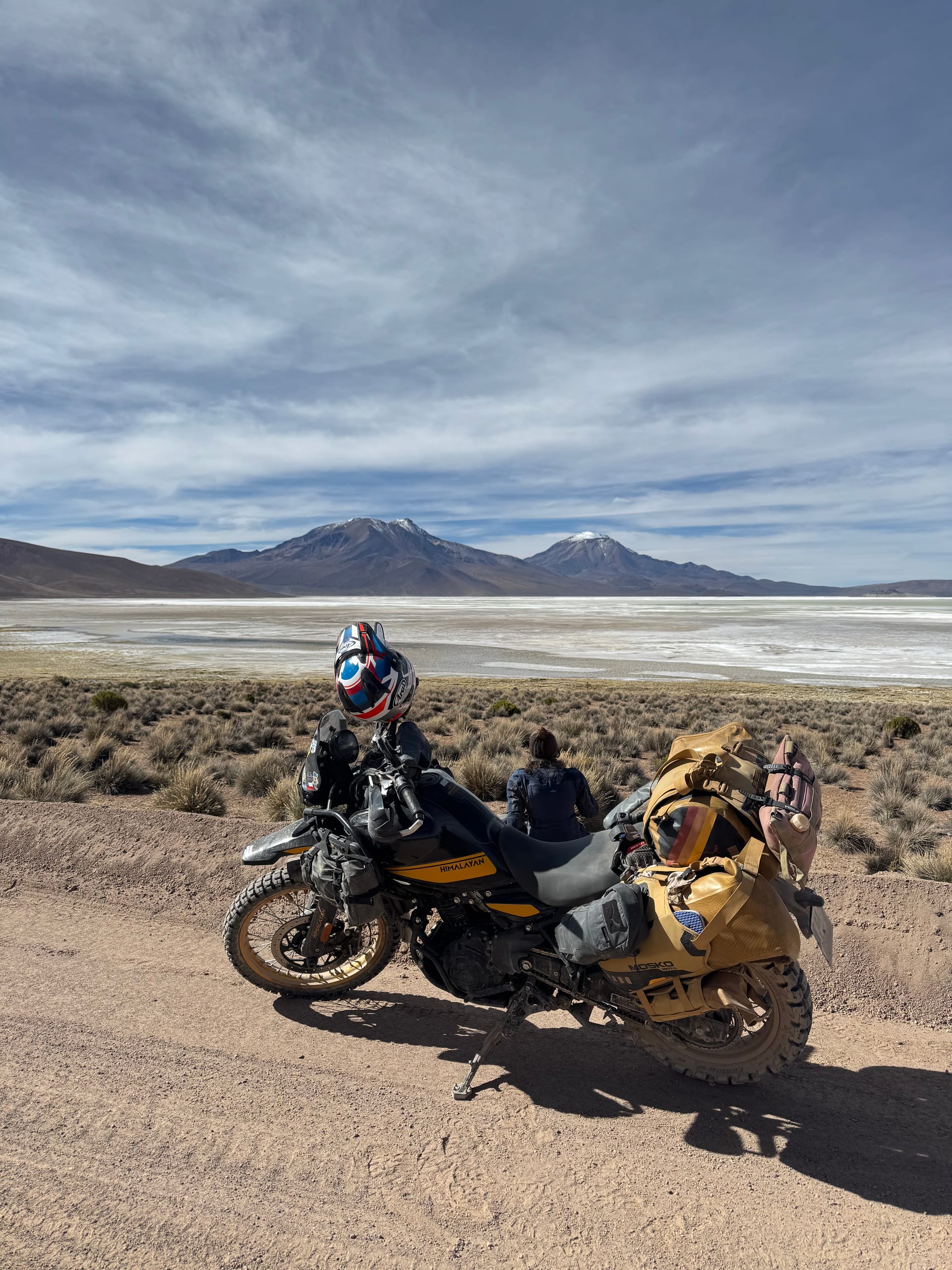
On June 1st, we leave Bolivia. The border drags on: on the Bolivian side, we fill in the same information three times in a row on three different forms. By noon, we're back in Chile. According to Jessy, the track to Putre is easy. He's right: one slightly rocky climb, a few sandy patches, and that's it. Google said more than six hours, we take 4h30. Volcanoes, salt flat, pink flamingos... we even get to have lunch facing the salar. Stunning.
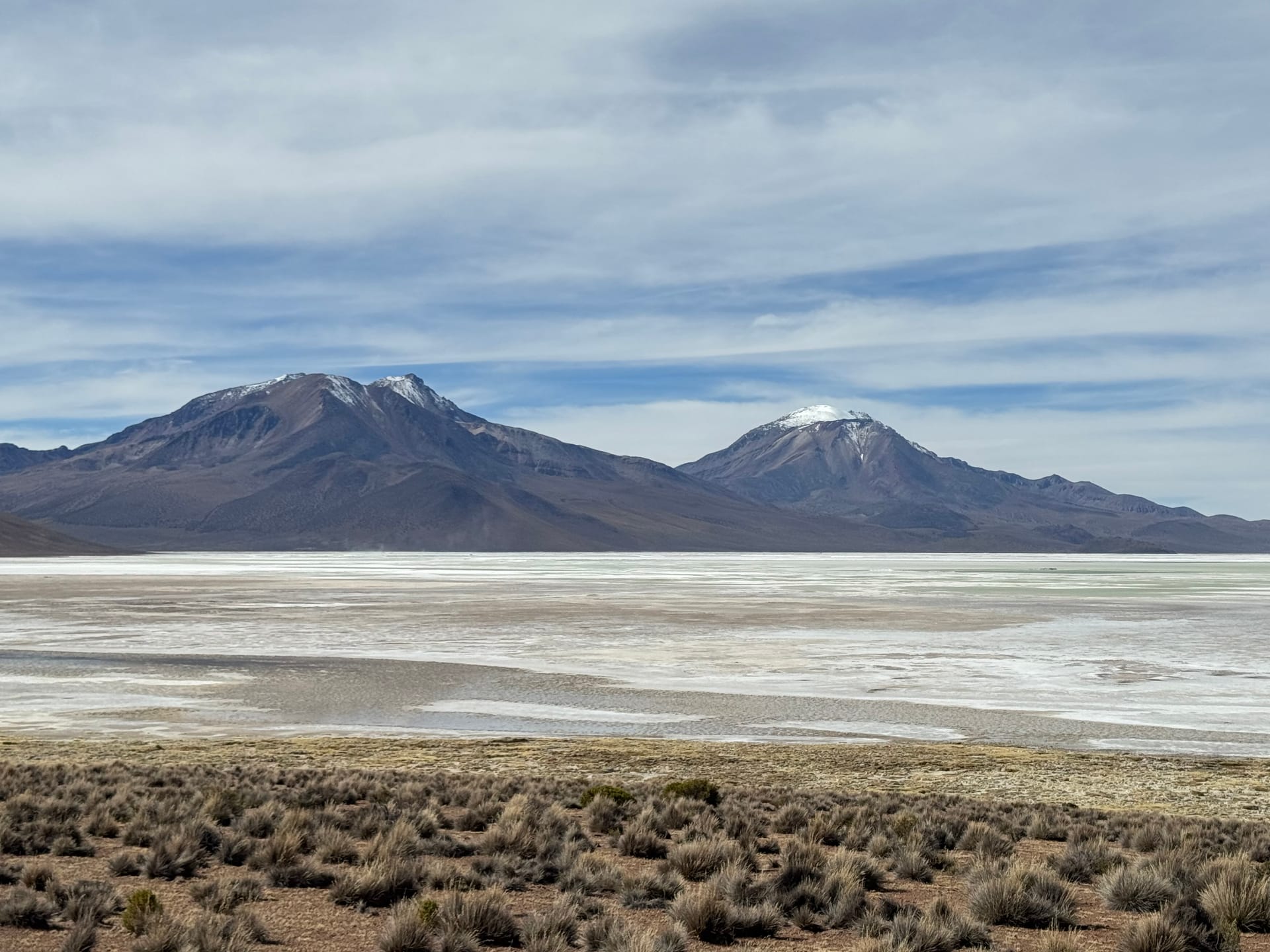
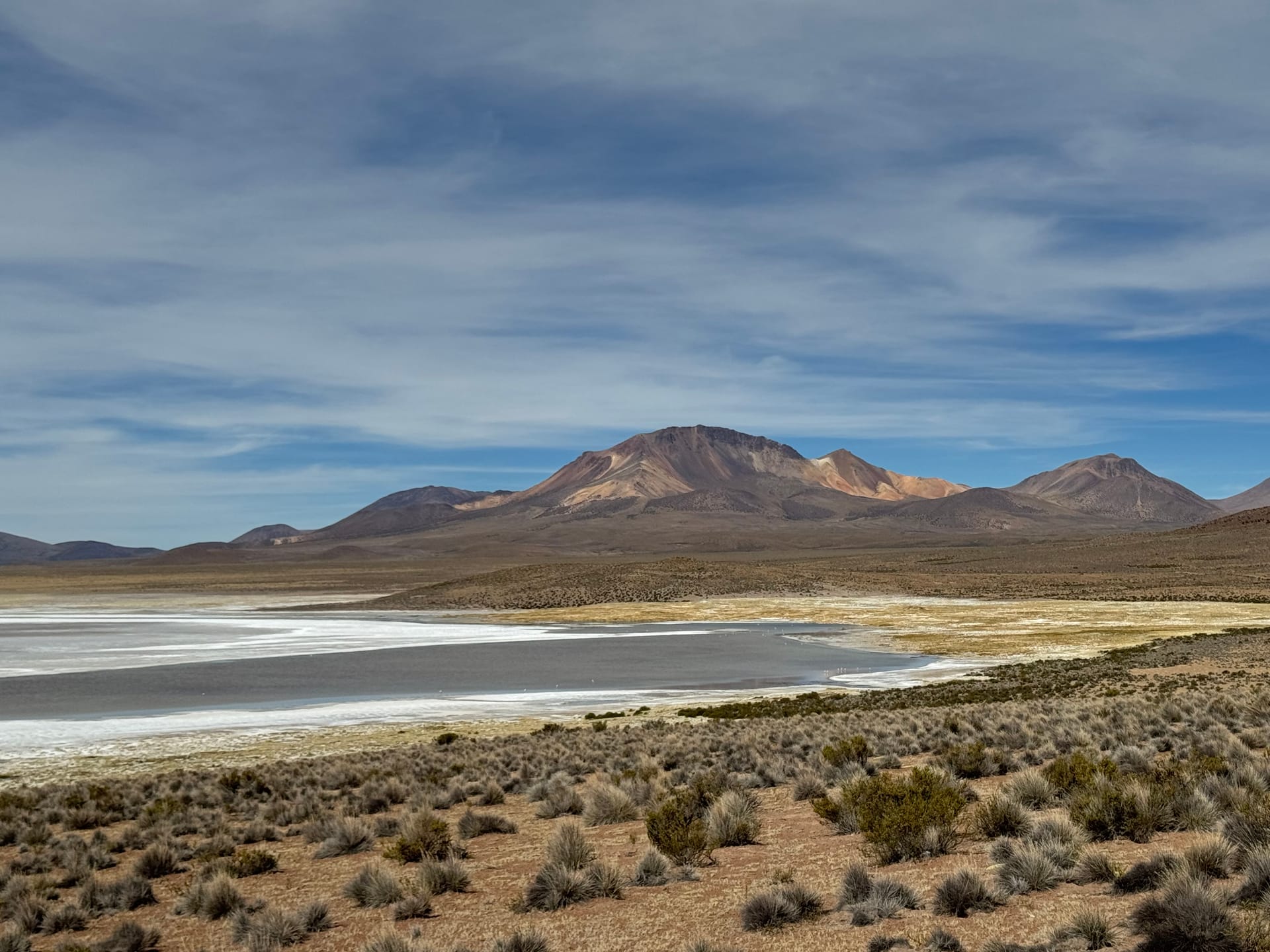
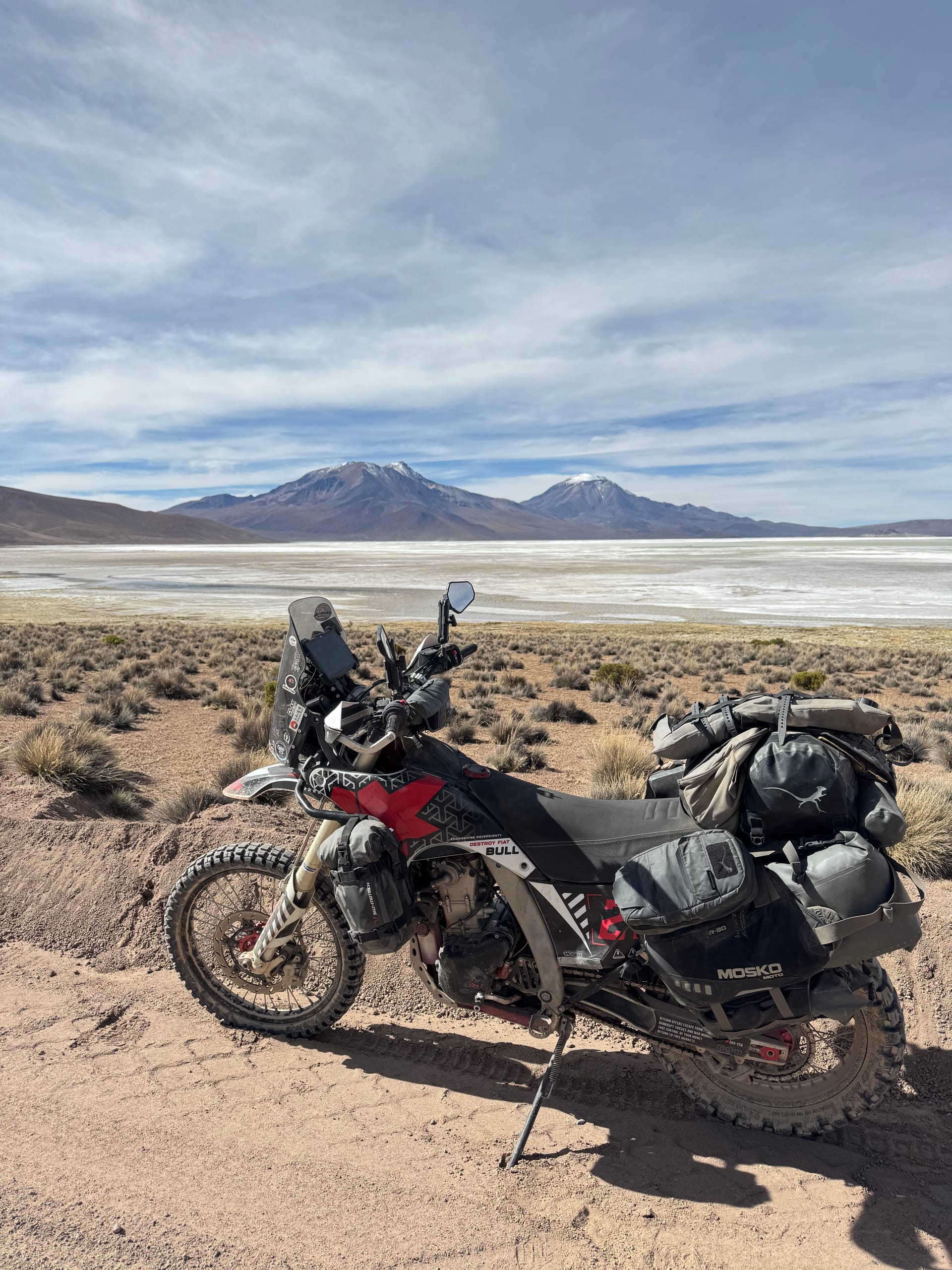
In Putre, we immediately feel we're not in Bolivia anymore. The town is charming, and so are the prices: €46 a night for the hotel. But the bed is ultra comfortable and the shower works. After our noisy getaway from Bolivia, we're not unhappy to get a bit of comfort back, and the restaurant at 6,000 pesos per person makes up for it a little.
The next day, off we go for 130 km of tarmac downhill to Arica. Mountain bends, then the desert, and the heat coming back: up to 30 °C. Arica isn't great, and neither is the beach, but it feels good to see the sea again after a month and a half at altitude. We celebrate our eighth wedding anniversary there with a little beer, pasta and a TV series binge until 1:30 a.m. Total meltdown. The next day, we have nothing planned and no intention of inventing anything. We treat ourselves to a Korean restaurant at lunch because we're a bit fed up with chicken and potatoes, and that'll be our only extravagance of the day. Wandering around town, though, the contrast with Bolivia is striking: roads, shops, infrastructure... it feels like being back in a modern society.
On June 4th, we head for the Peruvian border, 8 km away. It's an integrated border, meaning the Chilean and Peruvian posts are in the same place, and it's packed. A man helps us out with the tracking papers, then we go through six different offices. More than an hour and a half later, we're in! We get a 90-day visa, phew, we were planning on at least two months. The bananas forgotten in the panniers, on the other hand, end up in the bin.
Southern Peru, off the beaten track
First stop in Tacna to withdraw cash, and we regret not doing it at the border: finding a bank in this big city is a pain. We eat at a potato-and-pork restaurant. The food is very salty, Adeline isn't a fan, Thomas likes it. Then we climb back into the mountains to Tarata. In the evening we decide to go out for a snack and end up ordering a pizza since it's dinner time... Not at all: we discover it's not 7:30 p.m. but 6:30. When we crossed the border, we changed time zones without noticing. That's why all the restaurants were closed! What a pair of idiots.
We stay an extra day to enjoy the Putina hot springs, near Ticaco. Thomas has caught Adeline's cold, he's feeling rough but agrees to go anyway. The pools are a bit disappointing, not as good as the ones on the Lagoon Route, but for 10 soles we enjoy the hot water. We meet a Peruvian family there and talk politics: the upcoming presidential elections look complicated, and we hope they won't paralyse the country. On the way back, we discover picarones, honey-drizzled fritters, for an afternoon snack. Delicious!
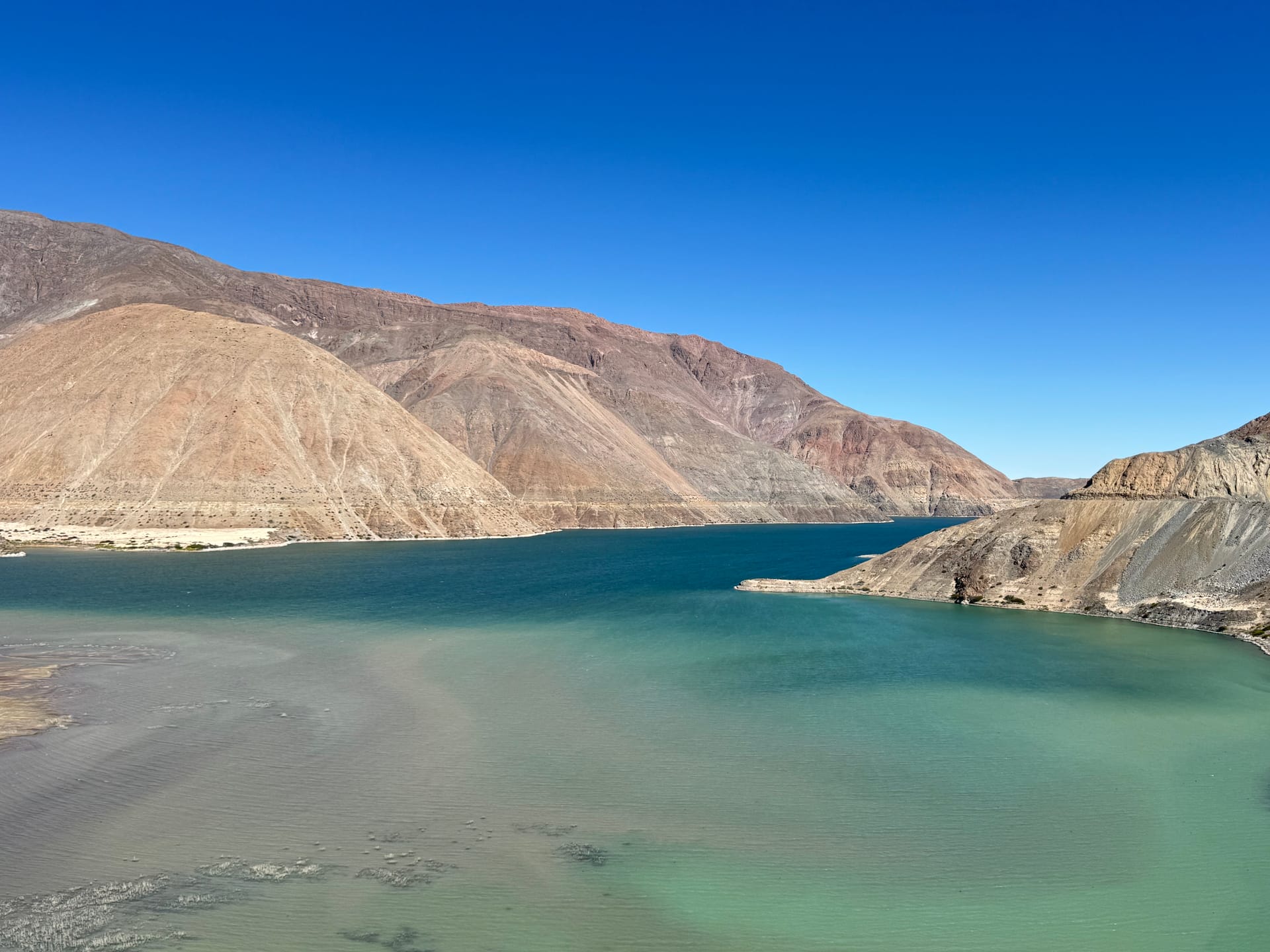
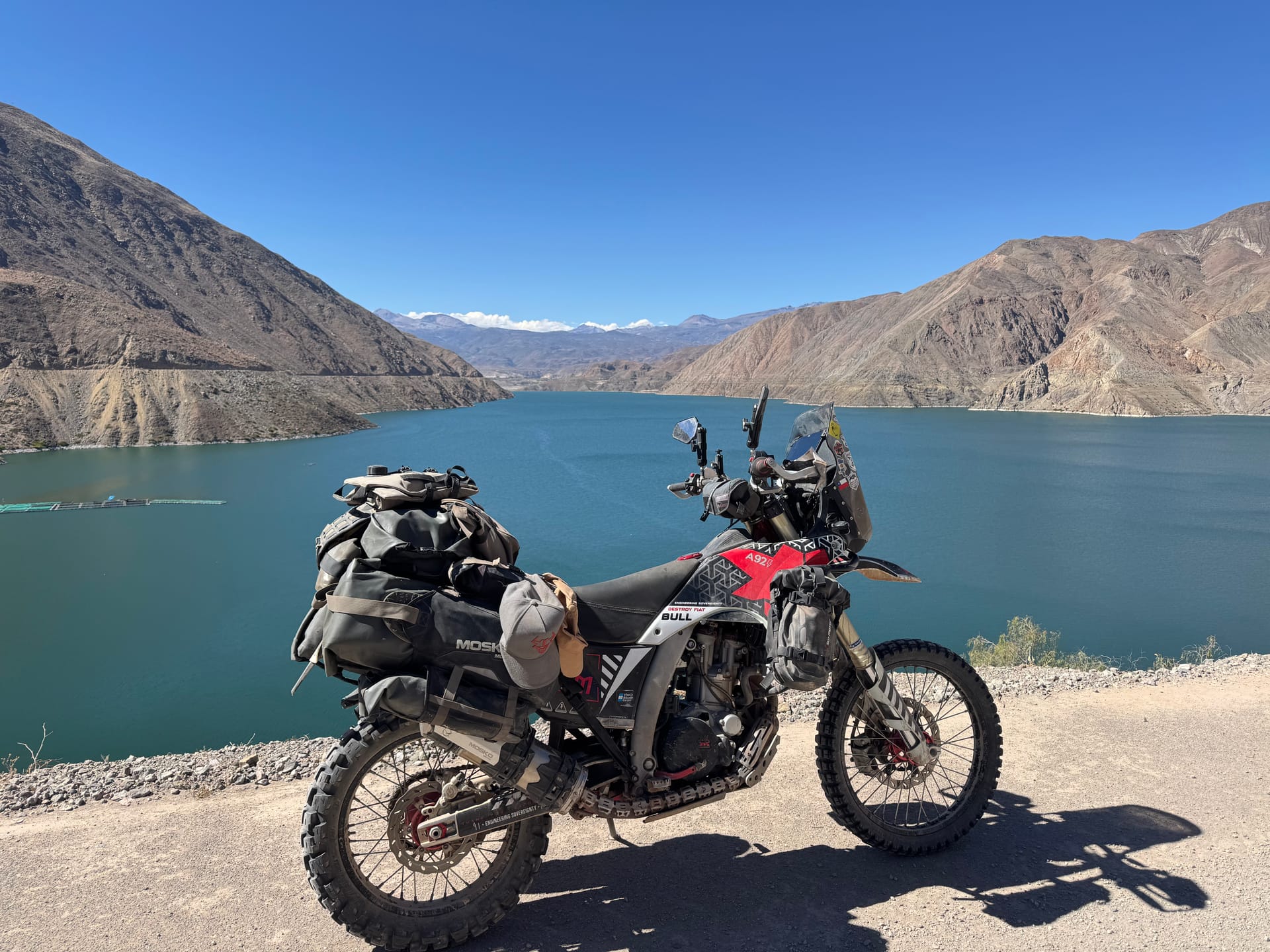
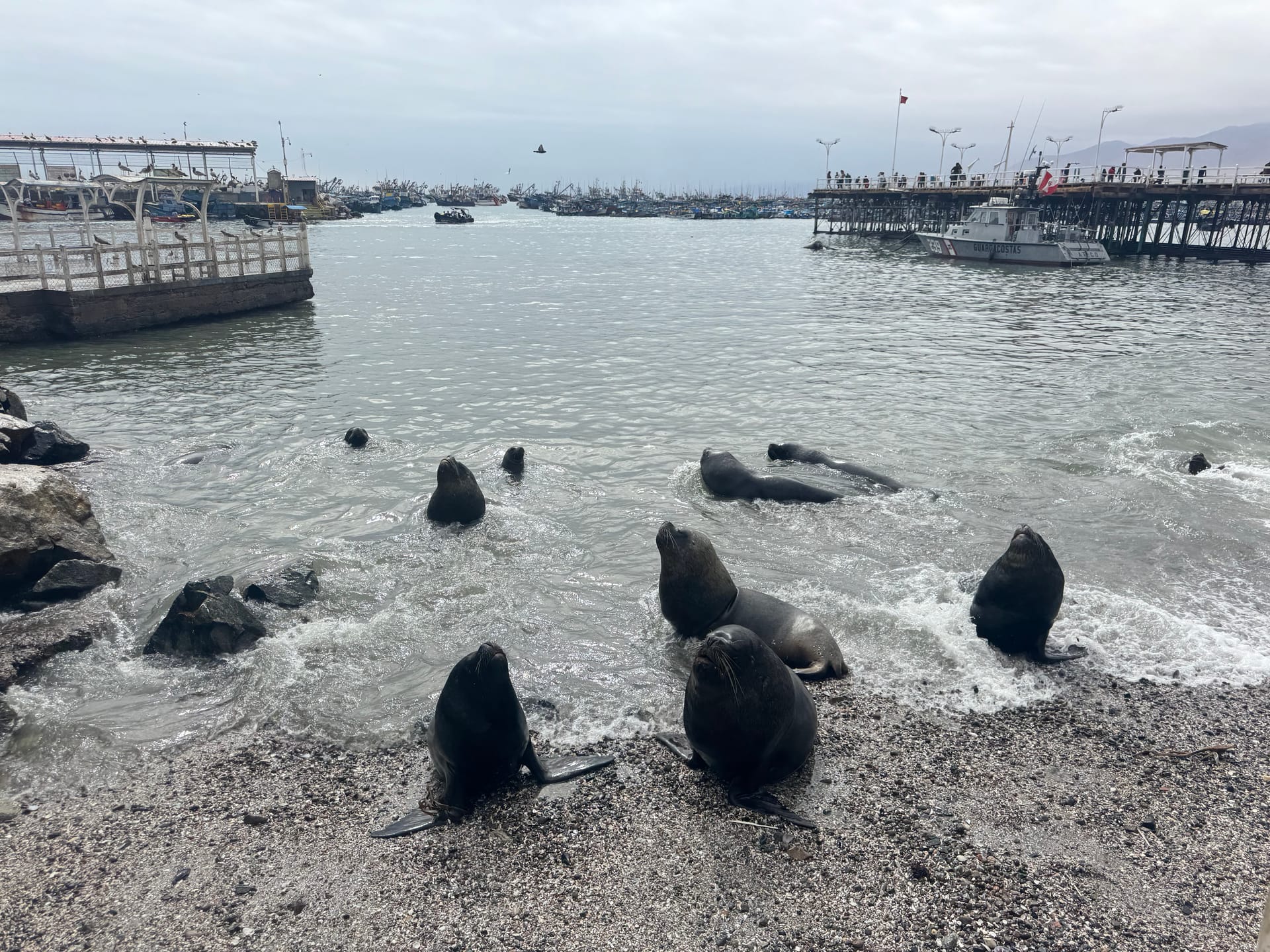
After this mountain escape, we head for Ilo, on the coast, via route 103 and then the gravel 104. We ride along a turquoise lake and think Peru really is beautiful. In Mirave, Thomas tries Inca Kola with tripe: 24 soles, a huge plate, impossible to finish. As for Inca Kola, it's strange but drinkable! In Ilo, we spend a day off at the fishing port, among sea lions and pelicans. A Peruvian man puts on a little show with the sea lions, but one downside: at the end of his act, he throws his plastic bag into the water, just like that. That annoys us.
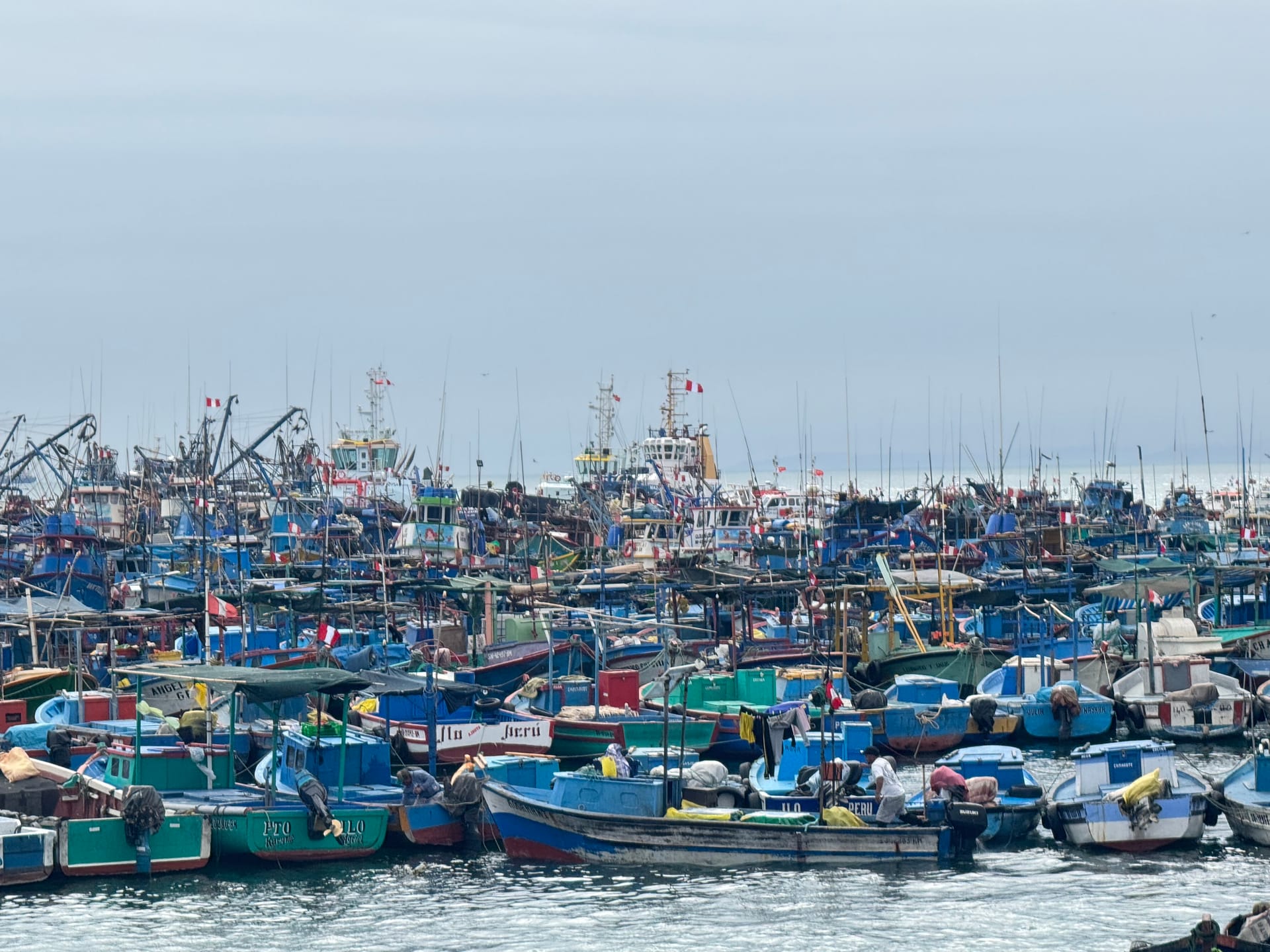
Then we head back up towards Arequipa the scenic way: Moquegua, then Omate. Desert in the morning, mountains in the afternoon, a bit of sandy gravel at the end. We're nowhere near the tourist zone, and yet it's a treat. In Omate, we land right on the hotel. In the garage, two CRF 300s with Canadian plates. Michel and Angelina, retirees, left Canada three years ago. They knock on our door to invite us to dinner. We spend the evening at the pizzeria talking bikes, travel and Peru tips.
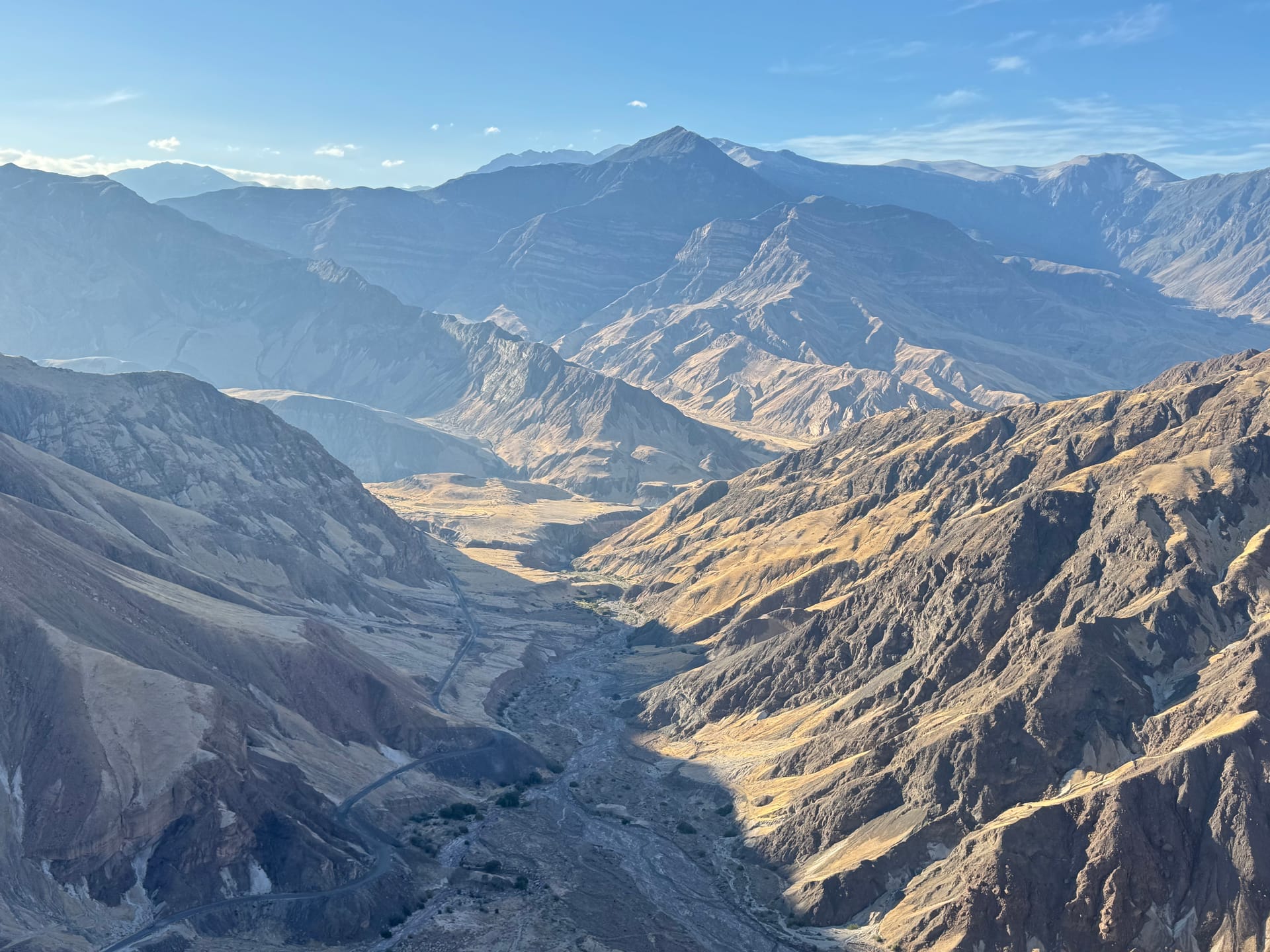
The next day, a last stretch of gravel with crazy landscapes, then tarmac from Puquina. In three hours, we're at the gates of Arequipa. And then it takes us an hour to cover 15 km. Traffic jams everywhere, Thomas starts losing his temper. At 3 p.m., we drop the bikes at the garage where they'll sleep for two weeks. We're not entirely at ease leaving them, but they're safe.
Arequipa with the parents
On June 10th, Adeline is fidgeting all day. We keep busy as best we can: video editing, blog posts, a haircut for Thomas (sorted for two months). At lunch, we discover the San Camilo market, 20 soles for two set menus, perfect. Eating at the market is the best way to get good food at an affordable price. Plus, the atmosphere is always nice. At 7:30 p.m., Adeline heads to the airport to pick up Patrice and Patricia. The reunion is emotional, we're so happy to hug each other. We don't stay out late though, they're tired from the trip and the jet lag. We agree to meet the next morning at breakfast.
It's funny to see familiar faces when we wake up, and at the same time it feels very natural to have them here. We've booked a free walking tour in English in the morning (we translate) to discover the city, complete with its "commercial breaks" for this bar or that restaurant. We learn that Arequipa means "place of passage" in Quechua and that the surrounding volcanoes form a family: the mother, the father and the children. The llamas in the reserve leave us cold. After eight months of seeing them roam free, we're a bit jaded. At the San Camilo market, the parents discover Peruvian-style meat storage. We're mostly pleasantly surprised there are no flies. In the evening, we watch the sunset from a viewpoint as it turns the volcanoes red. Brief, but very beautiful.
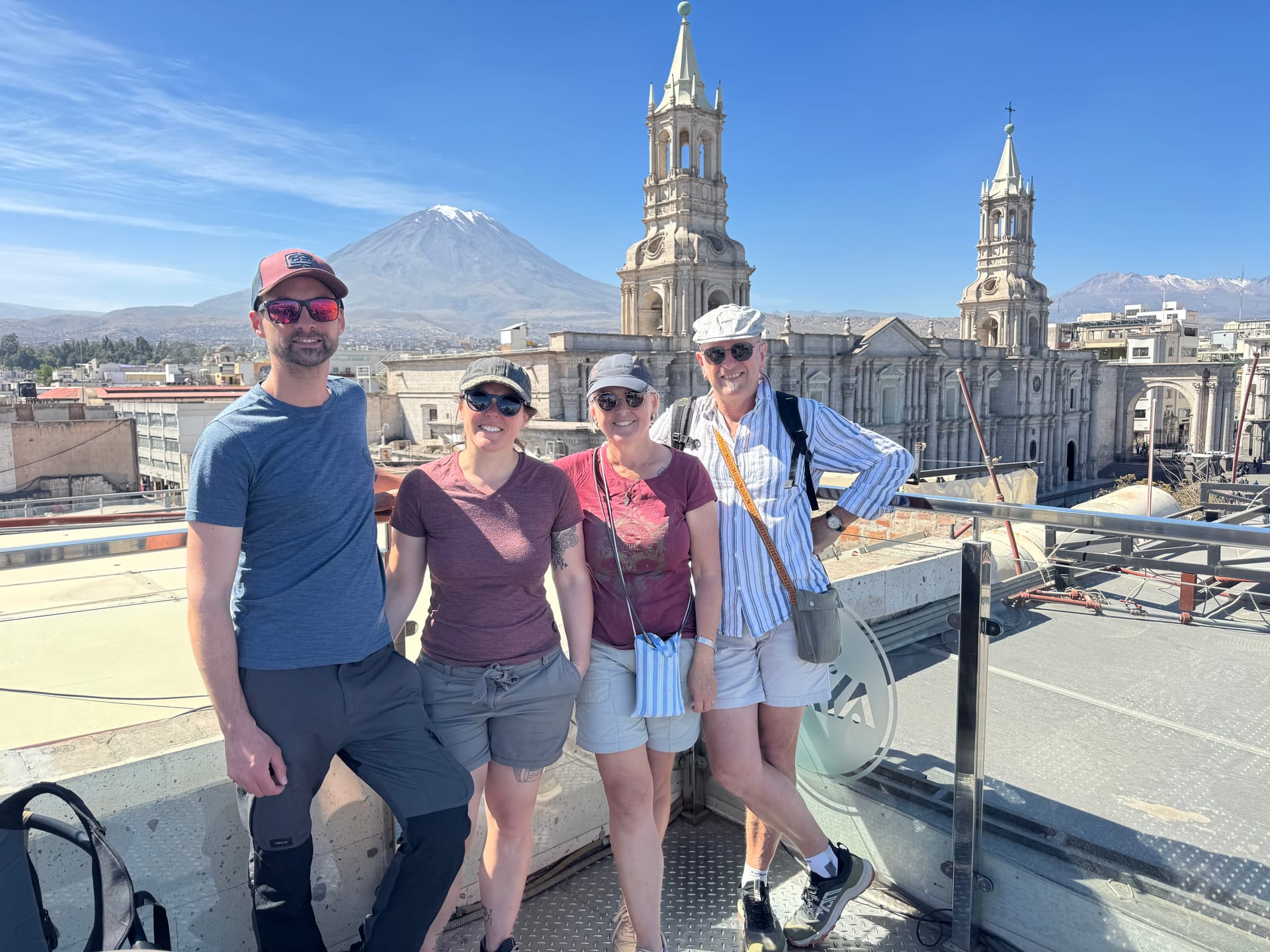
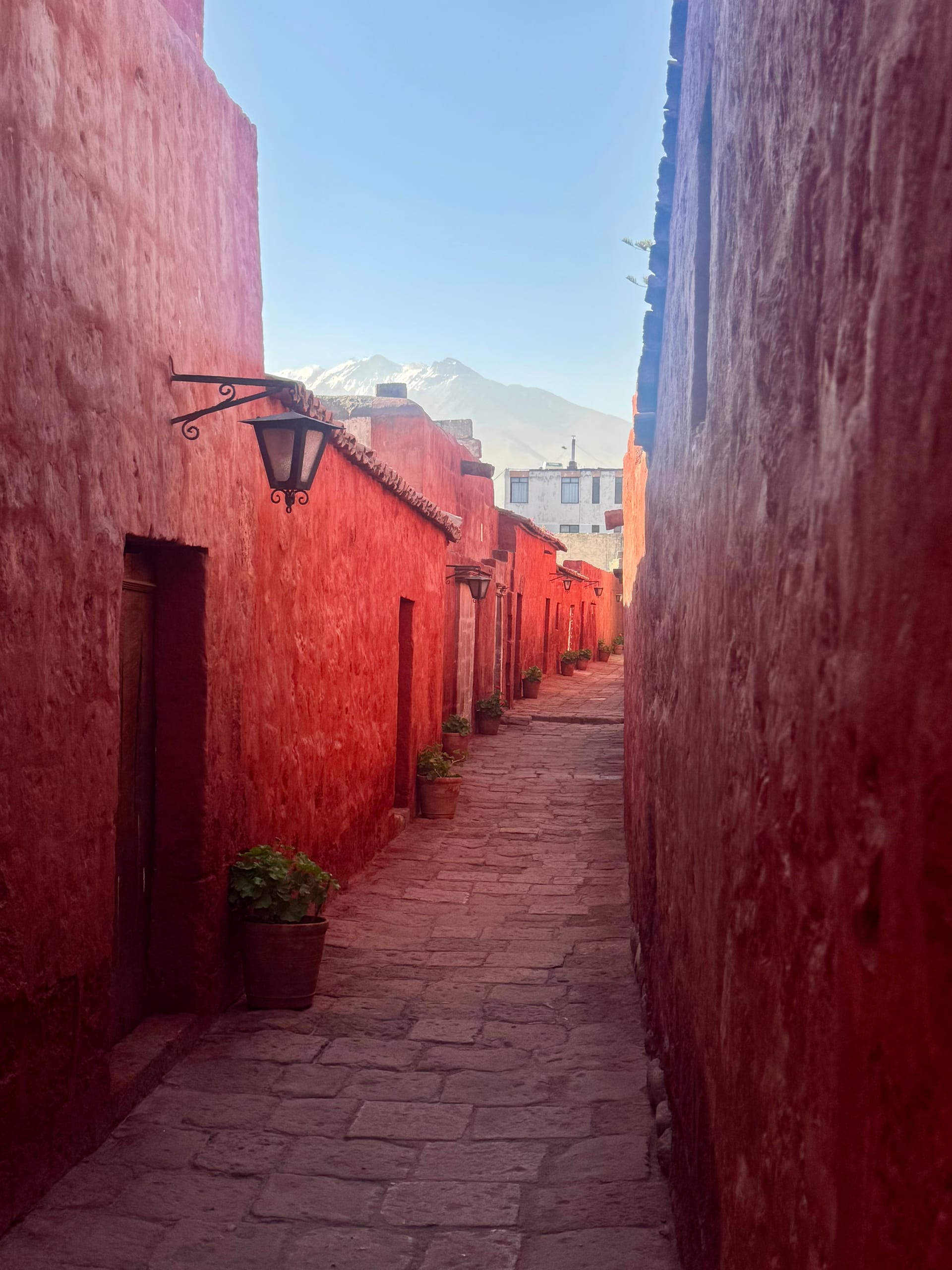
The next day we carry on with our sightseeing and food tour. We treat ourselves to a good meal at the picantería El Mundial, one of the best in town. That said, 100 soles for two is our record in Peru, luckily the portions are huge. In the afternoon we visit the Santa Catalina monastery, 50 soles entry. The budget explodes today, but it's huge, the walls are ochre and blue, you'd almost think you were in Morocco. We spend more than two hours there, well worth it.
Amantani island, at Nestor's
After two days in Arequipa, we hit the road again to discover Lake Titicaca.
The goal: two nights on Amantani island, with Nestor's family. Getting there is an adventure in itself. In theory the bus arrives in Puno at 1 p.m. and there are no afternoon boats to the islands. There's another option through the port of Chifrón, as long as you manage to catch the last boat at 3 p.m. We discover the options as we go, thanks to Nestor's directions, and decide to try the second one to avoid a night in Puno. The taxi picks us up at our hotel at 6:30 a.m., then the bus ride is endless. It takes us more than two hours just to get out of Arequipa. We reach Juliaca at 1:15 p.m. We still need to take a taxi and then a bus to Capachica, where we can (finally) catch the boat. In the end, a taxi offers to take us straight to the port for 100 soles. Given the time, we accept, and we catch the 3 p.m. boat. Close call. Traveling by bus means different reference points, but with a few months of travel under our belts, we manage to guide the parents through the maze.
On arrival, surprise: Nestor's house is on the other side of the island, and we have to get there... by motorcycle. So there we are, each climbing on behind a driver with our luggage. The paths are narrow, cobbled and full of holes: thrills guaranteed. Thomas thinks he's going down several times. At 15 soles per person, it's almost more expensive than an almuerzo. We promise ourselves we'll walk back. Once, not twice.
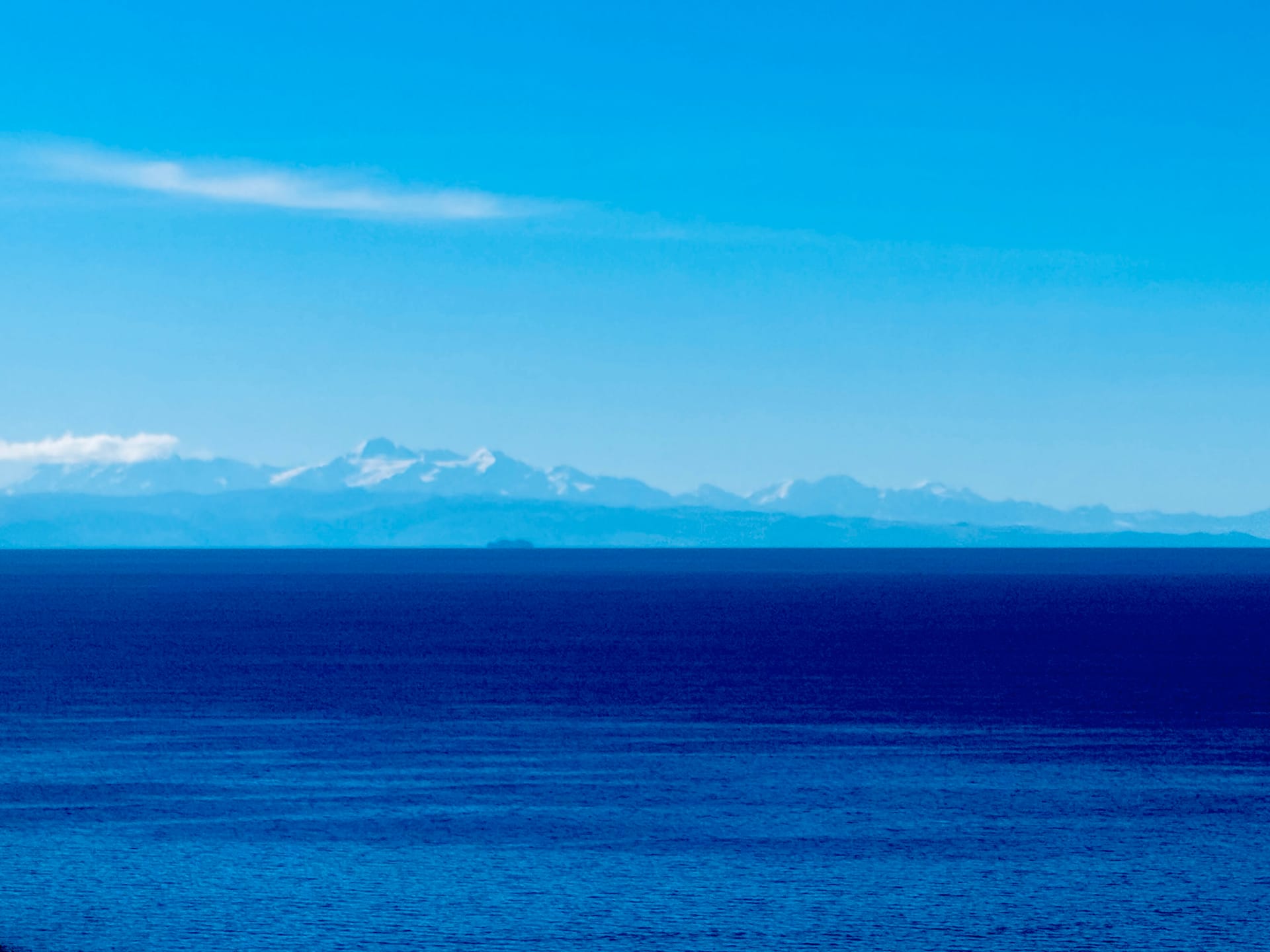
In the late afternoon, we spend some time with Nestor and his family, then in the evening they head back up the hill, where their plot of land is, to water potatoes so they freeze overnight. The next day, we help them peel them, and we admit we don't understand much: why freeze them, why walk on them? It's actually chuño, a preservation technique that's centuries old. The potatoes freeze at night at almost 4,000 m, thaw in the sun, then they're trampled to squeeze out the water and loosen the skin. Repeated for days, it gives a dehydrated potato that keeps for years. Freeze-drying before its time. We wonder whether they'd be better off pooling some machinery. They do everything by hand, on terraces where no tractor would ever fit, and with know-how we only appreciate afterwards.
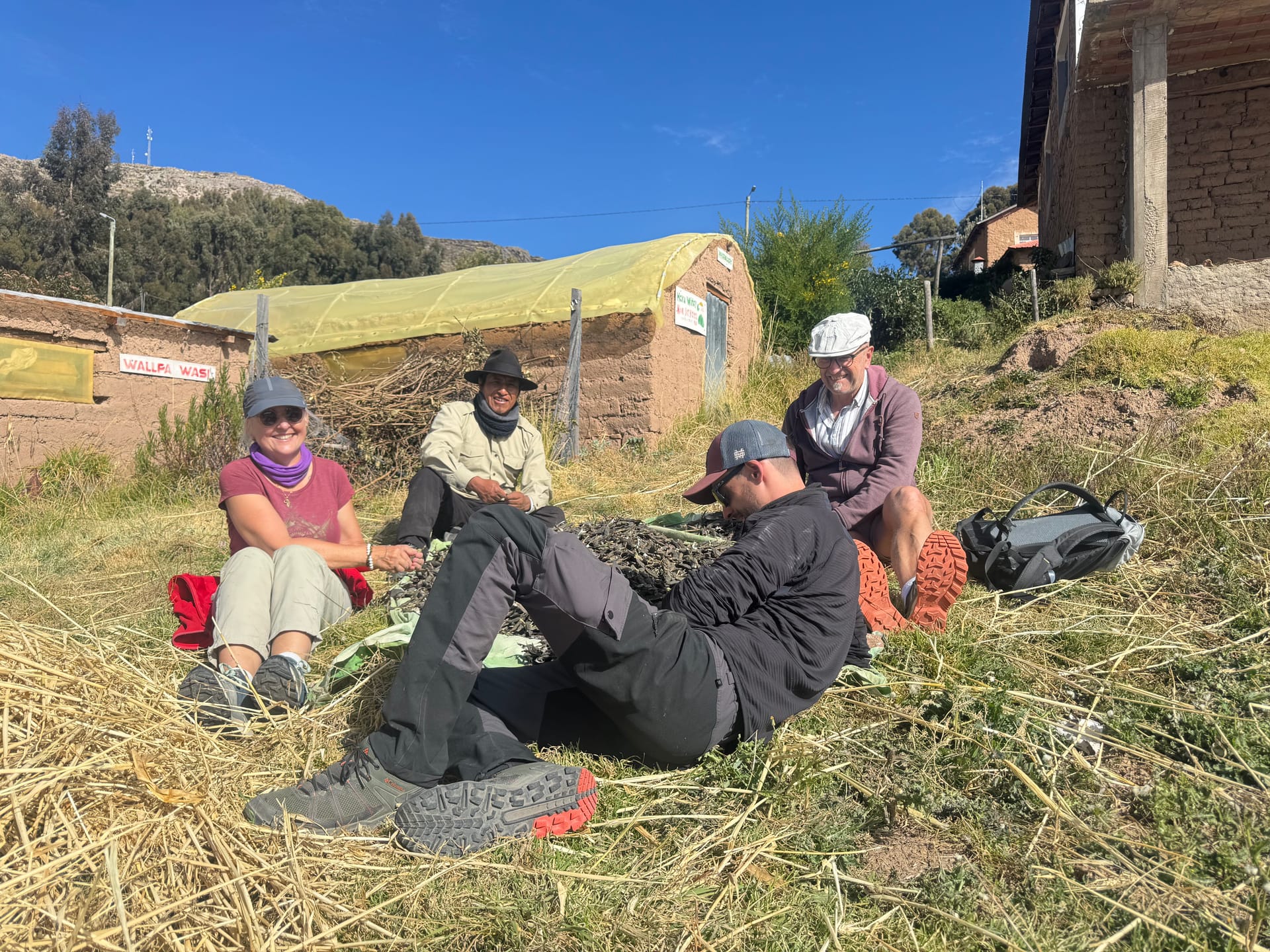
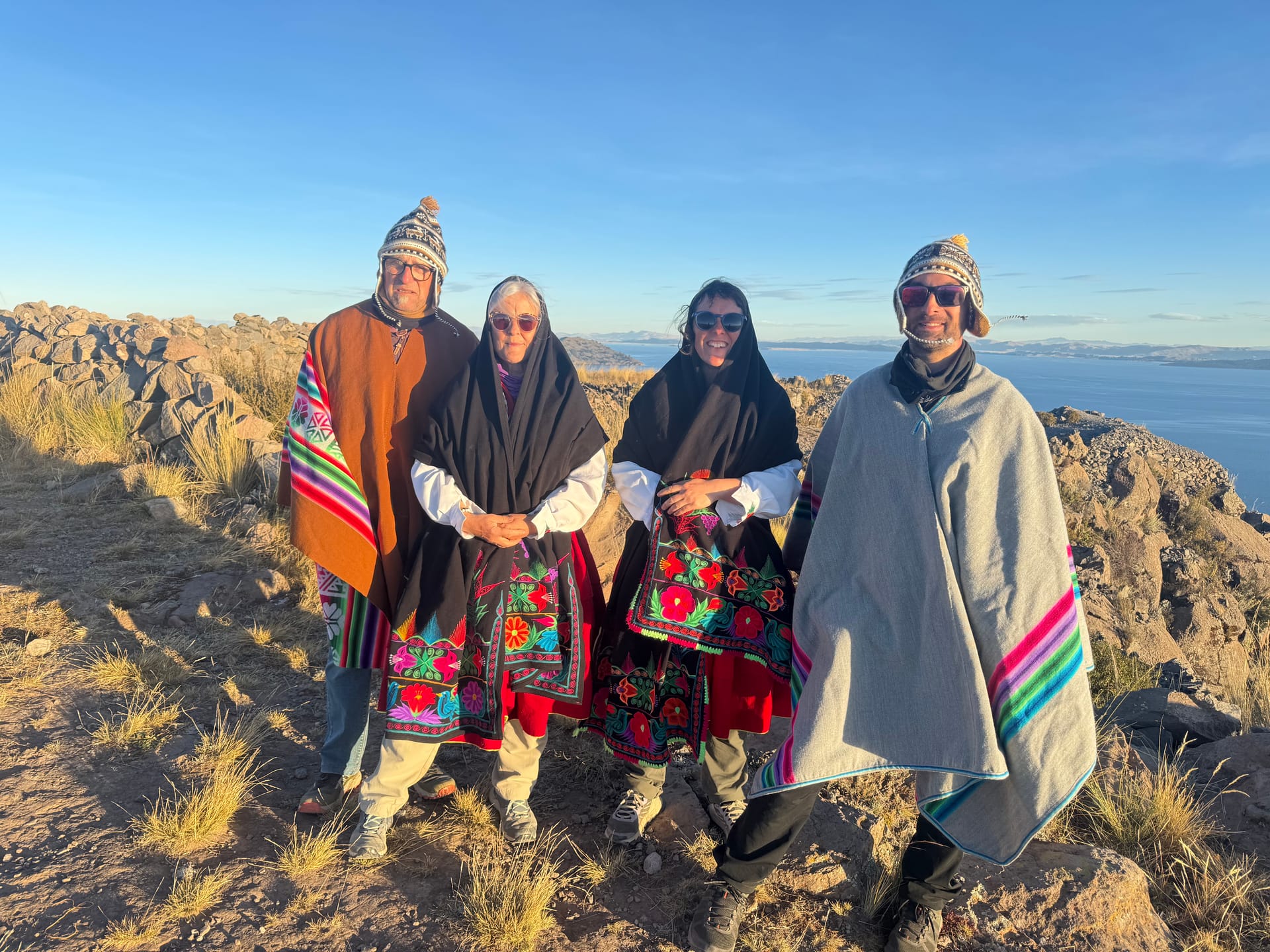
We also meet the cuyes, the guinea pigs that are a festive dish here, and we shell broad beans. We climb up to Pachamama and Pachatata, Mother Earth and Father Earth, two sanctuaries at the top of the island, with a view over the whole lake. At lunch, we eat with the whole family. Simple moments, no fuss. Later, we pass tourists in traditional clothes and we make fun of them a bit: dressing up is everything we dislike about tourism. Except that at 4 p.m., Nestor insists we put on the festive clothes for the sunset at the sanctuary. We don't want to offend him. So much for mocking this morning... And given the cold, we're actually not unhappy to wear them. In the evening during dinner, Nestor plays a tune on the flute. We try to blow a few notes but we lack technique!
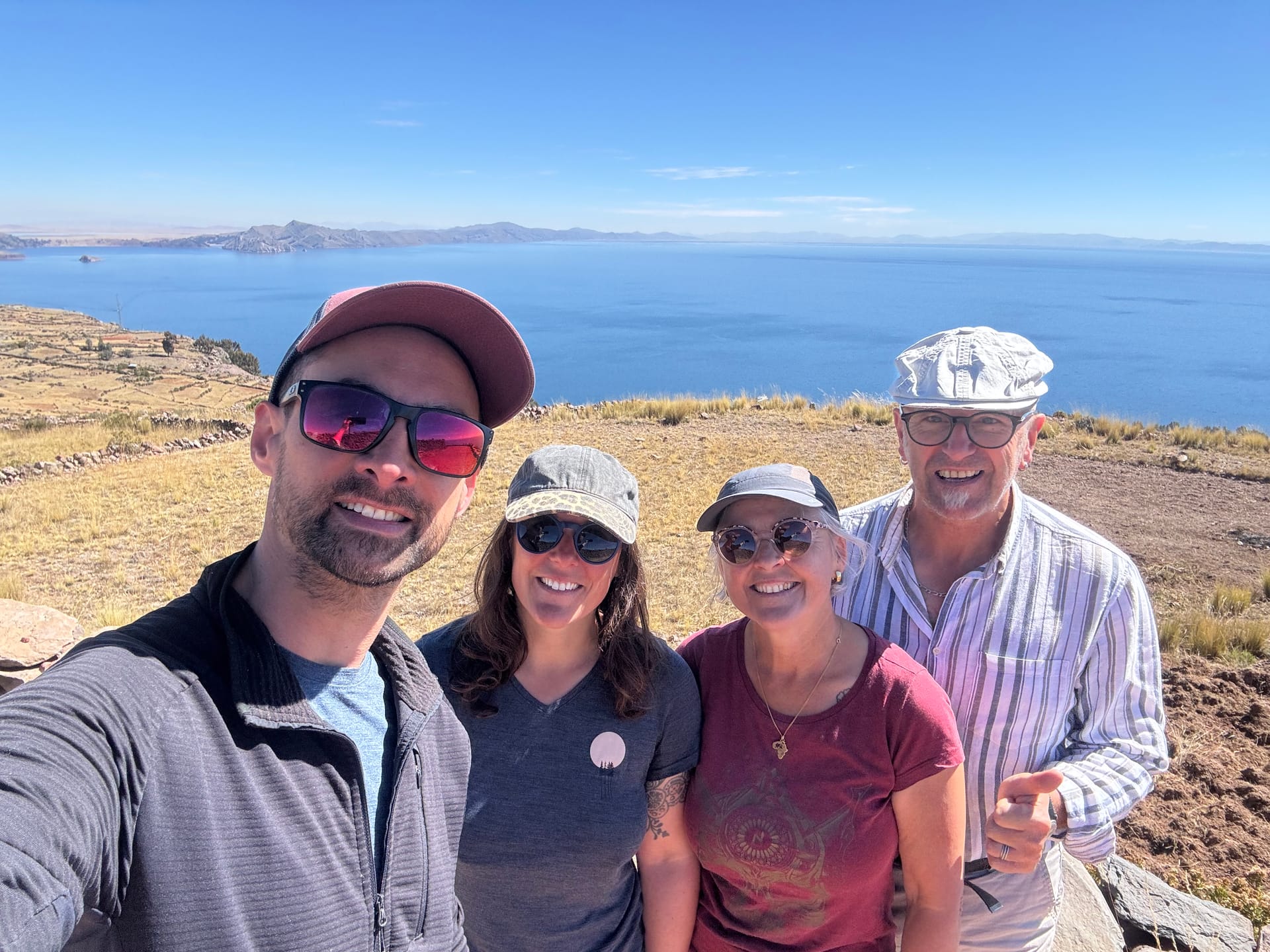
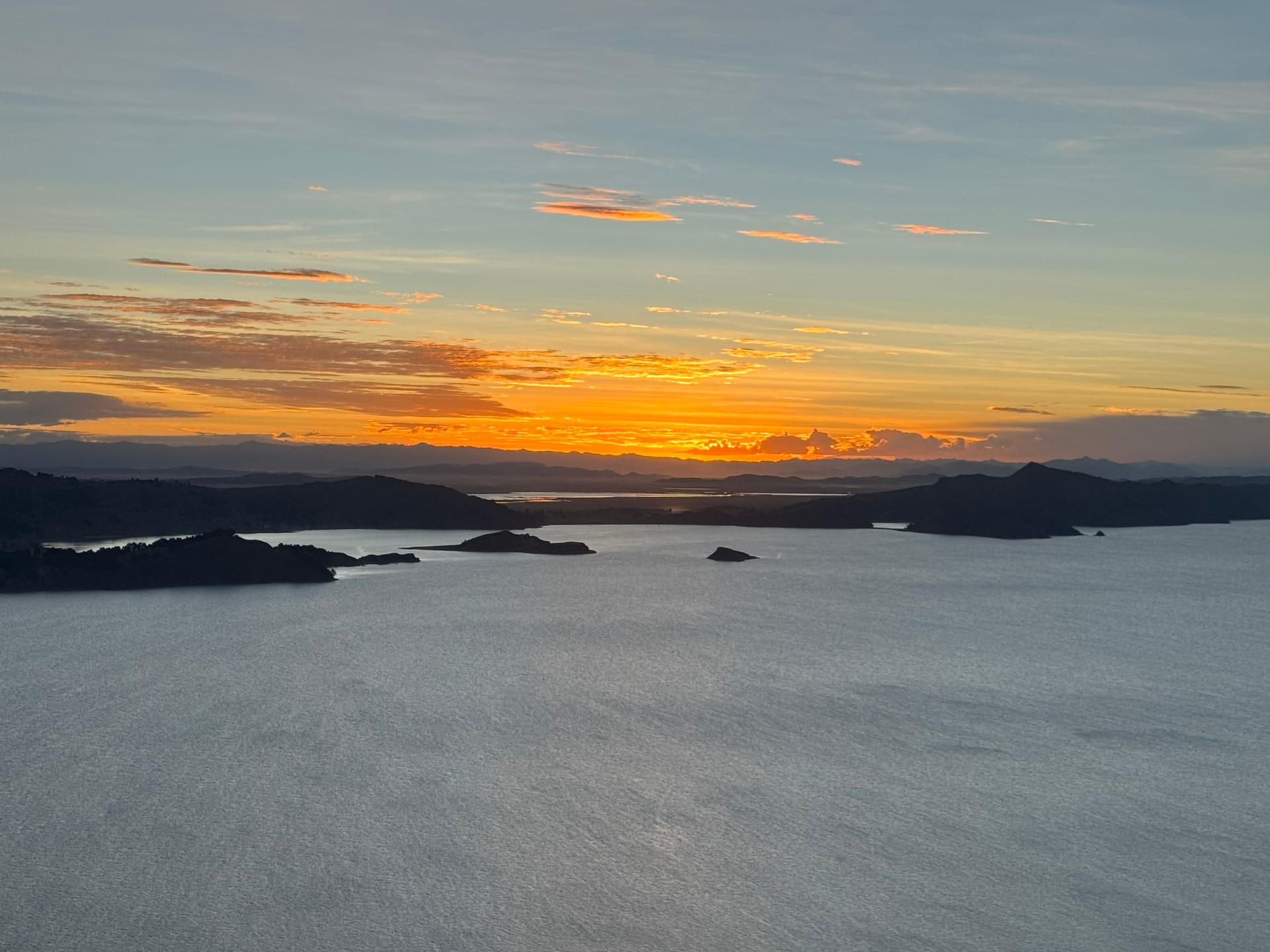
On the last morning, we fetch the sheep with Nestor and Sylvia, then make quinoa flour. It's their daily life, and we're delighted to have had a taste of it. Around noon we walk back to the port, as promised.
By bus to Cusco: Juliaca, Sicuani, Raqchi and Layo
On the way back, the local bus to Juliaca costs 5 soles per person. We realize the taxi we took on the way there was really expensive, but at least we caught our boat! We reach the bus terminal and decide to go as far as Sicuani. We have four hours to kill before the 7 p.m. bus, so we take a walk around town. We quickly realize we're the attraction of the day: some kids think we're American and, learning we're French, start talking about Mbappé. Back at the terminal, we're treated to a concert, the touts yelling "Cusco! Arequipa, Arequipa, Arequipa!". Tired of the noise and the waiting, we start discreetly imitating them, laughing. Finally it's time to board. We watch Peruvians climb aboard with huge bags they refuse to put in the hold. Needless to say, the driver is surprised to see us with our little backpacks. The ride to Sicuani is epic: a police check in the middle of the night looking for contraband, bend after bend, a swaying bus, and then a bag falls on Patrice's head... We really are putting the parents through everything. Luckily we reach Sicuani around midnight safe and sound. On arrival, we're happy to find a comfortable hotel.
The next day, we take a minibus to the Inca site of Raqchi, dedicated to Wiracocha, for 3 soles. Just when you think there's no more room in the vehicle, there's always more. Taking the bus really is an experience in itself! We arrive at the archaeological site at the same time as two groups, but they leave quickly and we soon find ourselves alone admiring the temple's stonework. It's fascinating: the Incas had real talent and a very particular technique for building. We stay and admire it for a while. Thomas, sick again, takes the opportunity for a nap.
After two nights in Sicuani, we take another minibus towards Layo. Backpacking means a different organization for us, different reflexes, but it lets us discover the country differently.
We decide to go to Layo to see the seven-color mountain of Pallay Punchu. The minibus costs 7 soles per person. In theory, it should take 1h30 to get there, but that's without counting an hour's wait in Langui, where the road is closed for roadworks. It only reopens at 12. At noon sharp, everyone charges onto the construction site at once. Chaos, of course, but we eventually get there. The place we've booked is rustic. We booked a room with "two double beds", which turn out to be pretty small. We'll be keeping each other warm tonight! As soon as we arrive, we decide to have lunch before going to see the mountain. That's when Adeline realizes she left her cap in the van. She's furious. And then, walking back up to the square, she spots a van in the distance... with the driver wearing her cap, two minutes from leaving. Unbelievable. As for the mountain, it's a failure: Google said 5 km, but after two hours of walking, some Germans we meet on the way tell us there are still 9 km to go. It's 4 p.m., so we turn back. We probably should have accepted the owner's offer to drive us there.
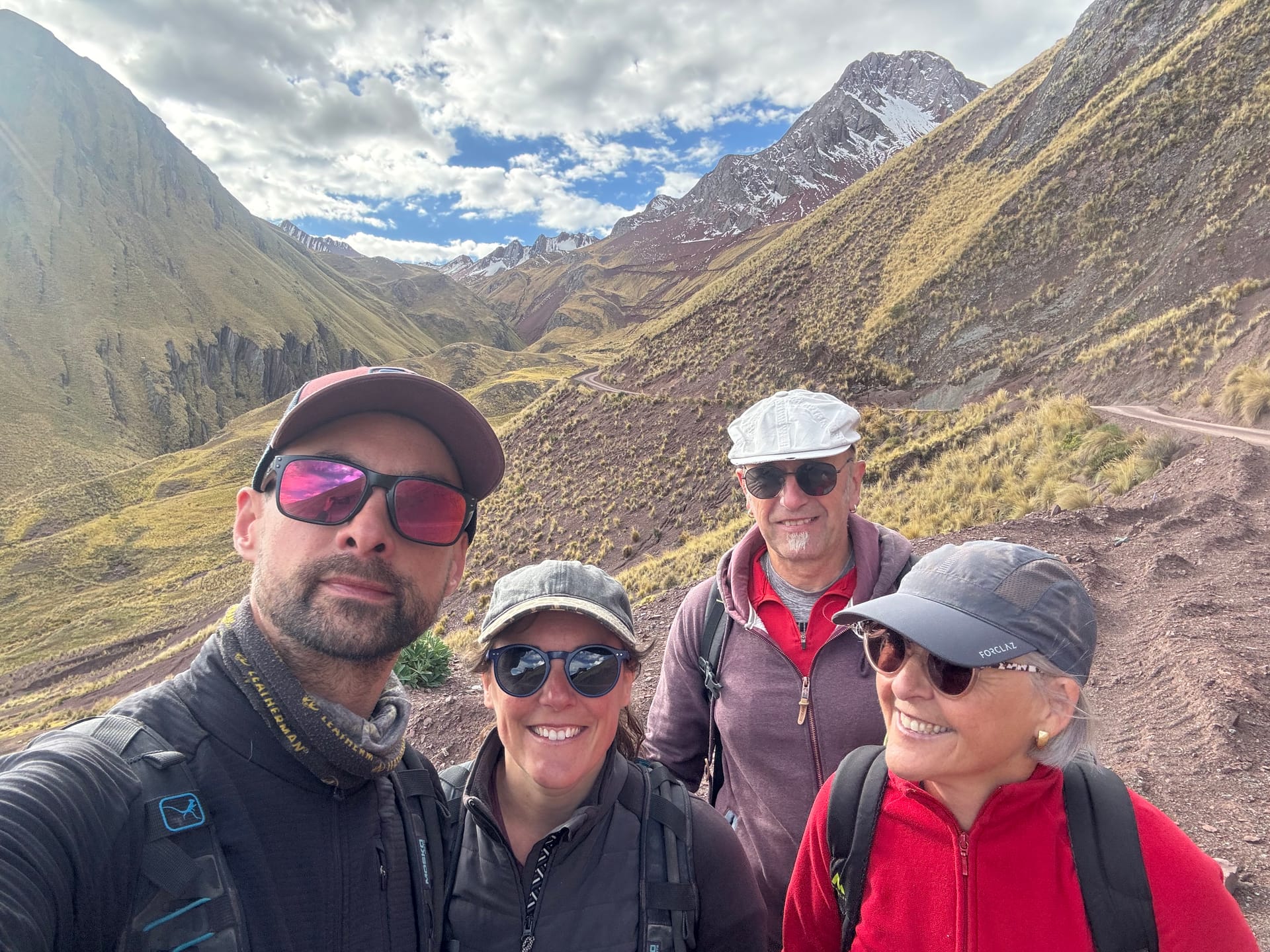
As expected, the night is quite something. In the morning, we don't linger in bed and head to the main square for breakfast. Once there, we get photographed without our knowledge. We feel a bit like circus animals, and we think that's probably what Peruvians in traditional clothes experience, photographed all day long. Around 10 a.m. we take a bus to Sicuani, and a second one with dead shock absorbers to Cusco. The landscapes are incredible, but the parents gasp and don't feel safe on the gravel. As for us, we're almost disappointed not to be on the bikes.
Cusco in full festival mode
We reach Cusco at the end of the day. First contact with Cusco during the June festivals: the city is very touristy, much more than Arequipa, and you can tell: 9-sol cappuccinos, street vendors everywhere, but we have to admit the Plaza de Armas is superb with its wooden balconies and its incredible cathedral. The next morning, the parents use this stop in Cusco to book a tour operator for the rest of their trip in Peru. They book two weeks with Escapate Slow Tourism to visit the coast and do a trek after we leave. They're happy with the program, and we're reassured to know they'll be well looked after. With that sorted, we head to the San Pedro market and eat side by side at the counter, which makes the parents smile. In the afternoon we wander around the city and discover the San Blas neighborhood. Cusco is definitely a beautiful city.
In the evening, we want to reach an Italian restaurant Patricia spotted because they serve spritz. To get there, we decide to cut through the Plaza de Armas, but in the middle of the Cusco festivities, that's a big mistake. We end up stuck in a dense crowd, unable to move. People sitting on the ground refuse to budge to let anyone through and the police are overwhelmed. We get scared. An opening finally appears and we get out, but not without a few frights. Two spritzes for our trouble! The meal is great... until Patrice discovers his wallet has been stolen. Inside, only 20 soles, but above all the keys to the apartment. Adeline's phone is almost dead, and she's the only one with the host's number. Luckily around 10 p.m. we get an answer, and he arranges to meet us at another restaurant with a spare set. No need to sleep on the sidewalk! But there we are at 11 p.m., crossing Cusco in full party mode, music and alcohol everywhere, a real village fête. We even stumble upon fireworks. Thomas laughs: "honestly, we're putting your parents through everything!".
The Sacred Valley by rental car
We rent a car for four days. Adeline takes the wheel in Cusco with one clear rule: only the co-driver gives directions. Boleto turístico in hand, we start with Tambomachay (just an Inca fountain, done in 30 minutes) and Puka Pukara, where in our opinion it's mostly the view that's worth it.
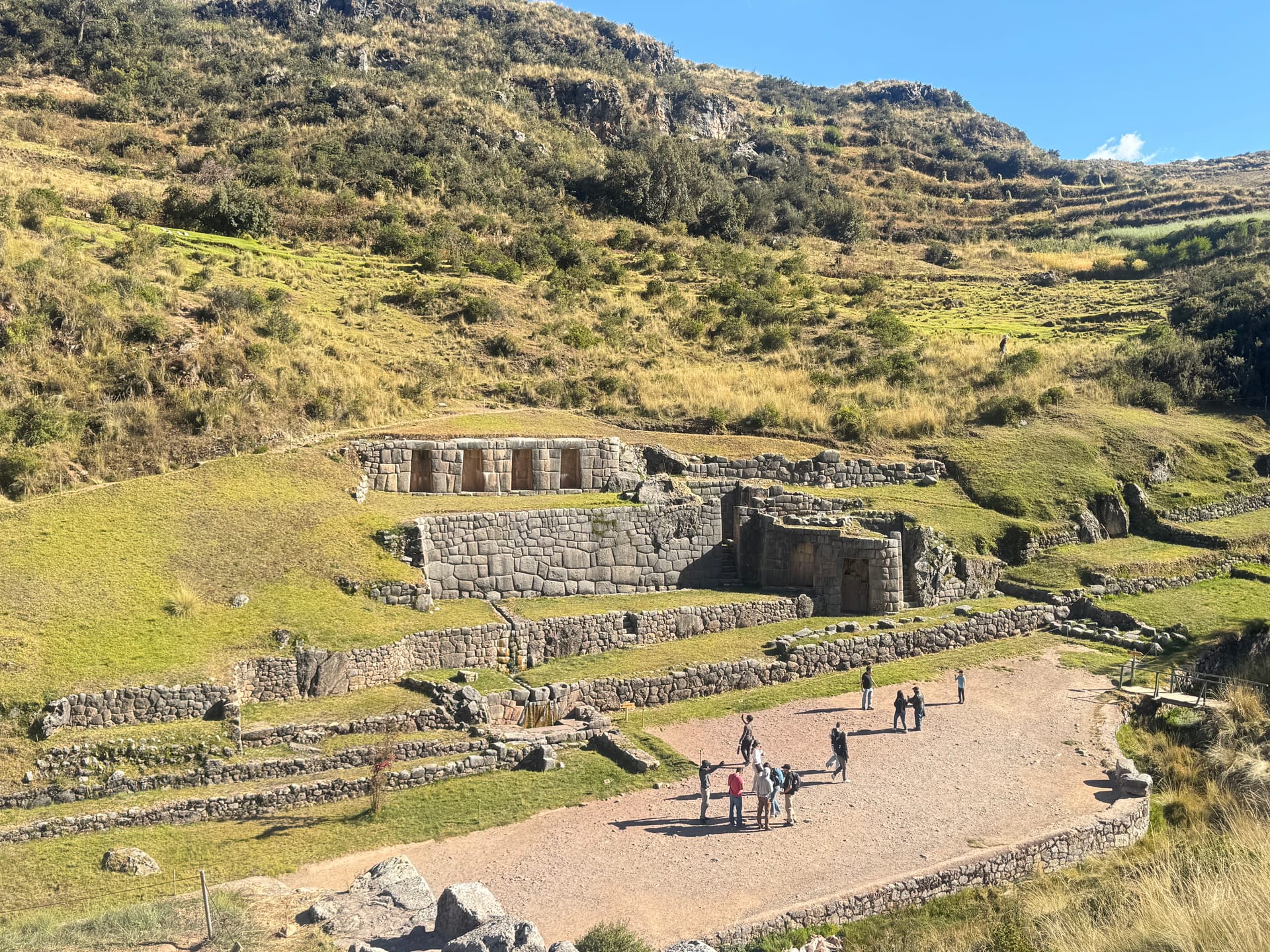
Then we head to Pisac, where we've booked a hostel for the night. The Booking reviews are very good and the photos look great. On arrival, the hostel with the beautiful garden turns out to be a hippie hangout. Check-in is done in pajamas and the vibe is very, very relaxed. We barely have time to drop our bags before heading into the village. We spot shaman posters everywhere, ceremonies on every corner, mostly offered by Europeans. Back at the hostel, the evening is bizarre, with a neighbor on mushrooms chatting Thomas's ear off all night. The parents laugh: "it's an experience". That said, we doubt they'll repeat it given the state of the sheets in their room.
The next day we visit the Pisac archaeological site, which is gigantic and magnificent. We arrive late morning and most groups are leaving, so we can enjoy the site in peace during our two-hour visit. The site is steep, it's quite a workout, but it's really a wonderful discovery that's well worth it.
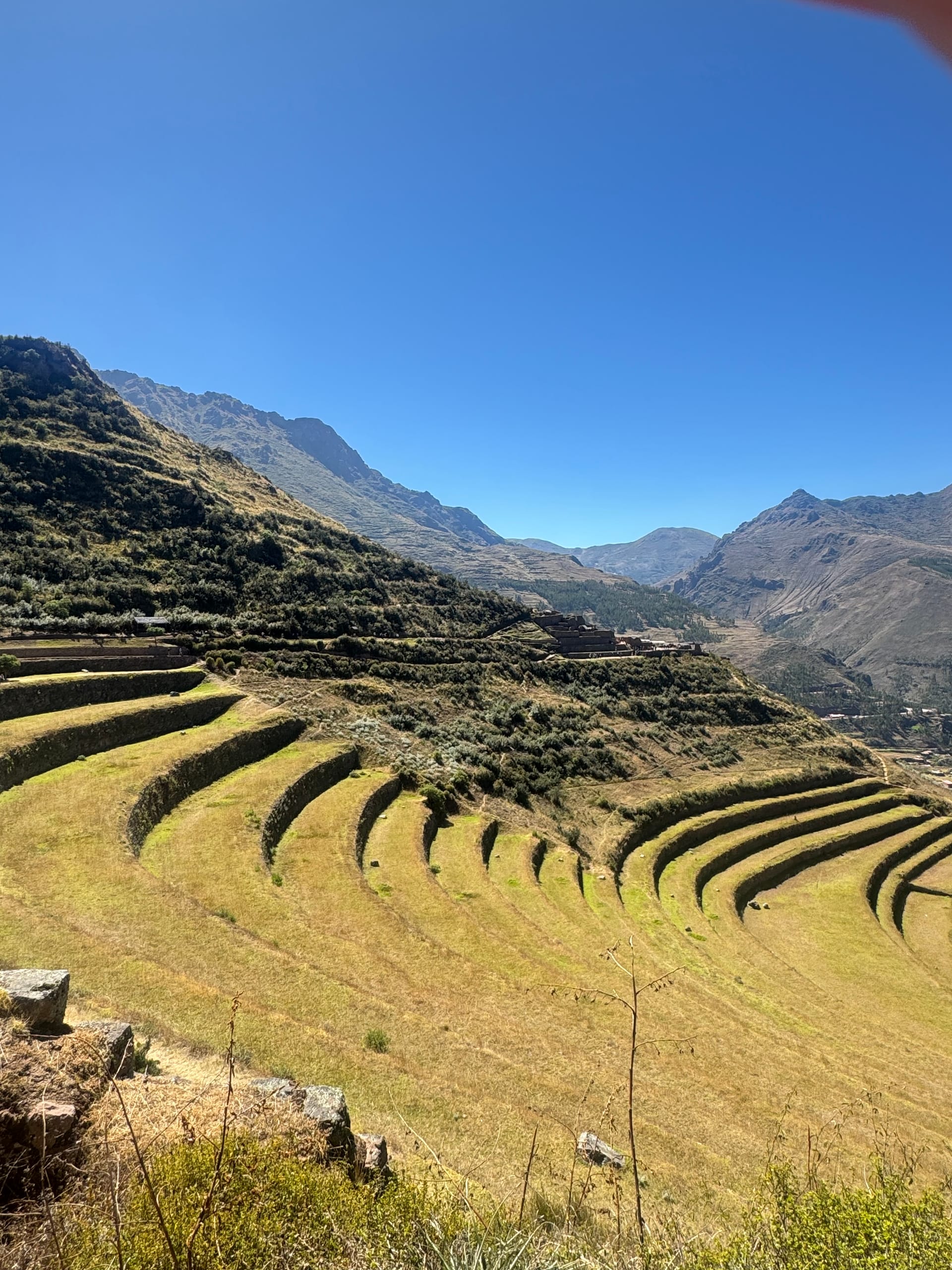
Then we head to Calca, where there's a village festival. Naturally, we decide to stop and eat at a stall: barbecued pork belly, sweet potato, onion, mint and tomato salad, and a chicha morada, the purple corn drink. A feast.
In the afternoon, we take a dirt track to the Lares hot springs. Patricia isn't relaxed at first, but it goes fine. Entry is 10 soles, well worth it. We spend more than two hours in scalding water facing the mountains, and come out all orange from the minerals. In the evening we get to rest in a comfortable hotel room. Small pleasures.
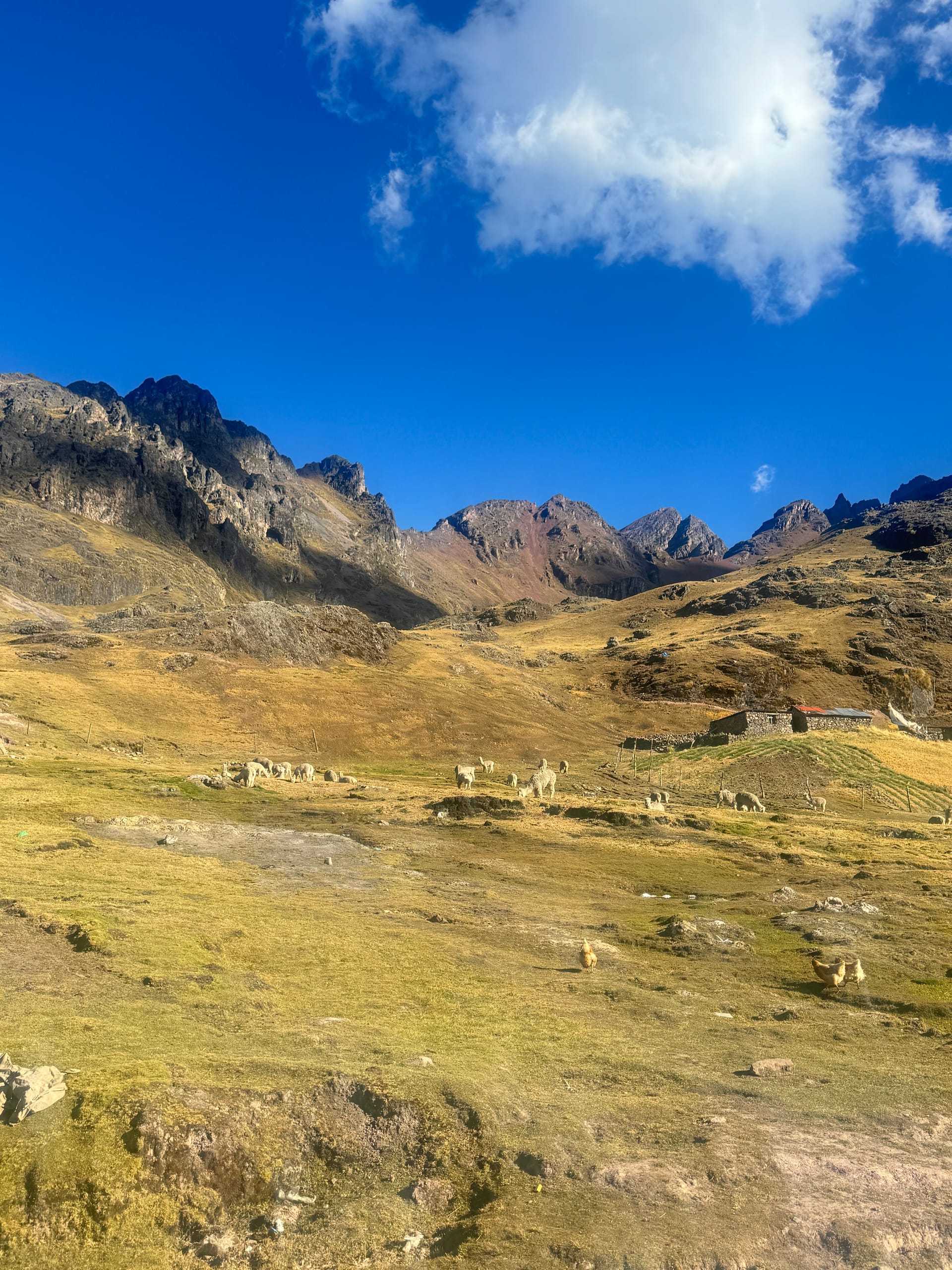
The next day, we head for Ollantaytambo, but we hadn't expected 60 km of dirt track. With an automatic rental car, we wonder if it'll make it. The hotel owner told us the car could handle the track, and it does, but on the first climb, given the amount of rocks, we have our doubts. In the end, the car does the job and we have a blast: the landscapes are insane. In the back of our minds, we can't help thinking we'd have loved to ride it! Once there, we discover that Ollantaytambo is a huge fortress, but packed with people. This time, there's no escaping the wave of tourists. That's the game, we have to deal with it. In the evening, though, we struggle to get out of town between the roadworks and the traffic, which leads to a bit of tension. Luckily, we end the day at "the Bull House", a hotel in Urubamba that lets us finish on a high note: the garden is magical, there's hot water, and the dinner is delicious.
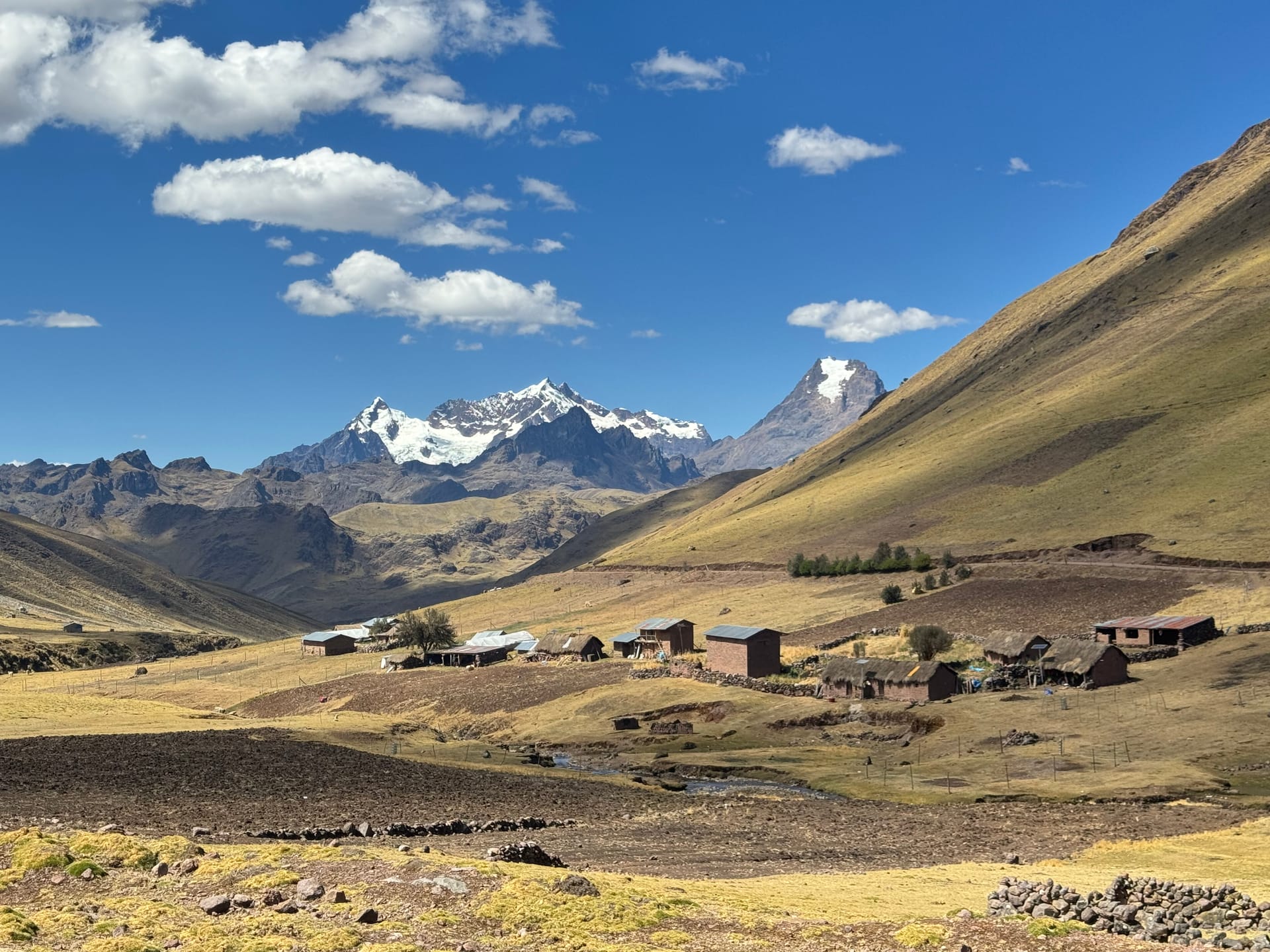
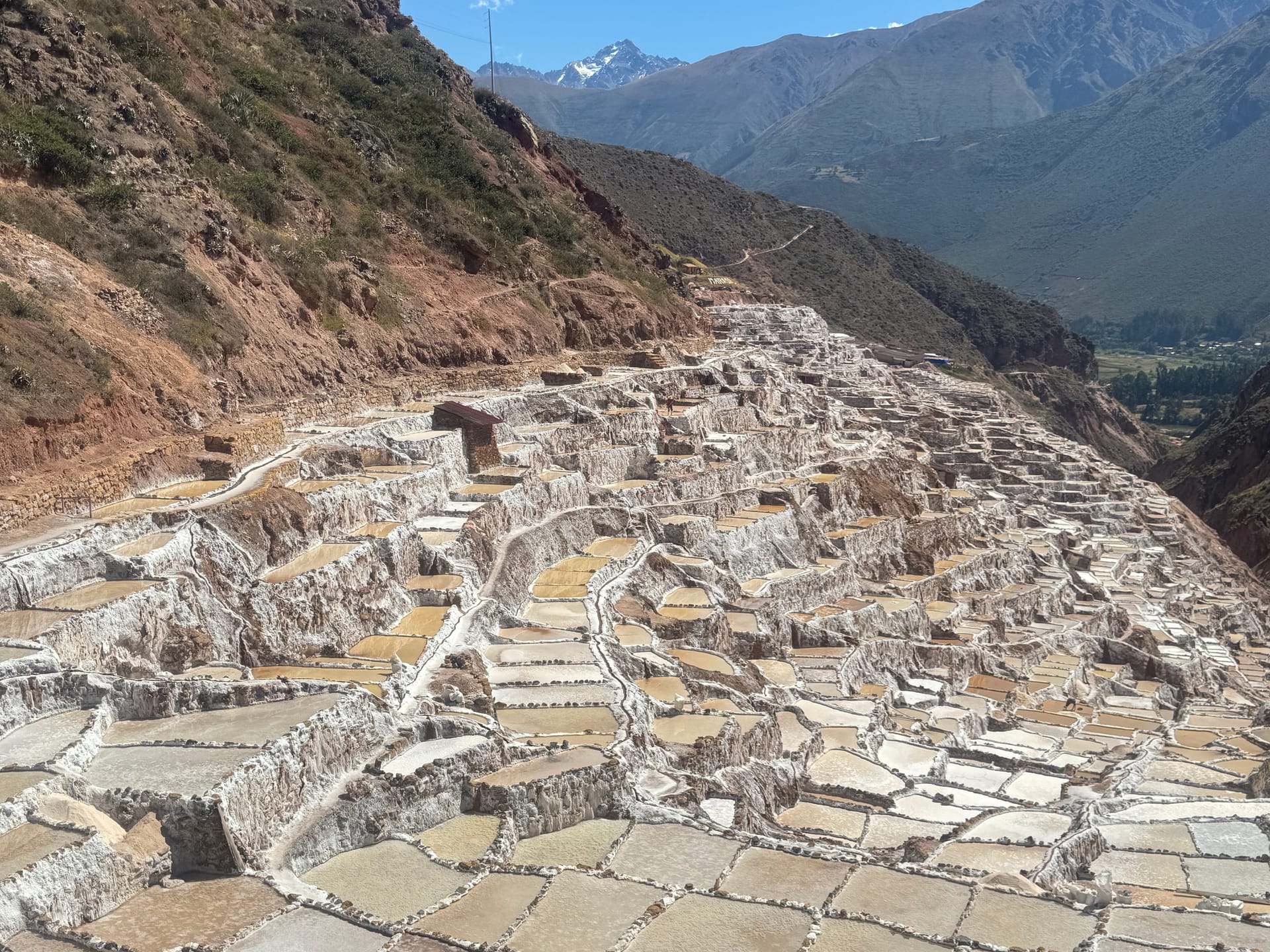
After four days traveling by car, it's our last day in the Sacred Valley. On the program: the Maras salt pans, more than 3,000 small pools passed down from generation to generation and fed by a salty spring coming from the mountain, then the circular terraces of Moray. We're glad we went, but we're starting to think one Inca site a day is plenty. After this visit, it's already time to head back to Cusco, but first we treat ourselves to a restaurant by a lake to make the pleasure last.
News from far away
Back in Cusco, we return the car without a hitch. For this second stay in Cusco we've chosen a hotel in the San Blas neighborhood. While Adeline sorts out the rooms, Thomas is on the phone with his mother: Grandpa has passed away. We thought he was immortal. We hoped to see him when we got back and tell him everything.
This kind of news is always hard in the middle of a trip. We're on the other side of the world, far from family, and we have to absorb it from a distance. Of course, we ask ourselves whether to go home. But that would mean ending the trip, and we're not ready. That evening, we go back to the little Italian restaurant for some comfort food.
The next day, June 24th, is Inti Raymi. Thomas stays in to rest, and on top of everything he was sick all night. Adeline, who keeps brooding, prefers to go out with her parents. From 7:30 a.m., they're leaning against a wall on the square (the locals advised 6 a.m., but let's not overdo it). Some Peruvians lend them chairs, just before a police raid that confiscates all the unused rental seats. At 11 a.m., the parade begins: costumes, colors, history. It was worth the wait.
On the last day, we watch the children's parade on the square and visit the Saqsaywaman archaeological site. You have to earn it: it sits on the heights above the city and the climb is steep. It'll be our last temple, and we come to a conclusion: what we love most about Inca sites are the landscapes around them. For our last day in Cusco we stick to our habits. We head to the San Pedro market for lunch and have coffee at the same stall as the previous days. The lady recognizes us and smiles, we've become regulars.
In the evening, we take a Cruz del Sur night bus back to Arequipa. The bus terminal is incredibly modern, you'd think you were in an airport! We arrive at 5:45 a.m. instead of 7... we go to the hotel hoping for somewhere to rest, and in the end, our rooms are free! Straight to bed, three extra hours of sleep can't hurt. It's our last day as four, tomorrow everyone continues the trip their own way. So in the evening we go out for one last restaurant to celebrate these two weeks of vacation together.
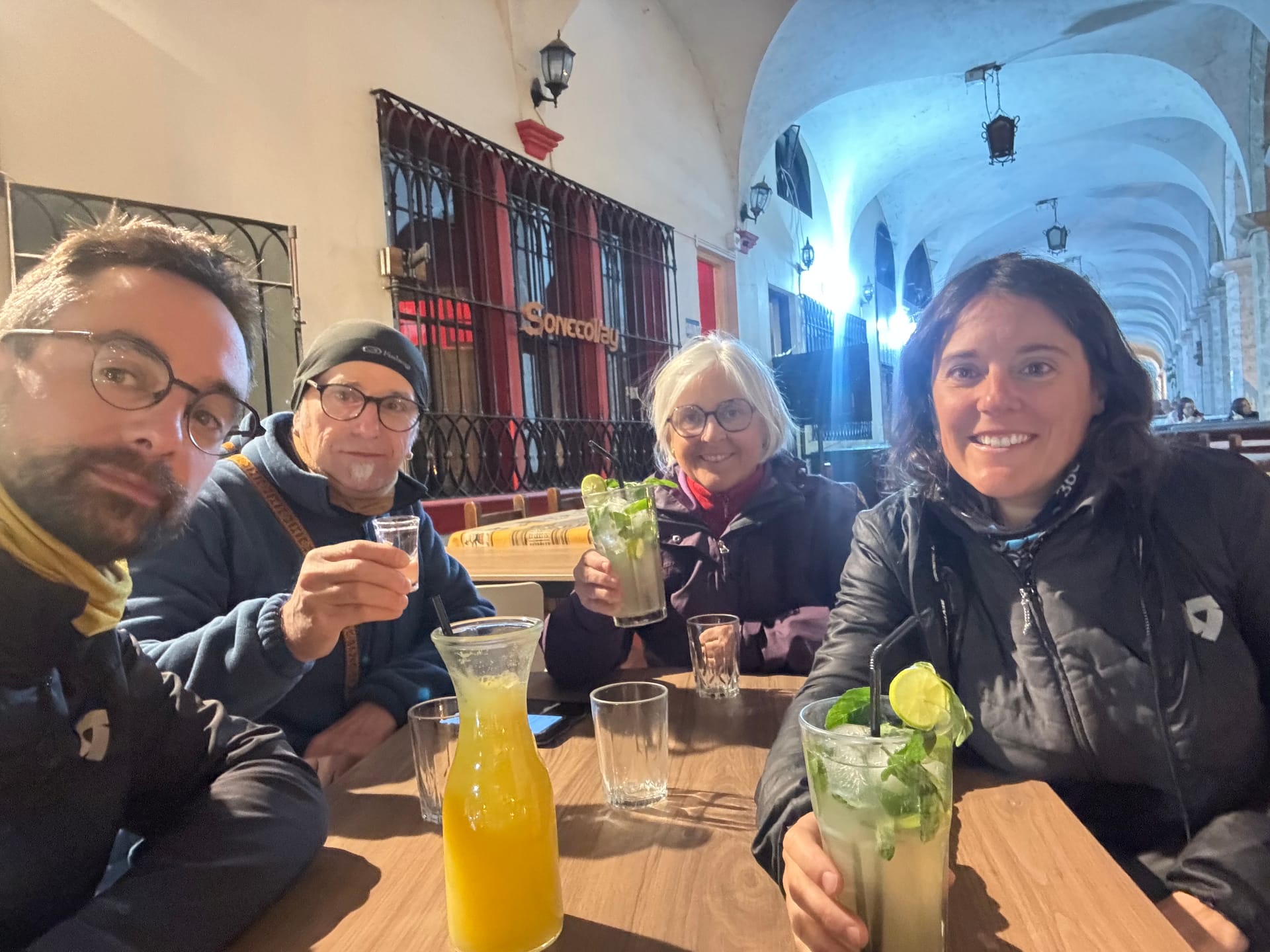
The goodbyes are of course emotional. Tomorrow, the parents leave for the Colca Canyon by bus. We pick up the bikes and head the same way, but on the dirt tracks!
Follow our adventures
Get an email for every new article.