
Salar de Uyuni, Sucre and the great escape: ten days across Bolivia by motorcycle
"Todo asfalto, they said. Yeah, right."
Ten days in Bolivia, from the Salar de Uyuni all the way to the Chilean border. Between the fuel shortages, the roadblocks and a rear shock that gave up on us in the middle of nowhere, we got the full package. And yet, we came away with an enormous memory of it.
The Salar de Uyuni by 4x4: yes, we did that
It wasn't for lack of wanting to ride our own bikes across that white infinity, but finding salt in every last nook and discovering rust spots three weeks later — no thanks. Some people have learned that the hard way, and we weren't going to push our luck this time. So we paid for a guide instead. Welcome Bolivia Tour, meet at 10:30, leave at 11:00. Tranquilo, tranquilo.
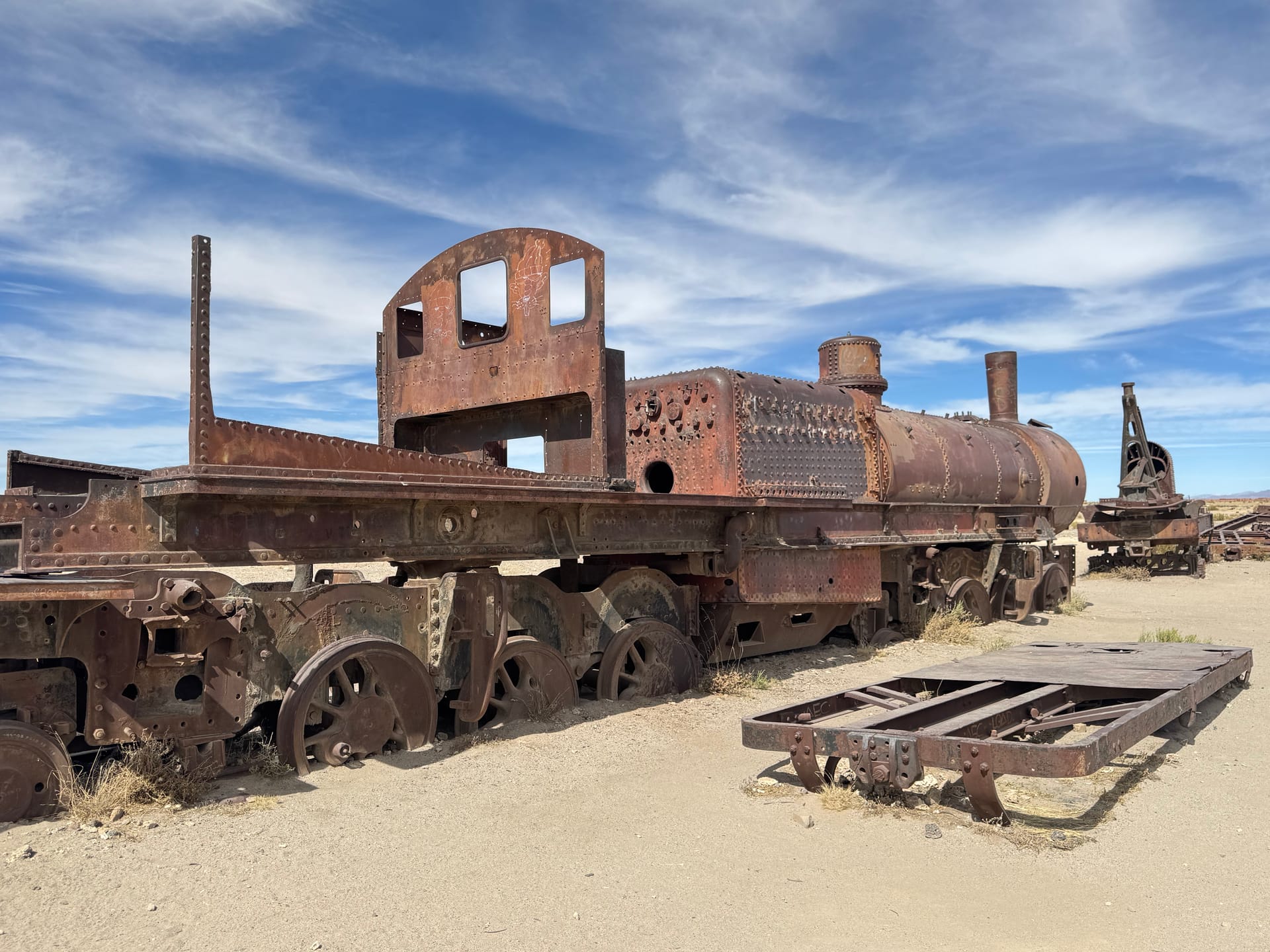
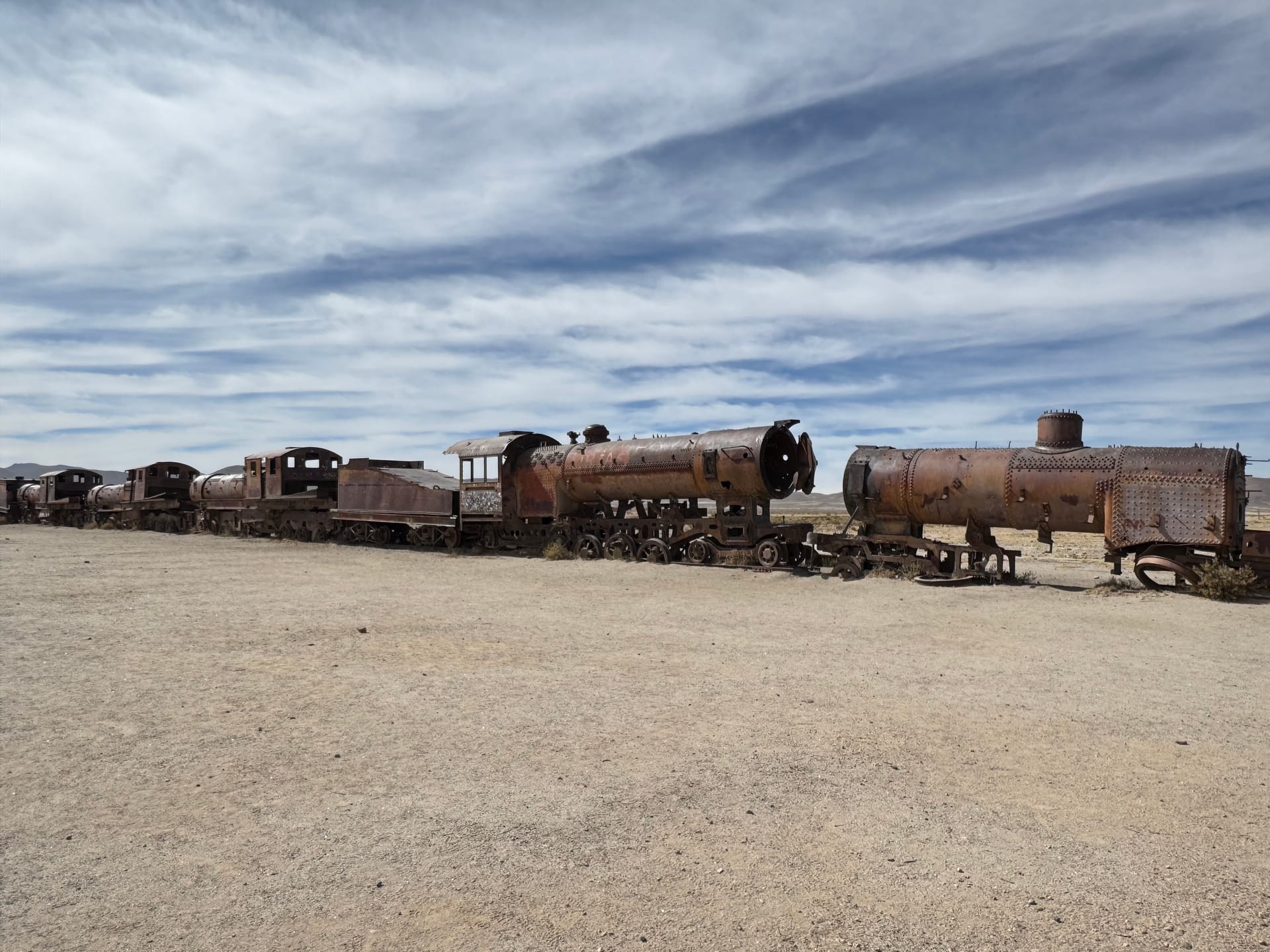
We share the 4x4 with an Italian couple and a Brazilian couple, and we get stuck in the very back, like the troublemakers at the back of the classroom. First stop, the train cemetery: packed with tourists, and we're part of the crowd. Twenty minutes planned, forty minutes on site. Bolivians are in no rush. Then we head for the salt museum, except first we have to pick up the food, a bicycle (?) and change the licence plate (??). Bolivians are really in no rush. The salt extraction demo isn't exactly mind-blowing, and being "almost Breton" ourselves, well, we know the drill. Then the museum: three salt statues and not much else. And let's not even mention the Colchani market behind it: a proper tourist trap.
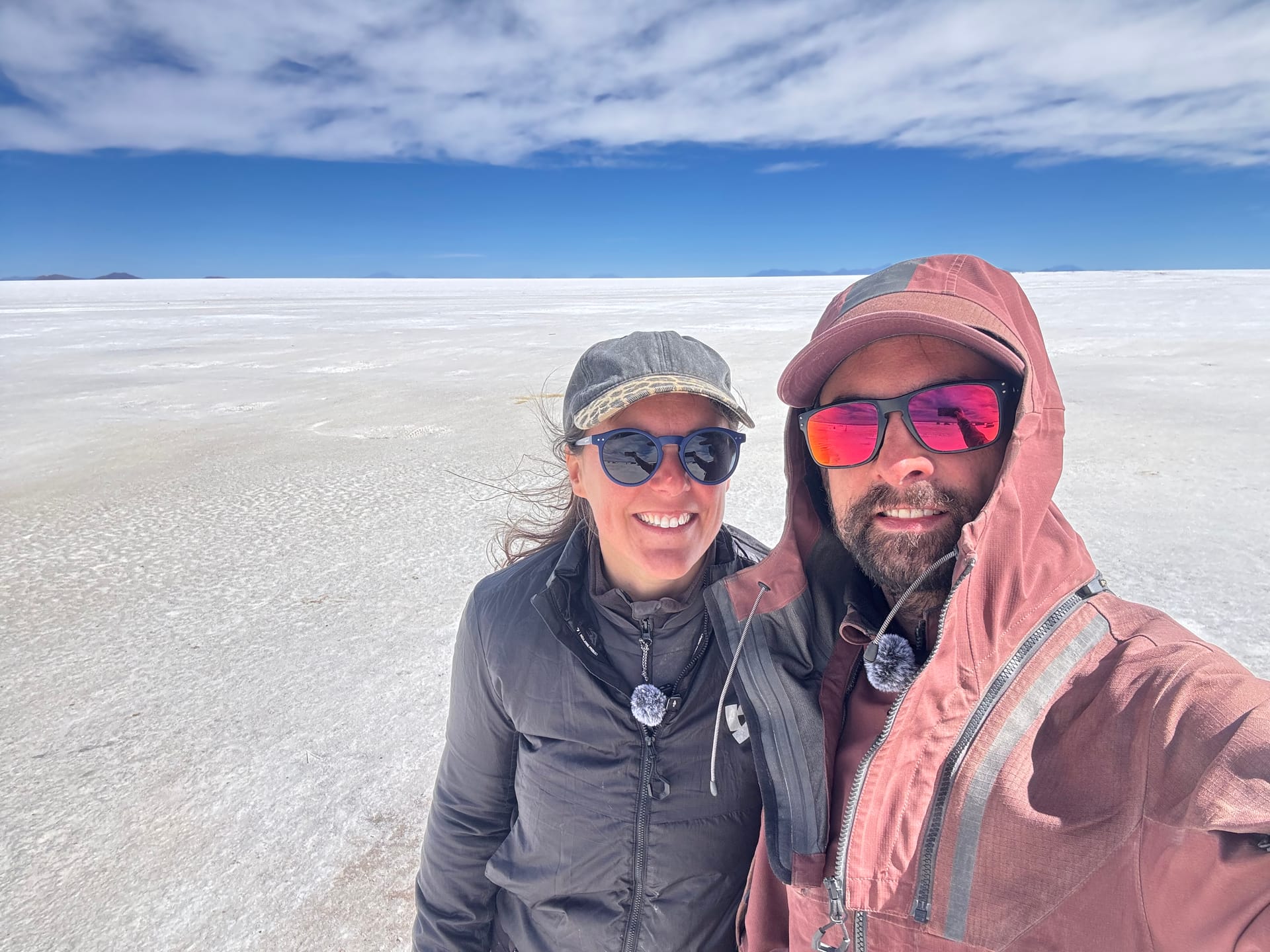
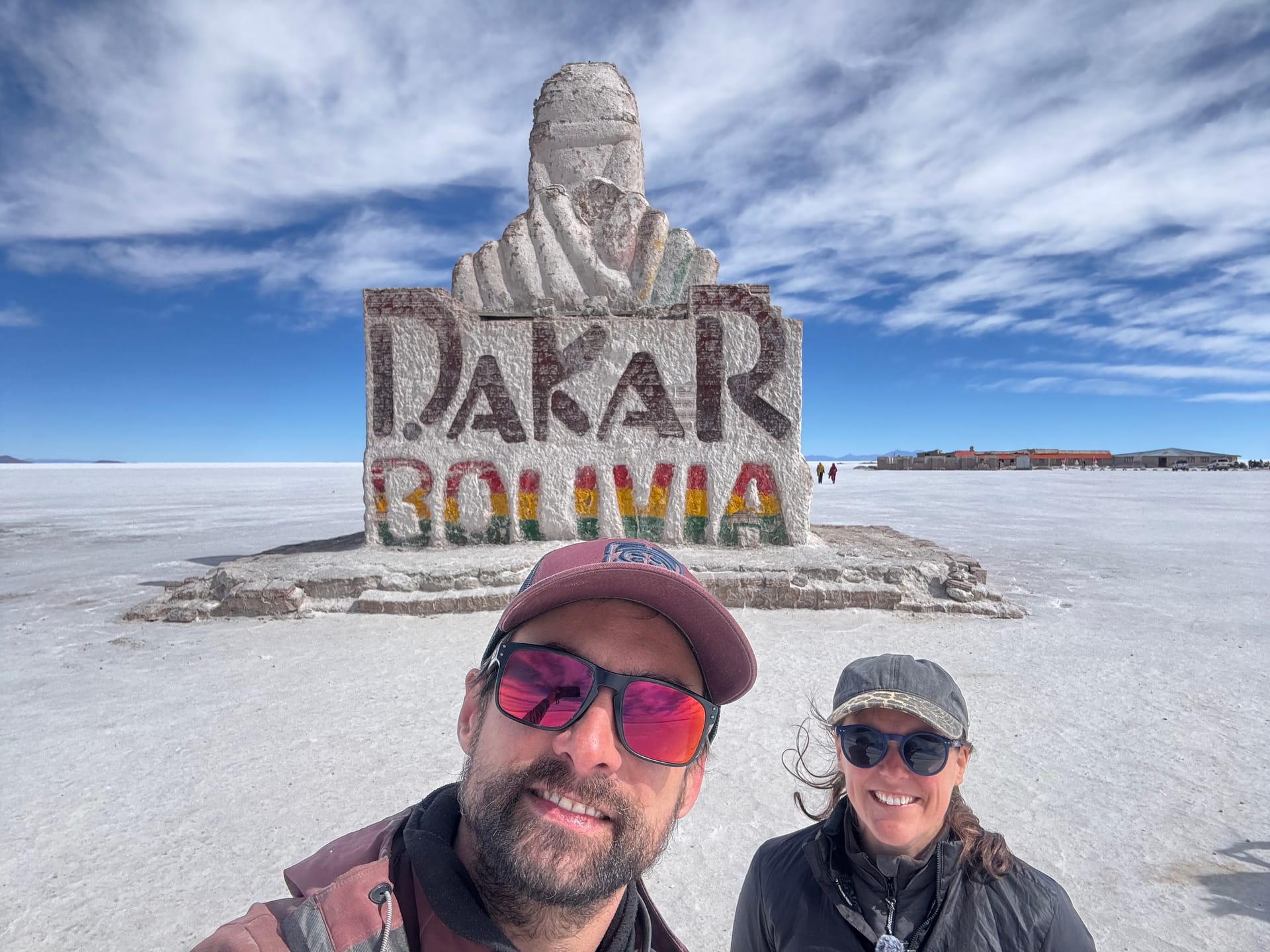
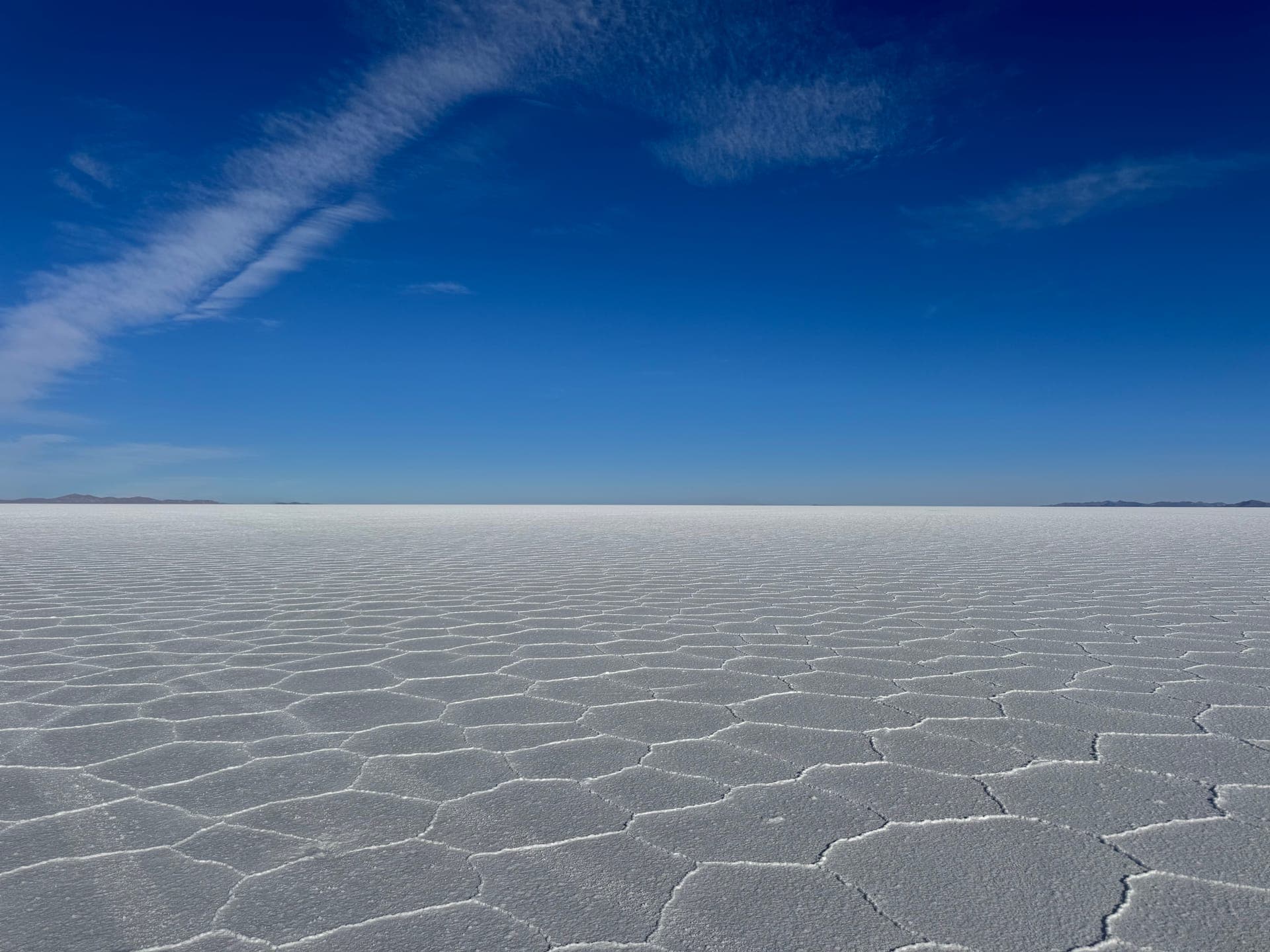
But at 1:15 pm, finally, the Salar. That expanse of white... We're stunned. First stop in the middle of nothing to walk on the salt, and it's immense. Then the Dakar monument, the flag monument. Being there is almost moving. We have lunch at the salt hotel, where we run into some bikes: seeing the salt caked onto the rim of a Royal Enfield, we're glad we came on an organised tour. The risk of not cleaning it off properly is very real. The group vibe, on the other hand, isn't great. Adeline tries to get a conversation going, it doesn't take. This is going to be a long day.
After the lunch break they offer us a visit to the salt sculptures, but we'd rather try a photo session, and that one works: playing with perspective against all that white, we crack up and end up with enough material to fill an Instagram album for six months.

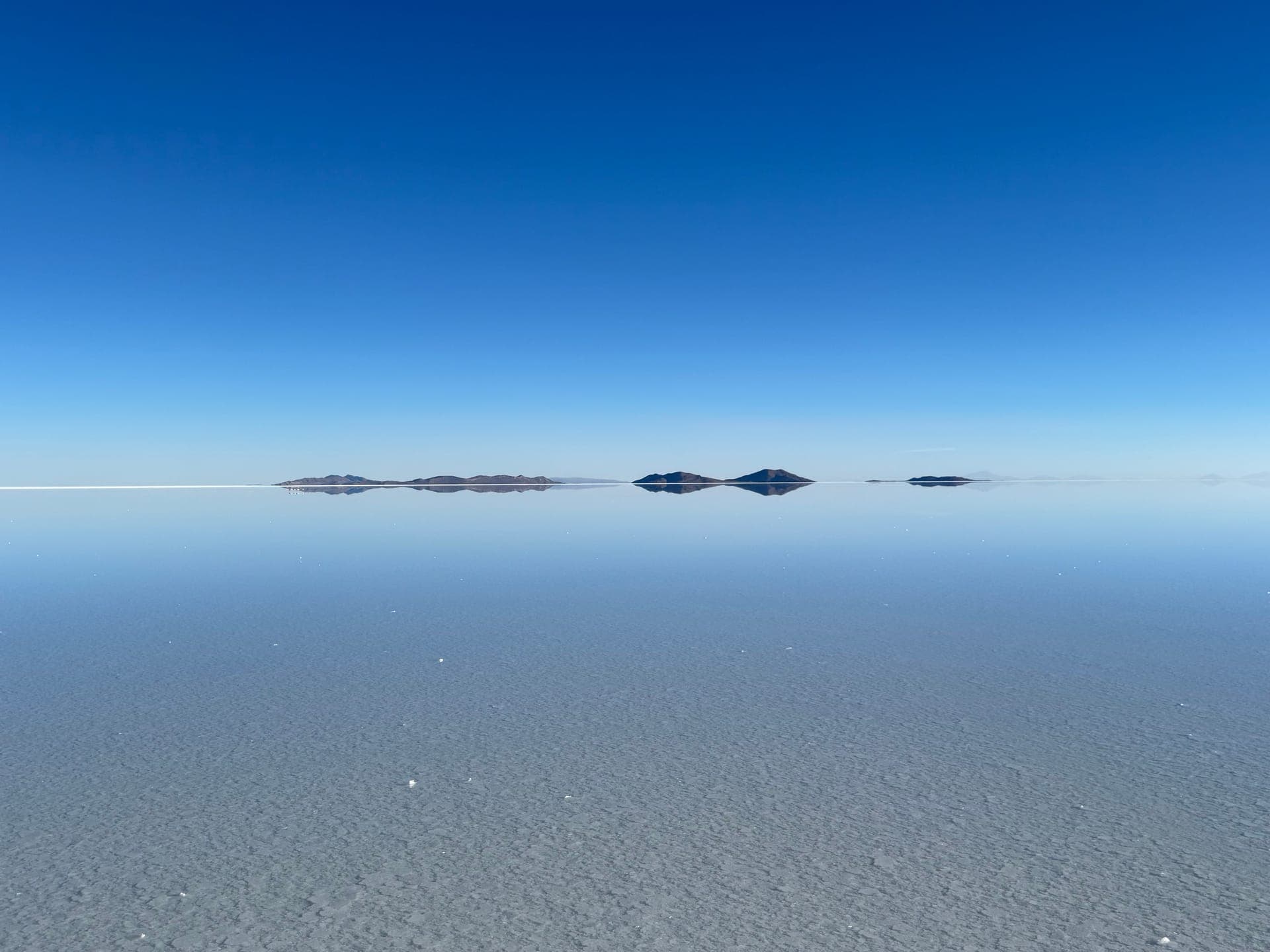
But the best is still to come. Sunset over the flooded section: the light reflects in the water, a perfect mirror. The lower the sun drops, the more beautiful it gets. We have no words. Not one regret about going with an agency — that show, we'd never have had it on the bikes. Tomorrow we head for Potosi. Well... if we can find fuel!

Potosi: the first test is filling the tank
Things are complicated in the country right now, there's social unrest, but we want to take our chances and see Bolivia anyway. As far as Potosi, in theory, no problem. Let's find out.
10:30 am, the YPFB station next to our hotel is closed and the queue is hellish. Great start. Adeline goes and asks the Bolivians who are waiting: there is fuel, but you have to queue. Except there are three separate lines. We join one of them and a guy explains that here, they don't sell to foreigners. Yes, really — in Bolivia not every station serves foreigners. Adeline checks directly with the attendants: confirmed, no point waiting. Thomas looks at the map and realises we're not even at the official station. We ride over, and there it's perfect: like in San Cristobal, they wave us to the front, probably because we're on bikes with small tanks. The pump attendant is lovely, Adeline makes sure the fuel is good quality and tells him about our trip. He's blown away — and this time we get our fill with no water thrown in as a bonus.
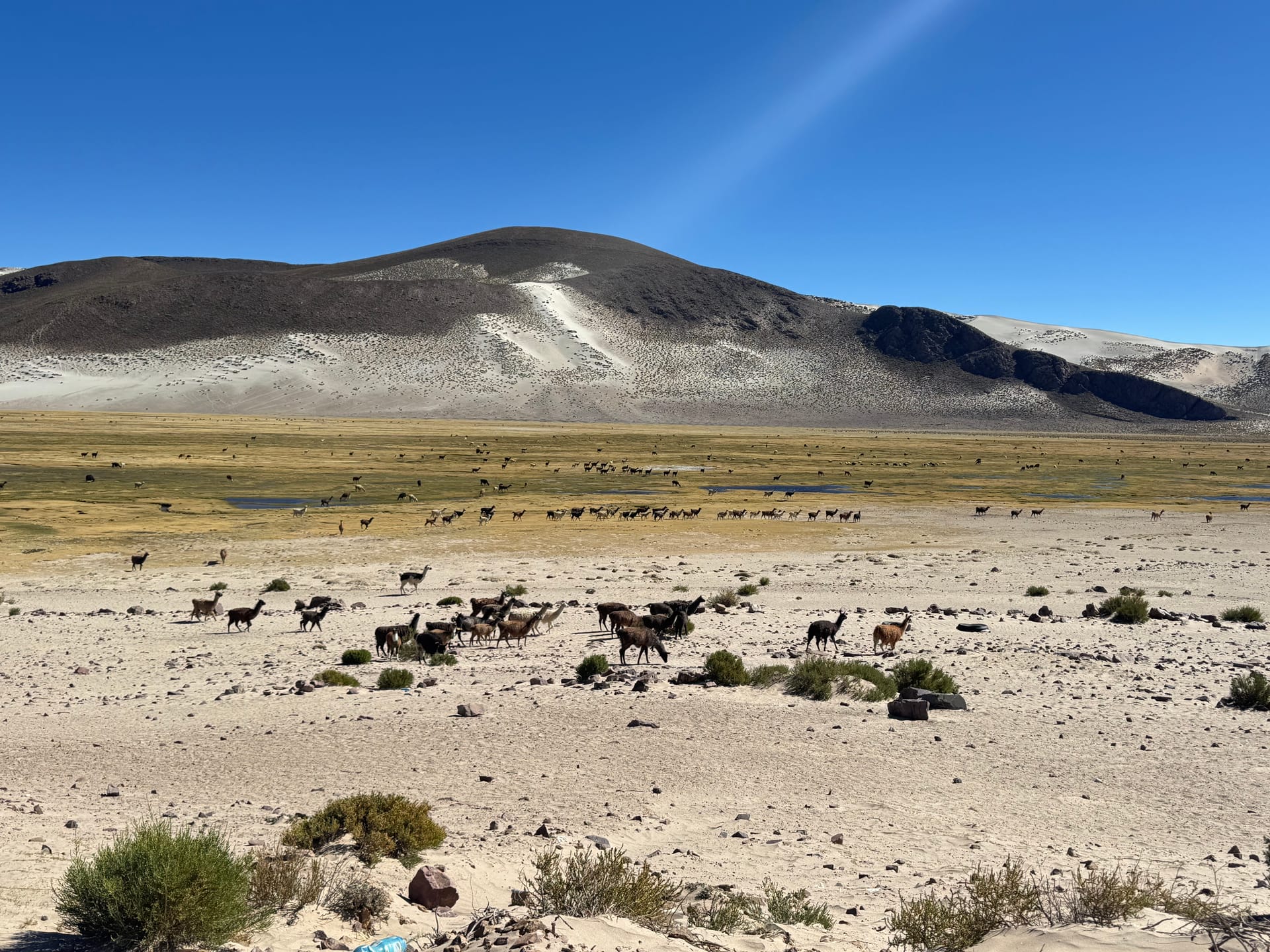
220 km, 100% asphalt, beautiful rolling landscapes. The rubbish along the roadside shocks us though, it's an open-air dump. A shame, because it's genuinely gorgeous. At midday we stop in a tiny village: the contrast with Argentina and Chile is brutal, you can feel the poverty. Soup and milanesa de pollo. Locals pay 18 bolivianos, we pay 25. We say nothing: for us it's still a bargain, and they need the money.
We reach Potosi around 4 pm. It's a surprising city, perched on the mountainside. At first glance it looks poor, broken, unfinished, and then the historic centre turns out to be rather lush. The contrast is striking. Less striking is the queue at the petrol station, which seems to stretch for kilometres — people are sleeping in their cars. What on earth is going on? And the arrival is quite the spectacle: demonstrations, traffic jams in every direction. It takes us over two hours to reach the hotel. Hell. Once there, we find steps leading up to the room: so where do we put the bikes? We decide to go somewhere else. A Bolivian helps us find our way — they really are lovely. We eventually find a hotel with a proper garage and a decent level of comfort: the bikes and their owners are going to be just fine!
The next day we take it easy. Over breakfast we meet the owner of a Chilean Himalayan parked next to ours, who turns out to be French. We advise him against riding the Lagunas Route alone, with no beacon and no GPS: too risky. He tells us it's impossible to get fuel in Potosi. That doesn't reassure us, because without fuel we're stuck. We head off to see the city, we'll deal with that later. Entry to the Casa de la Moneda is a bit pricey, so we give it a miss. Instead we discover the market and the bull heads sitting on the pavement. Hygiene isn't quite there yet. In the afternoon we start our fuel mission, and it turns out to be simpler than expected. At the official station we ask whether we can buy and whether we need to queue: ten minutes later our tanks are full. In the end the longest part was getting to the station — the traffic here is a catastrophe.
Back at the hotel, Thomas gets stuck into video editing and Adeline calls her girlfriends. After seven months on the road, we have to admit something is missing. We're tired of packing and unpacking every single day, of constantly changing places. We want to see our friends, it's been way too long since we had a proper night out. That hour on the phone does wonders for morale.
Towards Sucre: pushing the bikes, roadblock after roadblock
150 km on paper. With the blockades, we have no idea how this is going to go. We ride 30 km before hitting the first one: we can get through, on condition that we push the bikes. OK, fine, let's go. What a slog, especially for Adeline. On top of that we're far too well covered up and we're roasting.
Before the second blockade, a Bolivian rider advises us not to go that way: apparently they're puncturing tyres. He offers to let us follow him on the tracks — he's heading to Villa Villa, which is on our route. And there we are, in an improvised off-road session. He rides well and we're more loaded than he is, but he's cool, he waits for us. We do a 15 km detour to gain 3 km compared to the road. And bam, another blockade. We negotiate, we explain that we're trying to leave the country, and they let us through. Pretty decent guys — but we still have to push. Thomas has to help Adeline, her bike is too heavy. We push all the way to a third blockade, and there, seeing how much we're struggling, they let us start the engines for the climb. Phew. At the top, our guide (whose name we'll never learn) is waiting for fuel, delivered by bicycle. A chance to talk with him and with the protesters — who are pretty friendly, all things considered — about the situation in the country.
Further on, the start of the track isn't easy, and bam, Adeline goes down. Nothing serious, but as she sets off again she notices the handlebars are bent. Oops. Never mind, we have to keep moving. Two more blockades without trouble, the track gets faster and the scenery is incredible. We're pushing on though, no time for lunch. That said, the tuna-and-lentil mix in our reserves wasn't exactly calling to us.
We reach Villa Villa at 3:30 pm, 50 km to go. Last blockade: they want money to repair the bridge a little further on. We say we have no cash and they let us through. We take a photo with our mystery guide before saying goodbye, and then we arrive at the famous bridge: wooden planks laid across railway tracks. Damn, maybe we should have paid up. Adeline can't manage the manoeuvre, so Thomas handles it. And there we are on the other side. We're not moving fast, but we're moving. And at the end of it, asphalt! It's 5 pm. Only 10 km left.
Sucre: staying with Javier, the festival and Mama's Day
We're staying with Javier, the sensei of the kendo dojo in Sucre. We arrive filthy, starving and a little broken. His house is huge and beautiful, and we quickly understand that he has far greater means than most Bolivians. But it's interesting to discover every facet of a society during our trip. We get undressed outside — given the state of us it's the safer option — and head straight for the shower. It feels amazing. That evening, dinner out and a concert for the independence festival. Monstrous crowd, we end up in a corner where we can't see much, never mind. We drink "Canelo", a cinnamon infusion with rum and lemon, and try coca leaf for the first time. Right. We don't really understand why everyone chews it, but at least we've tried.
The next day is a public holiday. Javier takes us to the Feria on Plaza de la Recoleta. On his advice we try the chorizo and the mondongo, a kind of pork stew. Not amazing, but decent. In the afternoon we stay by the concert watching people dance, then go for an ice cream and a grapefruit juice bought from an old man on Plaza 25 de Mayo. Bolivia isn't expensive, which is exactly why we end up burning through cash! In the evening, Adeline takes over the kitchen to thank our hosts: 350 bolivianos of groceries for two meals — honestly, eating in the street works out better.
We stay a few days in Sucre, but given the current situation we decide to fill up on fuel while the station is still open. So on day two we set off on a fuel mission with Javier's help. Filling the tanks is no trouble at all, but the jerrycans are another story: as a foreigner, you can't take more than 5 litres. Bolivians themselves have to request authorisation — luckily we have Javier with us, who files a request and gets approval. Thanks to him, we leave with enough to get back to Chile.
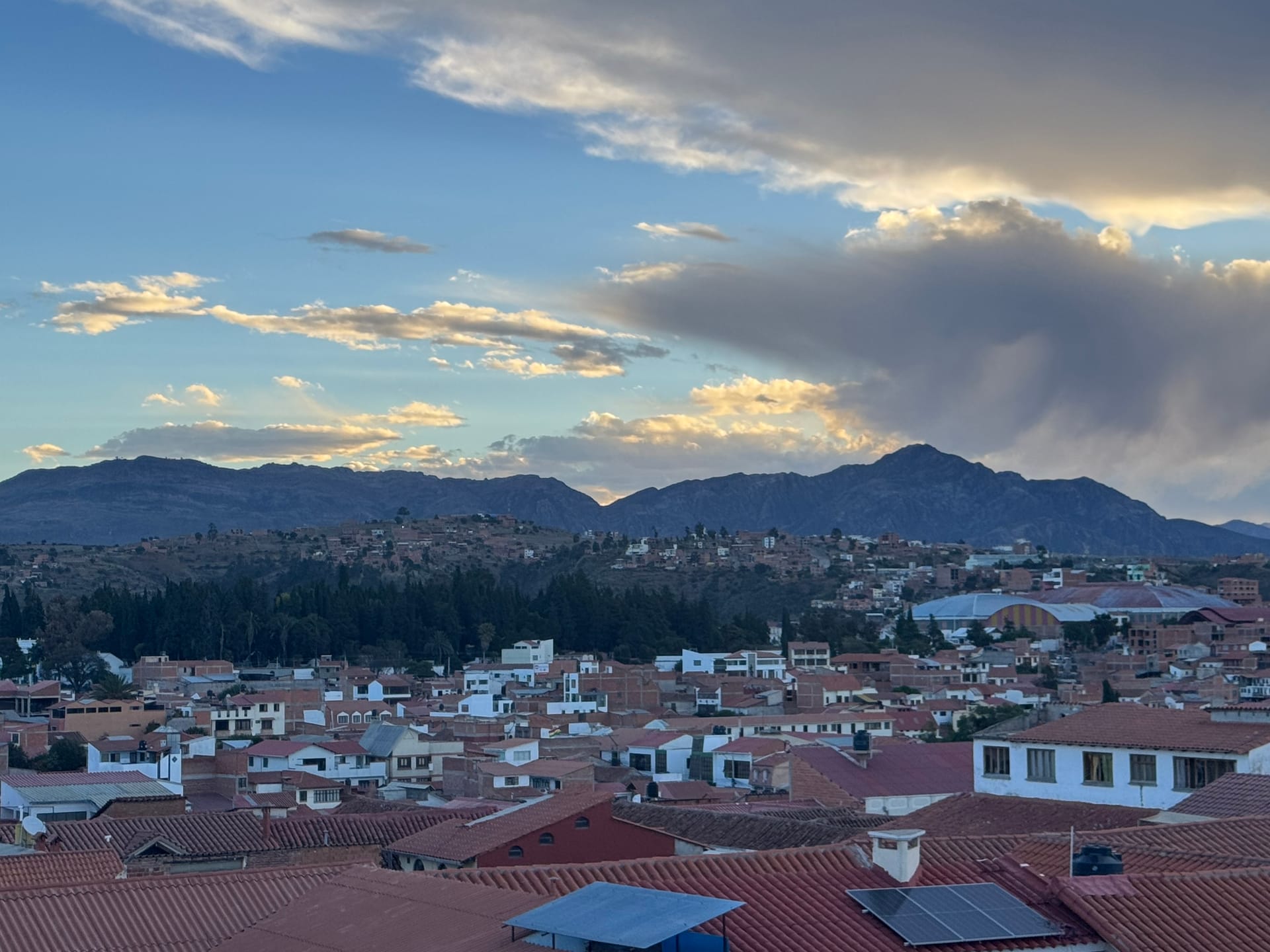
At midday we enjoy a boeuf bourguignon with Dalinka's parents before heading off to visit the historic heart of Sucre in the afternoon. We sit down at 1 pm and at 1:40 pm we're told "Go, vamos!". We thought we'd have five minutes to get our things together, but no, we're leaving immediately. For people used to taking their time, that's a bit rushed! We meet Grover, our guide for the afternoon, who speaks French. We visit the Casa de la Libertad, where we learn a huge amount about the country's history, with Juana the heroine and General Sucre, who gave the city its name. Then the constitutional court, Parque Bolívar, La Recoleta, the mirador. We even visit the school where Grover teaches French: and there we are in front of a group of teenagers, speaking French so they can hear the language and stumbling through Spanish to explain to them that the most important thing is simply to give it a go. We finish at San Sebastián with a magical view over the city from the roof. The safety standards, though... Low railings, unprotected stairs. Welcome to Bolivia. Four hours of private tour for 180 bolivianos, a very fair price, and we loved it.
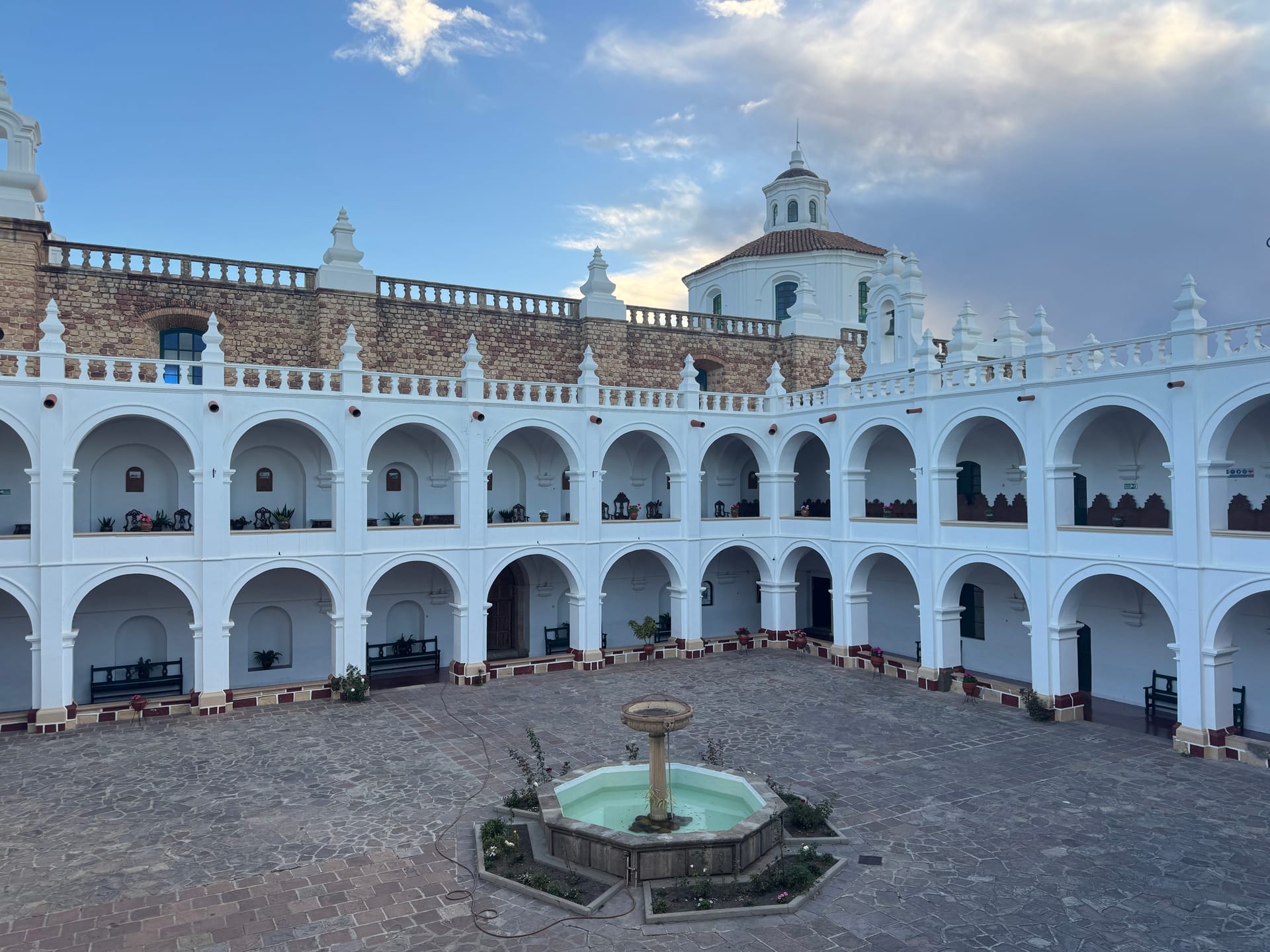
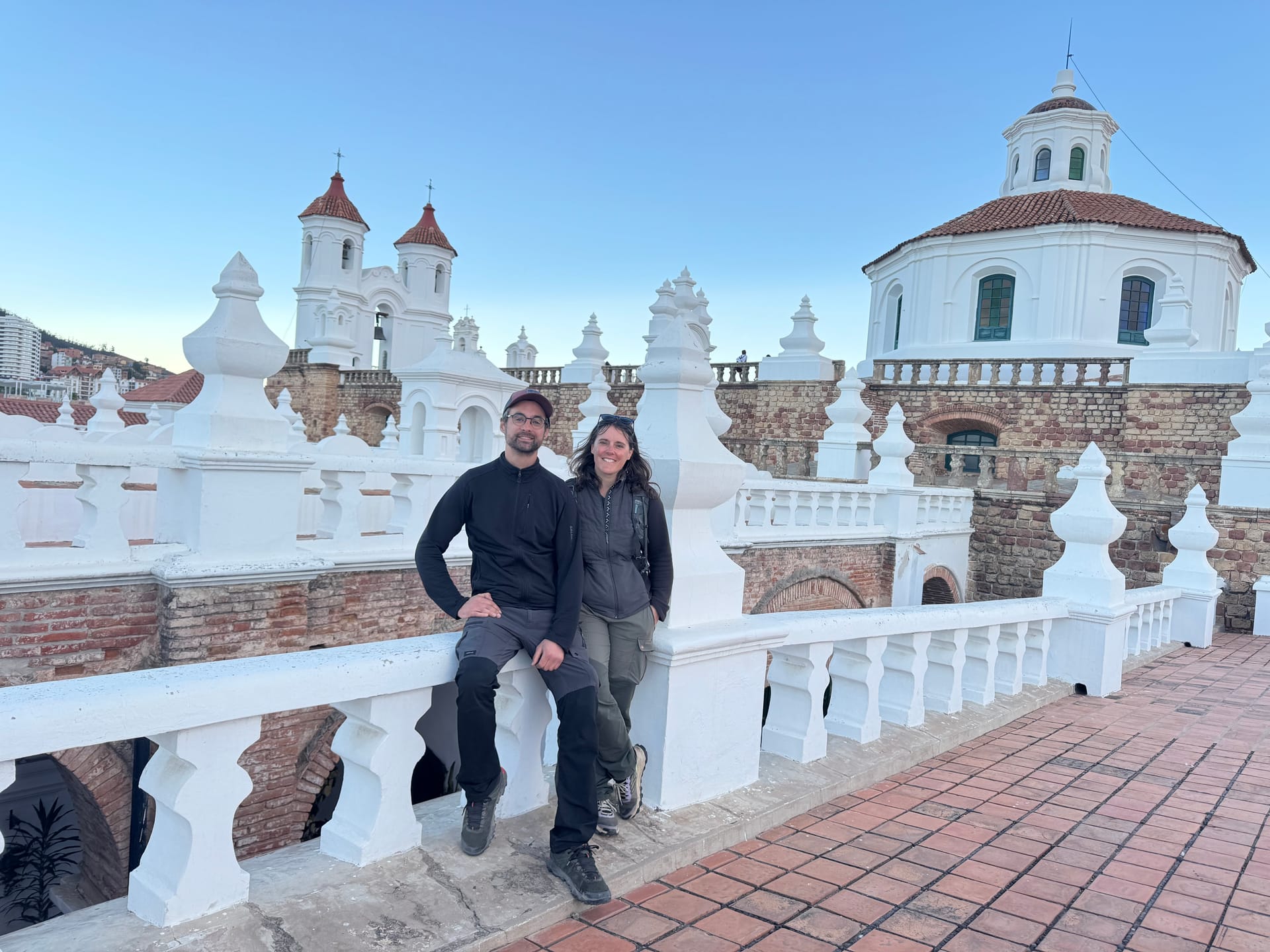
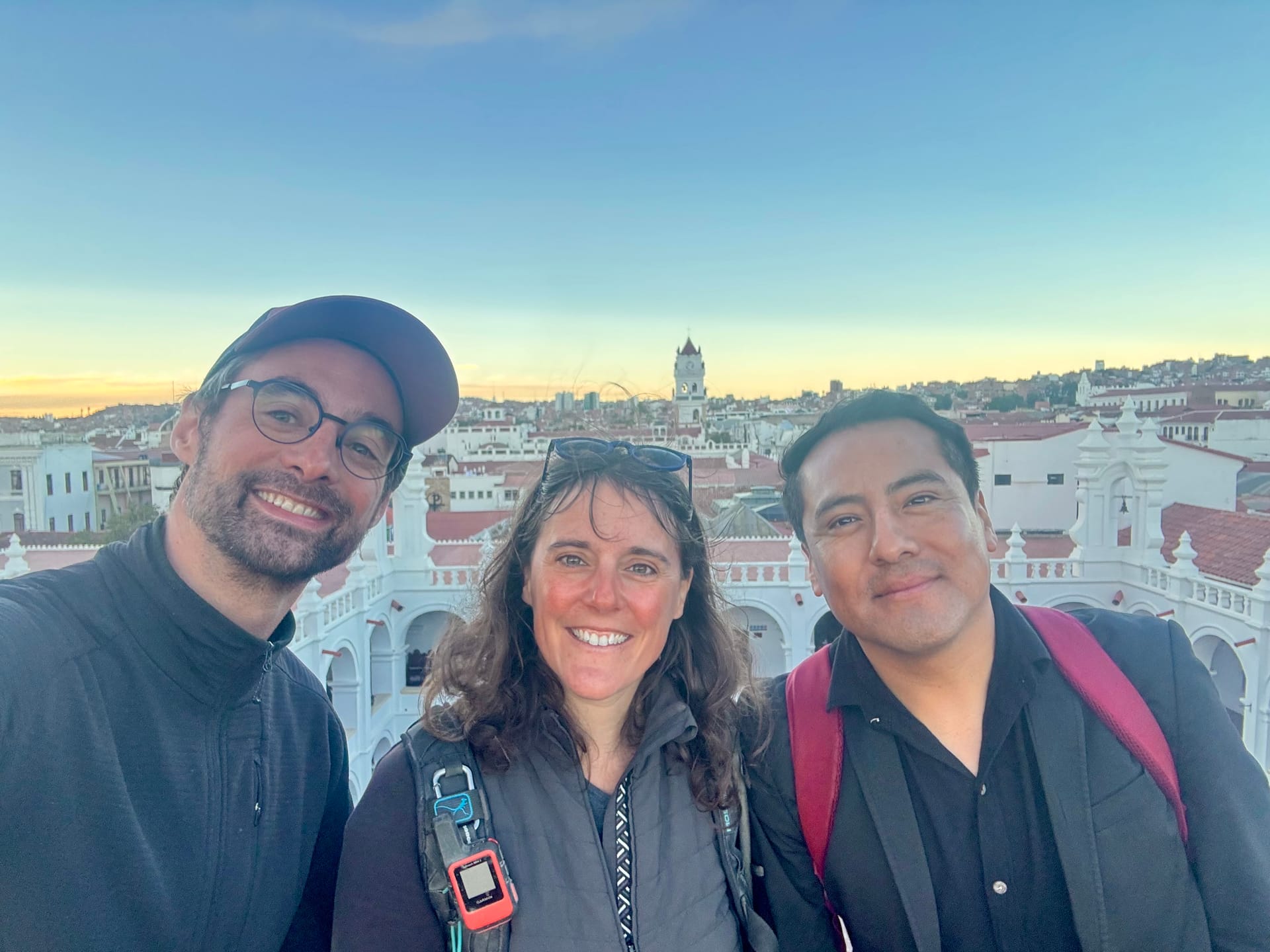
On our last day it's Mama's Day and we're invited to a family lunch at Javier's parents' house. Teresa, his mother, is delighted to show us her collection of Eiffel Towers. It feels like being at grandma and grandpa Laurenson's. They ask us to read a poem, they want to hear French: Adeline steps up with The Cicada and the Ant. They also want a song, but Thomas doesn't dare. Some Garou? No thanks. La Marseillaise? We're ashamed to admit it, but we don't know the words. We're exhausted by all this excitement and all this Spanish, but we're aware we've shared a slice of life that few tourists ever get. Mama's Day celebrates women's role in the country's liberation and the role of mothers. It teaches us more about their culture than any museum could.
The escape: Maragua, the crashes and a foot under 200 kg
After that stay in Sucre, it's time to get back on the road. We decide not to go any deeper into Bolivia. With the fuel shortages and the blockades, it could get complicated fast. From Sucre, it's still doable. To avoid the blockades we go via Cerro Maragua, Potolo, then Maragua the second. We leave at 10:15, our hosts looking a little worried for us. There's some wheelspin getting going, but overall the track is wide and easy. We cross Cerro Obispo, a huge open space with prehistoric traces. Thomas obviously doesn't miss the chance to crack a joke. It's a feast for the eyes, truly — Bolivia is stunning.
In Potolo we eat for 20 bolivianos between the two of us and talk to people about which way to go. We're ready to leave, except a truck is blocking the way. There's a river below and a lot of rocks blocking the track. There's no way through for us. They tell us thirty minutes of waiting, and above all a huge number of blockades on that road. They recommend another route, hard at the start but passable.
What a mistake. The start is hard — except it lasts 10 km. Adeline goes down a first time, no harm done. Then the track gets twisty, hugging a cliff face, and with the fuel cans we're heavy. Thomas waits for Adeline and bam, down he goes. And on top of that he's losing oil. Moment of panic: if the crankcase is cracked, we're in deep trouble. But no, it's probably just overfill. We set off again, grumbling. Further on, Adeline goes down again. She screams, her foot is trapped under the bike. 200 kg resting on one foot, that hurts. Thomas struggles with his sidestand, takes forever to get there, and finally frees her. It was horrible. The foot is painful but doesn't look too serious, and in any case we have to keep going: we're in the middle of nowhere.
We reach Maragua the second at 5 pm, but there's no accommodation here — we have to push on to Macha, 45 km away. "Todo asfalto," they said. Yeah, right: sand and ripio for 17 km before we find tarmac again. Night is starting to fall, but we're assured there are no blockades. We arrive at 6:30 pm and easily find a "hotel", or rather a room off a courtyard, with dubious bathrooms, but it'll do the job: there's a garage for the bikes and the sheets look clean. We're exhausted, Adeline's foot hurts, Thomas's ankle hurts and we're starving. We find a restaurant that serves us chicken with a mix of starches, perfect. An old gentleman, the owners' father, gives us advice for tomorrow. We get the gist. We finally head off to bed in our tiger-print bed, in the warm. We're very glad this day is over.
Eight blockades in one afternoon, and a monastic cell to sleep in
We don't sleep too badly in that tiger bed after all. In the village we're a bit of an attraction — tourists on motorbikes, they can't see many of those. In the morning, before we leave, the old man from the day before explains that we're better off going via Cruce Culta, or Vincilla, same thing: the easiest route. Several other people come over to give us advice on which road to take. With all that we don't get going until 11 am, but at least it's asphalt. Perfect.
40 km without a hitch, and there's the first blockade. Adeline volunteers to go and negotiate: no problem at all. On the way out of town, same again. We explain that they let us in, so why refuse to let us out? They reassure us, they just wanted to chat. To round off the morning, 35 km of track to avoid a blockade at Challapata. Easy track, apart from a small pass where Adeline goes down: she couldn't see the track properly behind the truck in front of her. Nothing serious. And we get a view over a lake, so beautiful. Given yesterday, at the second difficult section Adeline hands over to Thomas. We're not taking any risks with her foot. It's awkward for him, the Himalayan isn't his size, but he manages.
There are 120 km left to Santiago de Andamarca, and it's all road. We're hoping to be in a quieter area. What a failure. No fewer than eight blockades over the afternoon. Every time we get through without paying, but it's a constant negotiation. Pretty unbearable. It isn't necessarily complicated, but there's a bit of apprehension and stress at every barrier. Twice, Thomas has to get through sand dunes: we take off the luggage, push, and load up again.
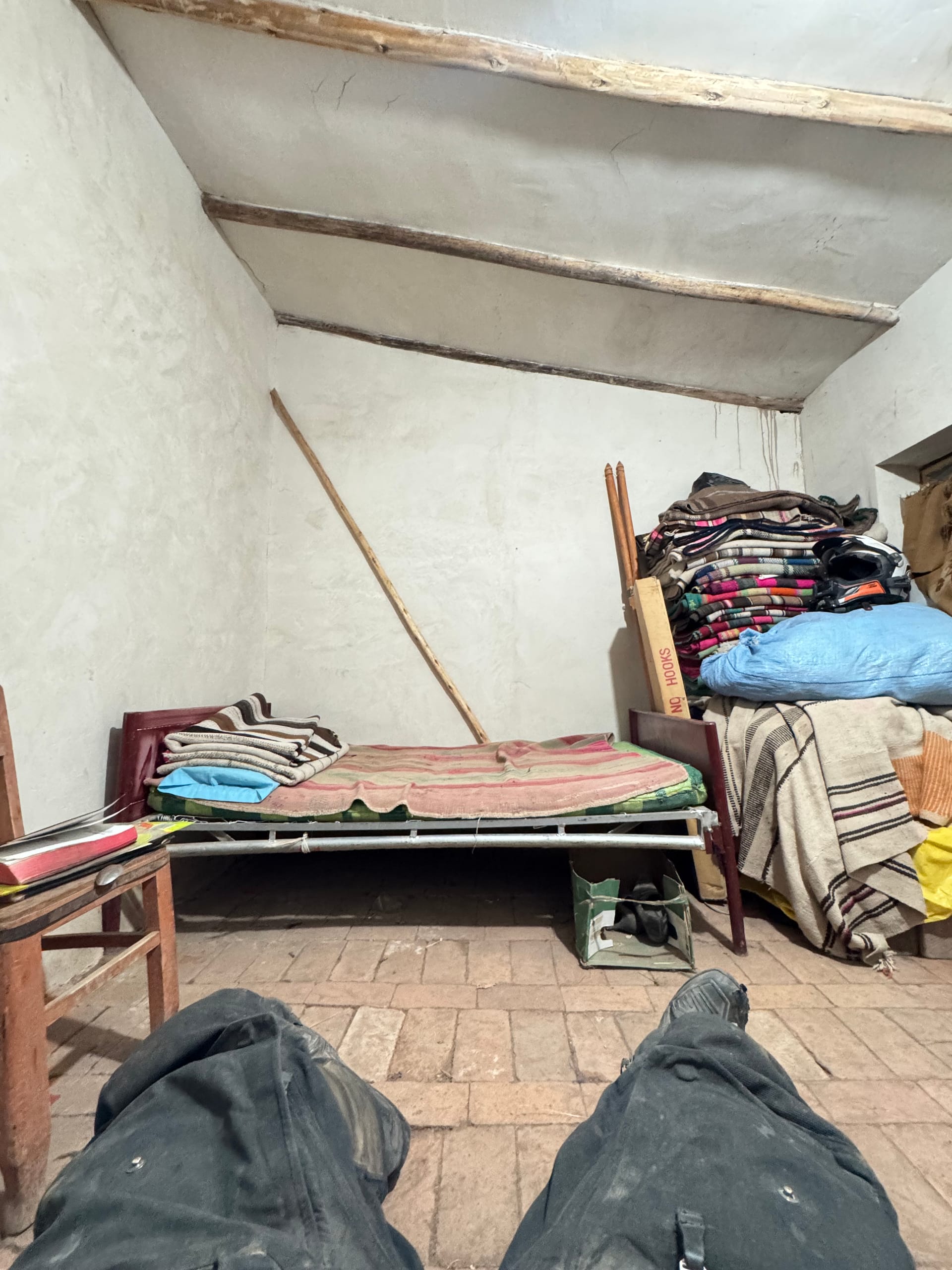
We finally reach our destination around 6 pm. Adeline had spotted a town with accommodation, but both places in the village are closed. It's la mierda. The next village is 40 km away, and there's nothing to say we won't hit a blockade. Night is falling. Adeline goes back to the square where we met people on arrival, explains the situation and asks whether anyone knows a family who could put us up. We're not fussy, we don't care about a shower, we just want a bed in the warm. We go for it and it works. They talk among themselves in a language she doesn't understand, and eventually they find us a solution: a kind of monastic cell, two straw beds, electricity and four walls. We'll be fine! We head out to eat, but there's nothing left. One plate of rice with a chicken wing between the two of us, that's it. We come back twenty minutes later to finish off the peanuts we have left. Dinner is light tonight, but at least we're sleeping in the warm.
Pisiga: the rear shock calls it quits, and we fix it
Around 9 am our saviour turns up — they hold their mass in the building. Loads of people greet us, and we even see a woman arrive with her baby llama.
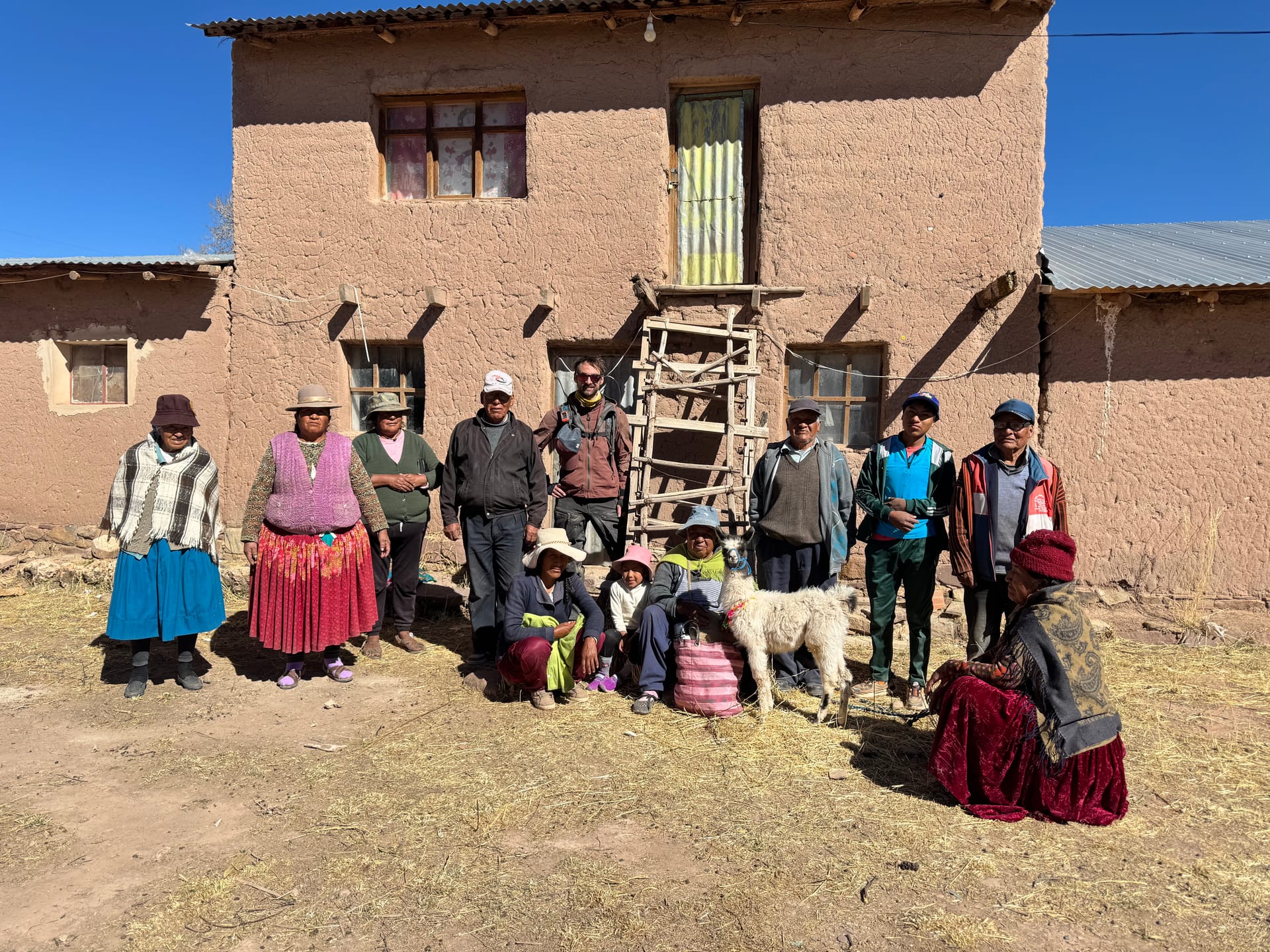
We try to get a coffee on the square, but everything is shut. A woman offers to boil us some water at her place, so kind. She makes us an infusion, tells us a little about her life, and tries to sell us a llama wool waistcoat. 200 bolivianos, not expensive, but far too bulky. She comes back with a hat for 20 bolivianos: this time we say yes, and give her another 10 bolivianos for the tea. She looks delighted, and we're happy to have been able to help. We do note, though, that she has a real head for business.
Before we leave, our hosts give us advice that turns out to be excellent: fast-rolling track, 65 km in an hour and a half, then a straight run to the border. No barriers here at all, which is great. Still nothing to eat though, so it's a packet of crisps and a cereal bar on the square in Huachacalla. We reach Pisiga around 4 pm and pick a hotel with a hot shower for 180 bolivianos a night. After two days without washing, what bliss — we feel human again.
Around 5 pm we get started on servicing the bikes. And that's when disaster strikes. Adeline has lost the nut holding the bolt between the linkage and the rear shock, so the shock has come adrift. Damn. We take the tank off: nothing serious at first glance, the top of the shock is in good shape, but we need seals and a correctly sized bolt to fix it. Lucky break — a shop doubles as a bit of a ferretería and we find the seals we need, something to file the spacers down with, plus a bolt and a nut. 45 bolivianos for the lot. Discovering the problem had triggered a proper argument, Thomas worrying and Adeline trying to stay positive. Once we have the parts, we're a lot calmer: finding those seals out here was beyond what we'd hoped for.

The next day, we spend the whole day on it. The hardest part is straightening the bent linkage. But first, everything has to come apart. We'd never done it before, and honestly the trickiest bit was getting the tank off. Thomas works calmly, far more relaxed than yesterday. The roles have reversed, it's Adeline who's worrying now. He manages to get the spacers back in, brilliant. All that's left is finding a mechanic for the linkage: we ask the taxi driver, and within ten minutes we've found one. He has a vice, perfect, and he even gives us a hand positioning the shock. Thirty minutes later, everything is back in place.


Little risk of it coming loose again, given how hard the bolt was to get in. We just hope the spacers hold up over time.
Yesterday the situation looked hopeless, today we're genuinely happy. By 3 pm everything is back together, and we move straight on to servicing the chains, checking every bolt along the way. We come out of it stronger: we managed to sort ourselves out, staying calm and sticking together, once the argument had blown over. It's also a good lesson. Here in Latin America they don't have much, but you can always find a way to fix things. They have a real knack for making do. And people have been lovely with us, from the first to the last. Truly, Bolivia — we loved it. Tomorrow, we cross back into Chile.
Follow our adventures
Get an email for every new article.